





Related: NTSB Finds Tesla Autonomous Control Activated During Crash
NTSB Wants Tighter Rules for Autonomous Vehicle Tests
The National Transportation Safety Board is urging Congress and the state of Arizona to create a review process to make it safer when autonomous vehicles are tested on public roadways.
November 20, 2019
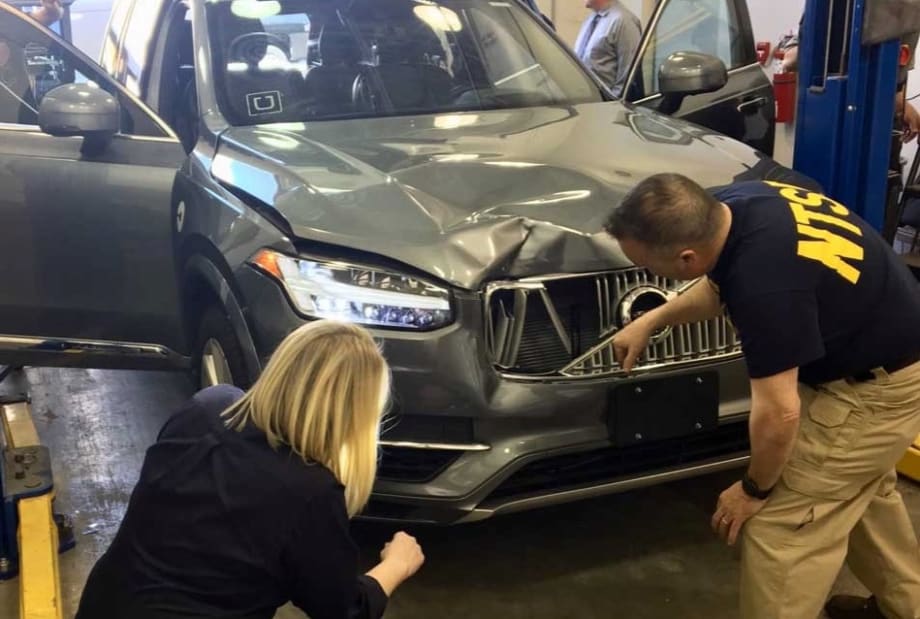
NTSB Investigators examine the Volvo XC90 sedan involved in a fatal crash on March 18, 2018, while under Uber autonomous control.
Photo: NTSB
3 min to read
The National Transportation Safety Board is tapping the brakes on autonomous vehicle tests on public roads. On Nov. 19, the agency called on lawmakers to create a review process before allowing automated test vehicles to operate on public roads, based upon the agency’s investigation of a fatal collision between an Uber automated test vehicle and a pedestrian.
During a board meeting held to determine the probable cause of the March 18, 2018, Tempe, Arizona, crash, the NTSB said an Uber Technologies Inc. division’s “inadequate safety culture” contributed to the fatal collision between an Uber automated test vehicle and a pedestrian. The vehicle operator was uninjured in the crash; the pedestrian died.
According to NTSB's review of the accident, Uber’s Advanced Technologies Group modified the 2017 Volvo XC90 with a proprietary, developmental automated driving system. The vehicle’s factory-installed forward-collision warning and automatic emergency braking systems were deactivated during the operation of the automated system. An Uber ATG operator was in the driver’s seat, but the automated system was controlling the vehicle when it struck the pedestrian at 39 mph.
NTSB investigators determined that the immediate cause of the collision was the failure of the Uber ATG operator to closely monitor the road and the operation of the automated driving system, because the operator was visually distracted throughout the trip by a personal cell phone.
Contributing to the crash, the report said, was Uber ATG’s inadequate safety risk assessment procedures, ineffective oversight of the vehicle operators, and a lack of adequate mechanisms for addressing operators’ automation complacency – all consequences of the division’s inadequate safety culture.
“Safety starts at the top,” said NTSB Chairman Robert L. Sumwalt in a release. “The collision was the last link of a long chain of actions and decisions made by an organization that unfortunately did not make safety the top priority.”
The pedestrian’s impairment at the time of the crash, coupled with crossing outside a crosswalk, contributed to the crash, as did the Arizona Department of Transportation’s insufficient oversight of automated vehicle testing, the NTSB found.
Among the investigation’s findings:
The Uber ATG automated driving system detected the pedestrian 5.6 seconds before impact. Although the system continued to track the pedestrian until the crash, it never accurately identified the object crossing the road as a pedestrian – or predicted its path.
Had the vehicle operator been attentive, the operator would likely have had enough time to detect and react to the crossing pedestrian to avoid the crash or mitigate the impact.
While Uber ATG managers had the ability to retroactively monitor the behavior of vehicle operators, they rarely did so. The company’s ineffective oversight was compounded by its decision to remove a second operator from the vehicle during testing of the automated driving system.
Uber ATG made several changes to address the deficiencies identified, including implementation of a safety management system.
The NTSB issued a total of six recommendations to the National Highway Traffic Safety Administration, the state of Arizona, the American Association of Motor Vehicle Administrators, and Uber ATG. Among them, NTSB recommended that NHTSA require entities wishing to test a developmental automated driving system on public roads to submit safety self-assessment plans before being allowed to begin or continue testing and that NHTSA should review the plans to ensure they include appropriate safeguards.
More Safety & Compliance

From One Generation to the Next: How Mentorship Builds Safer Truck Drivers
After three decades in trucking, Harold Perry shares what he's learned about driver safety, mentorship, and helping the next generation build confidence behind the wheel.
Read More →
FMCSA Pauses Biennial-Update Enforcement Amid Motus Transition
Carriers whose updates were due on or after June 1 have more time, while FMCSA works to stabilize its new registration system and warns of phishing sites impersonating its new carrier registration system, Motus.
Read More →
ZF Expands Commercial Vehicle Push in North America
ZF is expanding its North American commercial-vehicle presence with new transmission applications, electrification, trailer technology and autonomous-driving systems.
Read More →
Truck Drivers Need More Than Another Alert
Fleets have more visibility into truck health, safety events, and driver activity than ever. The next challenge is turning all that information into useful guidance for the person who has to decide what to do next.
Read More →
Tesla Wants a Self-Driving Semi. Are Cameras Enough?
Could Tesla’s camera-only autonomous driving technology work on an 80,000-pound Semi? In this commentary, HDT's Deborah Lockridge takes a look at Tesla, Cybercab, and how autonomous trucks see the road.
Read More →
What DOT’s Automated Vehicle Strategy Means for Trucking
The U.S. Department of Transportation issued a new automated-vehicle strategy that outlines plans for driverless-truck regulations, cross-state freight corridors, and federal safety standards.
Read More →
NYC Expands Speed, Pedestrian Safety Tech Across Fleet
New York City is expanding intelligent speed assistance and pedestrian-alert systems across its municipal fleet, moving the technologies from pilot programs into vehicle procurement and retrofit requirements.
Read More →
FMCSA Removes 110 Truck Driver Training Schools from Certified ELDT List
Federal regulators also are targeting more than 160 additional training providers and launching a nationwide audit of third-party CDL skills testers as part of a broader crackdown on trucking fraud.
Read More →
Beyond DOT Compliance: What Makes a Trucking Fleet Truly Safe?
A trucking fleet can follow every rule and still make unsafe decisions. The real test comes when safety conflicts with freight, productivity, or cost.
Read More →
Hours of Service Pilot Programs: FMCSA Readies for 2027 Rollout
Two pilot programs could eventually reshape hours-of-service rules, giving truck drivers options to pause their 14-hour clock or use longer split sleeper rest periods.
Read More →