





A New Reason to DataQ: Non-Preventable Crashes Will No Longer Be Counted Against Trucking Companies
3 Tips for Successful DataQ Challenges
Full enforcement of the electronic logging device mandate that went into effect April 1 will no doubt result in a great many fleets wanting to challenge incorrect citations and inspection reports. Here's one experienced Data Q challenger's top tips for succeeding.
April 5, 2018
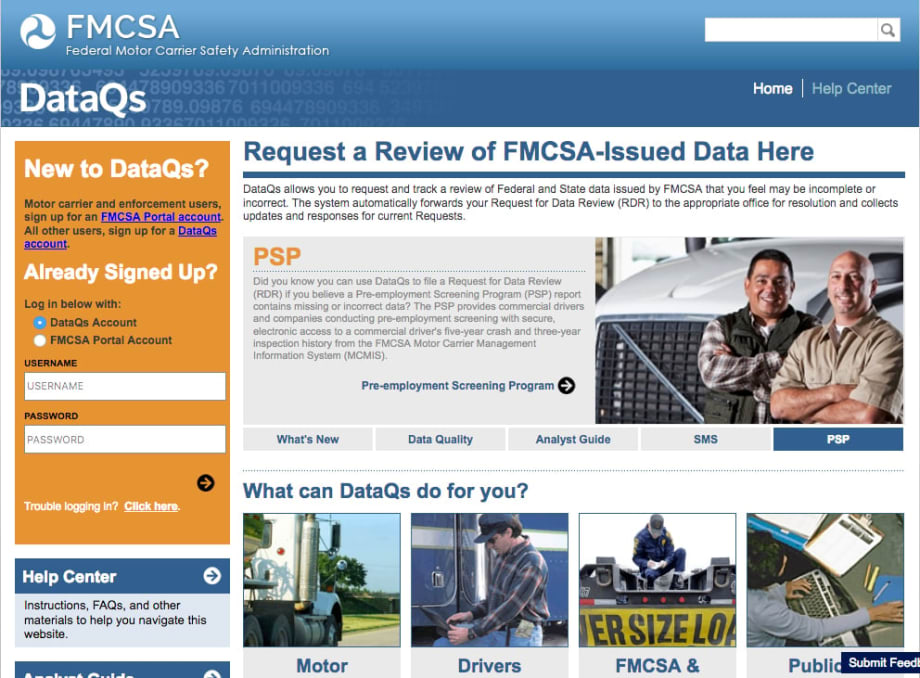
You can challenge citations you believe were in error – including ELDs – via FMCSA's DataQs process.
4 min to read
You can challenge citations you believe were in error – including ELDs – via FMCSA's DataQs process.
Full enforcement of the electronic logging device mandate that went into effect April 1 will no doubt result in a great many fleets wanting to challenge incorrect citations and inspection reports. Filing DataQ challenges is something John Seidl, a former commercial vehicle enforcement official turned transportation and now vice president of risk services at Reliance Partners, does frequently.
One of the biggest areas of confusion at roadside inspections, Seidl says, is enforcement officials trying to hold automatic onboard recording devices (AOBRDs) to the same standards as the new ELD rule.
AOBRDs are allowed to be used instead of ELDs under a grandfather clause up until December 2019, if fleets were using them before the 2017 ELD deadline. And the latest guidance allows a motor carrier that installed and required its drivers to use an AOBRD before Dec. 18, 2017, to install and use a new ELD-capable device that runs compliant AOBRD software until the December 2019 full compliance deadline.
The Federal Motor Carrier Safety Administration’s frequently asked questions on ELDs states that if you are operating a grandfathered AOBRD, “authorized safety officials will enforce … the requirements in 49 CFR 395.15 for ‘grandfathered’ AOBRDs,” while ELDs are to be enforced under the ELD regulations.
However, Seidl says, “there are many inspectors that are writing AOBRD devices up for ELD-related violations, thus prompting me to do a bazillion DataQs.”
One example? Data transfer. An AOBRD is not required to be able to transfer data to enforcement officials at roadside like ELDs are. “It doesn’t have the programming embedded in it, nor was it required to so; it is impossible to make an AOBRD transfer a data file…. You can’t make an AOBRD transfer a file that doesn’t exist.”
Even if it’s an ELD, FMCSA’s FAQs say the ELD will not be deemed non-compliant if the data cannot be sent electronically, if the driver can show either a printout or the actual ELD display of their RODS.
You can file Data Q challenges online at https://dataqs.fmcsa.dot.gov. Look for the Analyst Guide on this page for a how-to publication on Data Qs. But here are a few real-world tips from Seidl.
1. Know the commercial vehicle regulations
Before you can challenge a citation, you need to understand the regulations. You probably have a copy of the green book of federal motor carrier safety regulations, Seidl says.
But you’ll also want a copy of the Commercial Vehicle Safety Alliance’s out-of-service conditions guide, updated every April 1 — something he says many fleet safety people don’t even realize exists.
“This lists every out of service condition. Every inspector has it, and that’s what determines whether you get put out of service or not.”
In fact, he says, he has won challenges not to the violation itself, but to being put out of service. “Say you are in violation — you screwed up. You agree you were in violation. But you don’t agree you should have been placed out of service. Then you would use the CVSA out-of-service book.”
You can order a hard copy of the out-of-service guide or buy a downloadable PDF at www.cvsa.org; click on the “Store” tab.
Other regulations you need to have access to are the hazardous materials ones if you haul hazmat, and applicable state regulations.
2. Provide supporting documentation
One of the common mistakes Siedl sees in DataQ challenges is failing to provide adequate supporting documentation.
“You can’t just write it up without having evidence,” he says. “You shouldn’t be disputing violations without evidence to the contrary. You can’t just write up a summary and hope it goes well.”
Part of that evidence, he says, can simply be citing the appropriate sections of the regulations (back to our first tip above), if you prove that why they wrote you up is contrary to the regulation.
“Always get a copy of the actual driver vehicle examination report,” Seidl says. Don’t just get a screen shot. On the inspection report are additional notes that won’t be on the online summary, which may help you direct your challenge. Your driver should give you the copy of the inspection report, but if they don’t, Seidl says, you can request a copy through the Data Q website.
3. Challenge citations in court
“Many companies don’t know this, but if you get a citation and you take it to court, and they dismiss the ticket, that state is required to remove it from your CSA scores,” Seidl says. “If you get a citation and they reduce it to a lesser charge, the state is required to turn that violation in CSA into a 1-point CSA effect.”
So one key way to manage your CSA scores through Data Qs is to go to court. This is why in many cases, a ticket is actually better than a warning — because you can’t fight a warning in court.
“Are enforcement officials writing more or less tickets? They’re writing less, because if you fight it, you get rid of it,” Seidl says.
Updated May 2018 to reflect change in John Seidl's title.
Subscribe to Our Newsletter
More Safety & Compliance

FMCSA Pauses Biennial-Update Enforcement Amid Motus Transition
Carriers whose updates were due on or after June 1 have more time, while FMCSA works to stabilize its new registration system and warns of phishing sites impersonating its new carrier registration system, Motus.
Read More →
ZF Expands Commercial Vehicle Push in North America
ZF is expanding its North American commercial-vehicle presence with new transmission applications, electrification, trailer technology and autonomous-driving systems.
Read More →
Truck Drivers Need More Than Another Alert
Fleets have more visibility into truck health, safety events, and driver activity than ever. The next challenge is turning all that information into useful guidance for the person who has to decide what to do next.
Read More →
Tesla Wants a Self-Driving Semi. Are Cameras Enough?
Could Tesla’s camera-only autonomous driving technology work on an 80,000-pound Semi? In this commentary, HDT's Deborah Lockridge takes a look at Tesla, Cybercab, and how autonomous trucks see the road.
Read More →
What DOT’s Automated Vehicle Strategy Means for Trucking
The U.S. Department of Transportation issued a new automated-vehicle strategy that outlines plans for driverless-truck regulations, cross-state freight corridors, and federal safety standards.
Read More →
NYC Expands Speed, Pedestrian Safety Tech Across Fleet
New York City is expanding intelligent speed assistance and pedestrian-alert systems across its municipal fleet, moving the technologies from pilot programs into vehicle procurement and retrofit requirements.
Read More →
FMCSA Removes 110 Truck Driver Training Schools from Certified ELDT List
Federal regulators also are targeting more than 160 additional training providers and launching a nationwide audit of third-party CDL skills testers as part of a broader crackdown on trucking fraud.
Read More →
Beyond DOT Compliance: What Makes a Trucking Fleet Truly Safe?
A trucking fleet can follow every rule and still make unsafe decisions. The real test comes when safety conflicts with freight, productivity, or cost.
Read More →
Hours of Service Pilot Programs: FMCSA Readies for 2027 Rollout
Two pilot programs could eventually reshape hours-of-service rules, giving truck drivers options to pause their 14-hour clock or use longer split sleeper rest periods.
Read More →
New Guide Offers Pet Safety Tips for Truck Drivers
Hundreds of thousands of pets travel in truck cabs. A new safety guide from Volvo Trucks and the Center for Pet Safety offers practical advice for truck drivers who bring dogs and cats along for the ride.
Read More →