





Check out our impressions of the PowerLine transmission:
ZF: What Wabco Deal Means for Next-Generation Mobility
ZF says its acquisition of Wabco will create “a leading global integrated systems provider for commercial vehicle technology.” But what does that mean for North American fleets? Find out in this interview with HDT.
December 11, 2020
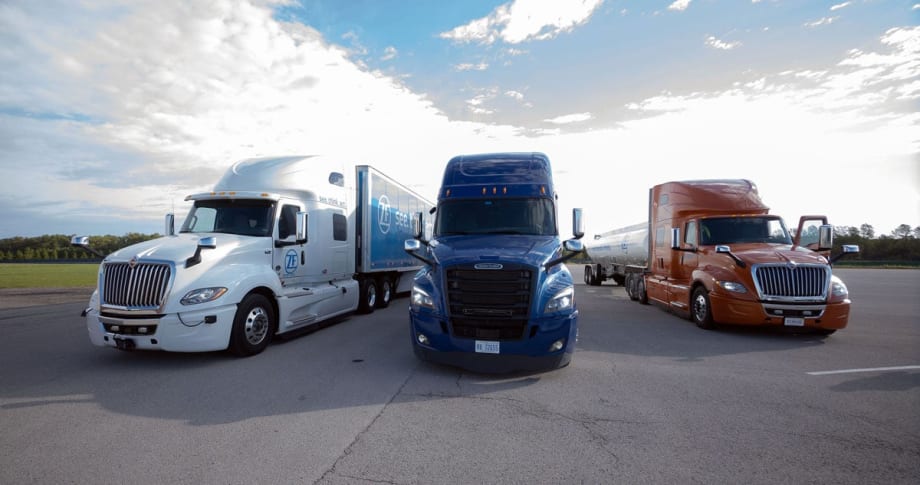
ZF says the transmission and advanced steering it has shown to journalists the past two years will come to North America in 2021.
Photo: ZF
8 min to read
ZF hasn’t had a large presence in the North American commercial vehicle market, but expect that to change. 2021 will bring a new “game-changing” automatic transmission, plus the electro-hydraulic ReAx power steering with lane-keeping assist. And watch down the road as its recent acquisition of Wabco helps it accelerate technologies that will make electric and autonomous trucks a reality.
"Next-generation mobility for commercial vehicles, that’s the ZF slogan,” said Andreas Moser, head of ZF’s commercial vehicle technology division, in an interview with HDT. But just what does that mean?
“It’s not just a slogan,” Moser said. The company sees itself as shaping the future in four technology domains:
Vehicle motion control
Integrated safety
Automated driving
Electric mobility
Mark Mohr, responsible for developing driver assist systems in the commercial vehicle sector, said ZF wants to use these technologies to solve three key challenges for the commercial vehicle industry: efficiency, safety, and digitization.
On the efficiency side, he noted, there’s ZF’s traditional drivelines business.
For instance, ZF plans to launch its PowerLine 8-speed automatic transmission with a major North American OEM in early 2021. It can offer up to 30% faster acceleration, up to 10% better fuel efficiency, up to 45% weight reduction, and up to 30% less noise than a manual transmission, according to the company – and also offers improvements over an automated manual, said Mohr, who called it “a game-changer.” The transmissions initially will be imported from Germany, but in 2023 a “dramatic high increase in volumes” will mean ramping up production in North America.
Looking ahead for efficiency, there’s a full portfolio of electrification. ZF’s CeTrax, for instance, is an electric system for medium-duty commercial vehicles and buses. This is an electric central drive that can be integrated simply into vehicle designs with a conventional driveline layout. It looks a bit like a transmission, but it’s an electric motor, using standard axles with common ratios.
“We have combined our in-house electric driveline know-how with our transmission know-how and combined elements …. to get a perfect adaption for electric drive for these applications,” Mohr said.
In both efficiency and safety, ZF’s “Vision Zero” goal of mobility with zero accidents and zero emissions will only be improved by the Wabco acquisition from what it’s already achieved as an independent company.
And digitization can help fleets be more efficient and safer as well as optimizing processes. That part of Wabco is very strong on the trailer side, Mohr said, as well as some on the truck side, “so it’s really a perfect fit.”
Moser pointed out that increasingly, “you cannot separate these three trends anymore. If you want to achieve efficiency improvements, you don’t need only a nice driveline, you also have to anticipate the road ahead, and that’s given by digitization. And safety also depends very much on digitization.”
For instance, ZF has fleet management systems for truck and bus fleets that help them operate leaner, greener, and safer. It can optimize electric-vehicle range using intelligent shift strategies and driving strategies using mapping combined with telematics.
“We look into what is the best routing for electric vehicles with recharging recharging places, looking at how is the driver able to drive all his stops with one charging, but also interaction between goods in the trailer by detection systems, for example, documenting temperature,” Mohr said. “We’re using data from the truck-trailer combination to make our next generation of products.”
How Does Wabco Help ZF Meet its Commercial Vehicle Goals?
ZF and Wabco have been working together for several years. For instance, in 2016, the two demonstrated a prototype collision avoidance technology for commercial vehicles called Evasive Maneuver Assist. EMA leveraged the combined capabilities of Wabco's OnGuardActive radar-only collision mitigation system, its electronic braking system, advanced emergency braking system, electronic stability control, and vehicle dynamics control systems, with ZF's electro-hydraulic ReAx power steering system.
“Wabco was a major supplier on the braking side,” Mohr explained, “as well as integration for braking and advanced driver assistance systems, where we have been a major supplier of ADAS components and subsystems.”
In electrification, he said, ZF has a full range of electric drivelines, shifting strategies, and energy recuperation, but recovering energy during braking depends on the right tuning between the electric motor and the foundation brakes. That’s where Wabco’s braking expertise comes in.
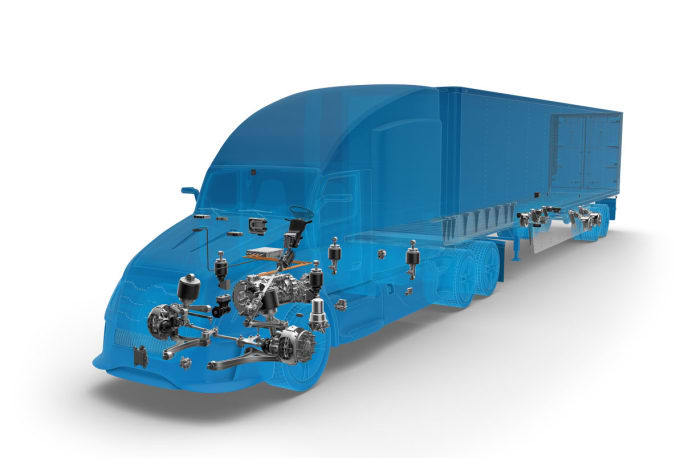
On the tractor side, the ZF-Wabco acquisition brought together a lot of complementary expertise. For instance, Wabco's brake and stability control solutions dovetail with ZF's steering systems in ways that will help make autononous trucks possible.
Illustration: ZF
“And we bring together 4,500 dedicated engineers for commercial vehicles; they have truck, trailer and bus business in their blood. So we can create even more ideas and make even better system approaches.”
Moser also cited the example of complementary abilities in transmissions. “We are very successful with transmissions,” he said, “but with Wabco bringing in the mechatronic knowhow, it’s a perfect fit.”
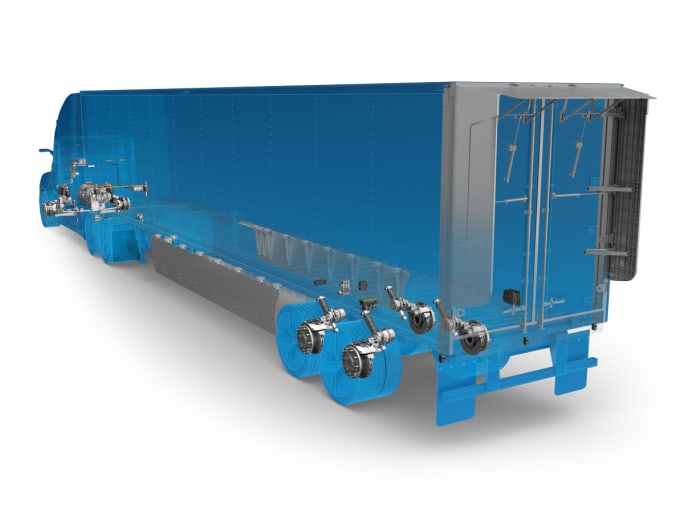
The Wabco acquisition brought a host of trailer technology to ZF, including foundation brakes, aerodynamic solutions, suspension control, stability control, and trailer telematics.
Illustration: ZF
Innovations on the Horizon
In a normal year, ZF would have shown off some of the capabilities the newly combined company will be able to offer with a concept truck at the IAA Commercial Vehicle Show in Hannover, Germany. With that event cancelled due to the COVID-19 pandemic, they shared some highlights with HDT in a video presentation and interview, and talked about how the Wabco acquisition will help drive these technologies.
Advanced Reversing Assist
This technology clearly shows how the ZF-Wabco combination can benefit fleets, Mohr said. This advanced driver assistance system uses cameras and radars, combined with the trailer brakes, pedestrian detection and active braking system, to help the driver in tractor-trailer reversing maneuvers. This improves both efficiency and safety, he noted.
Automated Coupling Assist
Take the reversing assist to the next level and you get automated coupling assist. ZF said this is the industry’s first fully automated coupling assist system for a heavy-duty tractor-trailer combination. It can cut coupling time in half, they said, while increasing safety and helping less-experienced drivers.
“You can see better the interaction between all the systems we now have,” Mohr said. “The truck can detect the right trailer and the driver can activate active coupling mode, where all the pieces from the driveline, low-speed driving, braking as well as steering, are playing together in a synchronized manner to automatically couple the trailer without driver interaction.”
With a camera on the back of the vehicle to help eliminate mirror blind spots, it can also detect pedestrians who may be in the way.
Adopt Control
Building still further on this technology is Autonomous Driving Open Platform Technology, or Adopt, which provides intelligent autonomous vehicle chassis control.
This is designed to help autonomous driving systems from the likes of Waymo or TuSimple contend with situations such as wet roads or oil on the road, which are not easy to detect, Mohr explained. Using intelligent driveline and braking systems, such as electronic brake control and electronic stability control, it addresses vehicle dynamics in situations such as driving at high speed on a curve in wet conditions, keeping the truck and trailer stable. This kind of technology, he said, will help advance autonomous driving systems development, not only for on-highway use, but also for restricted-area applications such as ports and delivery yards.
Mohr explained that for these applications, ZF can combine the high-precision, low-speed driving capabilities it has from its transmission development with high-precision braking from Wabco. “We need less sensors than we did before because of the high-precision wheel sensor in their portfolio. And they are expert on the trailer side, so we have automatic connection between the air supply and power supply between the truck and trailer, so it’s a full system.”
eTrailer
The eTrailer is an electric trailer using an electric motor on the axle.
Mohr explained that there are various use cases for adding electrification to the trailer.
For instance, you can use it in a hybrid scenario. Because a tractor-trailer combination brakes more on the trailer side than truck side, you have higher energy recuperation. By turning the whole tractor-trailer combination into a hybrid, it can offer up to 16% less fuel consumption, improved traction, and less noise and less wear.
Or for refrigerated trucks, the electricity can cool the trailer, rather than using an internal combustion refrigeration unit.
“And if we go to full electric vehicles or fuel cell vehicles, there are some special use cases where if you need more traction power or battery isn’t enough, a combination with an electrified trailer can deliver additional performance.”
Because they rely heavily on high-tech trailers, most of these technologies will be more adoptable in Europe than in North America, thanks to the different ways fleets approach trailer utilization.
“We might see it first in Europe or special applications like ports,” Mohr said. “Normally North America is a bit more conservative [and less willing] to invest money into the trailer than the European market. It’s a hard fight but it’s going forward…. we might see it in four or five years on the road in the North American market.”
He also noted that his Wabco colleagues are looking into retrofit technologies that would allow step-by-step upgrades of trailers.
What to Expect from ZF in North America
Nearer term, in North America, ZF said it will launch its ReAx steering with lane-keeping functionality in 2021 with a yet-to-be-announced truck maker.
It’s also working on next-generation full electric steering, targeted for 2024. This will help in developing future Level 4 autonomous vehicles, but also helps improve fuel consumption, which helps optimize electrically driven vehicles.
ZF has been working with Daimler on its eCascadia field testing, and Moser and Mohr explained that the electric drive motors currently being used are adapted from ZF’s bus experience, but weren’t really designed for high-speed transportation, so “the next generation is in preparation.” The Freightliner Innovation fleet is as much about learning how electric trucks work in fleet applications as it is about testing the equipment itself.
“We are working to have a complete portfolio of central and axle [electric drives], from medium-do heavy-duty,” Mohr said.
Moser noted that central drives are a little bit easier to integrate, “but with our experience in the bus segment, we see both have pros and cons.” Because central drives can be used in trucks that are set up to have an internal combustion engine, they’re easier for OEMs that may have a small volume of electrified versions they’re producing alongside ICE versions. With axle drives, you have more engineering freedom to integrate batteries or other components. Mohr said we will see both in North America, depending on the use case and the OEM.
Subscribe to Our Newsletter
More Equipment

How Volvo Updated Its D13 for EPA 2027 [Watch]
Volvo’s updated D13 promises lower emissions without sacrificing performance or fuel economy. Take a closer look at what changed inside the engine in this HDT Spotlight video.
Read More →
Michelin Tire Improves Efficiency and Durability for Regional Fleets
The Michelin X Multi Energy D2 is a regional haul drive tire engineered to help fleets improve fuel efficiency, durability and traction in demanding stop-and-go operations.
Read More →
ZF Expands Commercial Vehicle Push in North America
ZF is expanding its North American commercial-vehicle presence with new transmission applications, electrification, trailer technology and autonomous-driving systems.
Read More →
Tesla Wants a Self-Driving Semi. Are Cameras Enough?
Could Tesla’s camera-only autonomous driving technology work on an 80,000-pound Semi? In this commentary, HDT's Deborah Lockridge takes a look at Tesla, Cybercab, and how autonomous trucks see the road.
Read More →
Kodiak: Driverless Long-Haul Truck Launch on Track for 2026
Kodiak AI says its driverless long-haul safety case is 93% complete and it remains on track to begin commercial operations by year-end 2026.
Read More →
What DOT’s Automated Vehicle Strategy Means for Trucking
The U.S. Department of Transportation issued a new automated-vehicle strategy that outlines plans for driverless-truck regulations, cross-state freight corridors, and federal safety standards.
Read More →
East Coast Port Launches $45M Electric Truck Push
The Port Authority of New York and New Jersey announced millions in incentives for zero-emission drayage trucks, yard tractors, and new charging hubs near the port.
Read More →
PlusAI Going Public to Fund Autonomous Truck Launch
A SPAC deal could provide PlusAI with up to $300 million as it works toward a 2027 commercial launch of factory-built autonomous trucks.
Read More →
NHTSA Moves to Rewrite Truck Fuel-Economy Rules
The National Highway Traffic Safety Administration says it lacks authority to regulate medium- and heavy-duty truck engines separately from complete vehicles, but the existing standards have not yet been eliminated.
Read More →
Detroit Opens Orders for EPA 2027 Engines
Detroit isn’t starting from scratch to meet EPA 2027 diesel emissions standards. Its Gen 6 DD13 and DD15 engines keep much of today’s platform while updating the fuel and aftertreatment systems.
Read More →