





Manual or Automated Manual Transmission: What’s the Difference?
ZF Teases Automatic Transmission, Lanekeeping System
ZF has adapted its highly successful Powerline automatic transmission for vocational fleet applications up to 57,000 lbs., and is showing off a more advanced lanekeeping system it's working to get on commercial trucks.
June 15, 2018
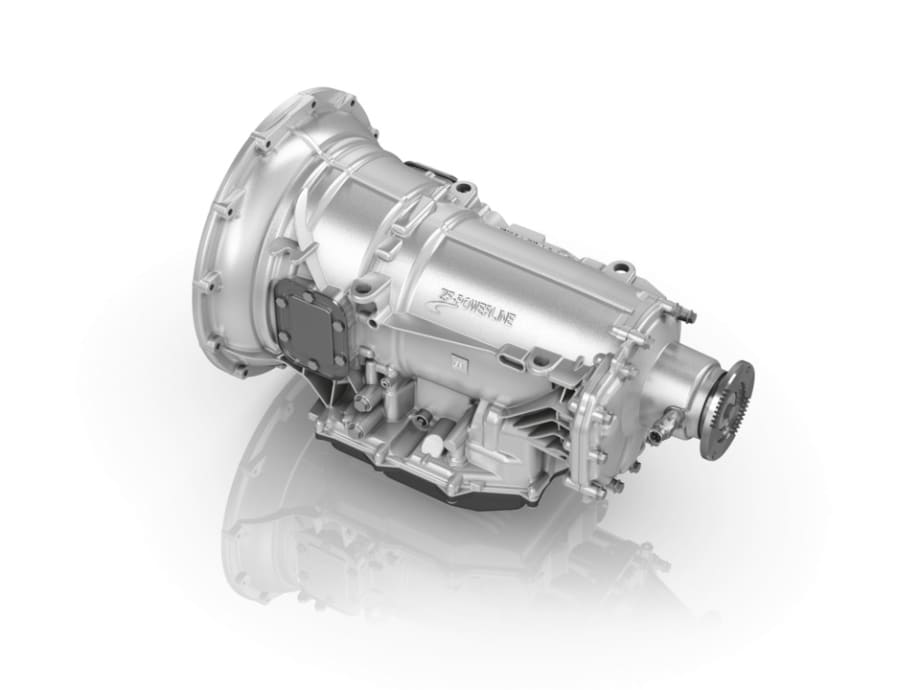
ZF is adapting its passenger car Powerline automatic transmission for vocational truck applications up to 57,000 lbs.
Photo courtesy ZF
5 min to read
ZF has adapted its highly successful Powerline automatic transmission for vocational fleet applications up to 57,000 lbs., and is showing off a more advanced lanekeeping system it's working to get on commercial trucks.
If you scan the headines on emerging automotive and transportation technology, you'll see a lot of new companies being talked about. Dig a little deeper, though, and look at stories like this one or this one, and you see some older, more established company names coming up again and again as well. ZF is one of those companies, which is quietly and steadily working away on cutting-edge technologies that will soon be on the trucks you spec, buy, own or drive.
It's something the company has been steadily doing since the eccentric German count who founded it over 100 years ago decided he needed better transmissions for the airships that carry his family name – Zeppelin – to this day.
Almost a year ago, I traveled to LaFayette, Indiana, to see ZF’s new (for commercial vehicles) Reax steering assistance system – a “smart,” electronic control unit that helps drivers maintain lane discipline, and augments hydraulic steering systems to make low-speed truck maneuvering much easier.
It’s a slick system, and I predicted that it would be a hit with fleets across North America because it directly addresses many of the issues that keep fleet executives awake at night, such as safety, efficiency, productivity and driver retention.
I’ve just returned from another visit with ZF in Indiana, where the company showed off its new OnTrax lane-keeping assistance system, which uses the Reax system as a technological foundation for a new driver assistance system, which takes telemetry from a variety on onboard vehicle systems, including active safety systems, camera systems and driver inputs, and uses it to reduce fatigue and help “nudge” wandering drivers back into their lanes before accidents occur.
ZF feels it has a truly transformational technology on its hands with its Reax steering assistance system, and is already using the system as a building block for even more enhanced and automated driver/steering systems to come.
Tom Otter, ZF’s aftermarket business unit leader, says ZF’s new OnTrax Lane Keeping Assist Technology is the next step in driver comfort, safety, and control. According to Otter, the new system works by combining information from the road, vehicle, camera, and Reax modules, to boost and monitor steering control for the vehicle. It soon will help reduce unintentional lane departures, detect and increase awareness of driver fatigue and interact with and enhance collision mitigation systems on commercial vehicles.
Currently, ZF is refining the OnTrax system while talking with both fleets and OEMs about adding the new system as a specification on new model commercial vehicles in the near future.
The Powerline Premiers
ZF's “new” automatic transmission is called the Powerline. It is an 8-speed, fully automatic (torque converter equipped) transmission designed for commercial vehicles in vocational applications up to 57,000 pounds.
The Powerline isn’t actually new. The basic transmission unit has been ZF’s standard passenger car automatic transmission both here and in Europe since 2007 and can be found in some truly impressive performance cars, including BMWs and high-performance Dodge Challenger Super Bees.
But transmissions are amazingly adaptable machines. And with just a little fine-tuning here and there, and the addition of some highly sophisticated electronic control algorithms, ZF engineers have some up with a new option for vocational fleets that offers some very interesting capabilities.
According to Christian Feldhaus, senior project manager at ZF, the new PowerLine automatic features up to 1,000 lb-ft engine torque, a ZF patented 8-speed gear set and intelligent skip-shift to improve acceleration performance by up to 30%, and is designed to accommodate engine-driven power take-offs on both sides of the unit with up to 485 lb-ft. Feldhaus also said the unit is designed for superior reliability, supported by a fully integrated transmission control unit with one central electric connector and transmission-mounted oil cooler. He added the PowerLine also provides a 45% weight benefit and enhanced fuel efficiency of more than 10% over comparable products.
Additionally, Feldhaus said, with optional predictive shifting, sailing, and stop-start capabilities, the Powerline is both ready for vocational fleet operations today and prepared for electric-hybrid transmissions in future zero- and near-zero emission trucks.
“Sailing” is ZF’s term for when an automatic or automated transmission automatically shifts into neutral on downgrades to save fuel.
The transmission’s stop-start feature is particularly interesting for fleets, as the unit automatically and seamlessly shifts out of Drive to Neutral after three seconds – when a truck has stopped at a traffic light, for example. This simple act dramatically reduces the amount of torque the transmission is producing and, as a result, the amount of fuel an engine has to burn to keep those torque levels up. As a result, ZF engineers say, an average vocational fleet engaged in city and urban delivery applications can see up to a 5% boost in fuel economy fleet-wide thanks to this Powerline feature alone.
Additional Powerline features include:
Up to 1,000 lb-ft engine torque for maximum traction
485 lb-ft engine-driven dual side PTO interface
Superior reliability supported by a fully-integrated transmission control unit with one central electric connector, and transmission-mounted oil cooler
Additional 45% weight benefit over comparable products for improved freight efficiency / capacity
ZF patented 8-speed gear set and intelligent skip-shift to improve acceleration performance by up to 30%
Smart software features such as Adaptive Starting Gear, Neutral Idle Control, Multi Skip Shift, Maneuvering Mode, Stop-Start and more.
Fuel efficiency performance provides significant savings of more than 10% over available automatic transmissions.
ZF intends to have Powerline transmissions available for purchase in the North American market in the latter part of 2020.
Related – Q&A: ZF's Emerging Technology Push Gains Steam
More Equipment

How Volvo Updated Its D13 for EPA 2027 [Watch]
Volvo’s updated D13 promises lower emissions without sacrificing performance or fuel economy. Take a closer look at what changed inside the engine in this HDT Spotlight video.
Read More →
Michelin Tire Improves Efficiency and Durability for Regional Fleets
The Michelin X Multi Energy D2 is a regional haul drive tire engineered to help fleets improve fuel efficiency, durability and traction in demanding stop-and-go operations.
Read More →
ZF Expands Commercial Vehicle Push in North America
ZF is expanding its North American commercial-vehicle presence with new transmission applications, electrification, trailer technology and autonomous-driving systems.
Read More →
Tesla Wants a Self-Driving Semi. Are Cameras Enough?
Could Tesla’s camera-only autonomous driving technology work on an 80,000-pound Semi? In this commentary, HDT's Deborah Lockridge takes a look at Tesla, Cybercab, and how autonomous trucks see the road.
Read More →
Kodiak: Driverless Long-Haul Truck Launch on Track for 2026
Kodiak AI says its driverless long-haul safety case is 93% complete and it remains on track to begin commercial operations by year-end 2026.
Read More →
What DOT’s Automated Vehicle Strategy Means for Trucking
The U.S. Department of Transportation issued a new automated-vehicle strategy that outlines plans for driverless-truck regulations, cross-state freight corridors, and federal safety standards.
Read More →
East Coast Port Launches $45M Electric Truck Push
The Port Authority of New York and New Jersey announced millions in incentives for zero-emission drayage trucks, yard tractors, and new charging hubs near the port.
Read More →
PlusAI Going Public to Fund Autonomous Truck Launch
A SPAC deal could provide PlusAI with up to $300 million as it works toward a 2027 commercial launch of factory-built autonomous trucks.
Read More →
NHTSA Moves to Rewrite Truck Fuel-Economy Rules
The National Highway Traffic Safety Administration says it lacks authority to regulate medium- and heavy-duty truck engines separately from complete vehicles, but the existing standards have not yet been eliminated.
Read More →
Detroit Opens Orders for EPA 2027 Engines
Detroit isn’t starting from scratch to meet EPA 2027 diesel emissions standards. Its Gen 6 DD13 and DD15 engines keep much of today’s platform while updating the fuel and aftertreatment systems.
Read More →