




Peterson to Debut Genesis Fail-Safe Truck and Trailer Light at Major Industry Events
Peterson will debut its new Genesis truck and trailer light at Work Truck Week and TMC.

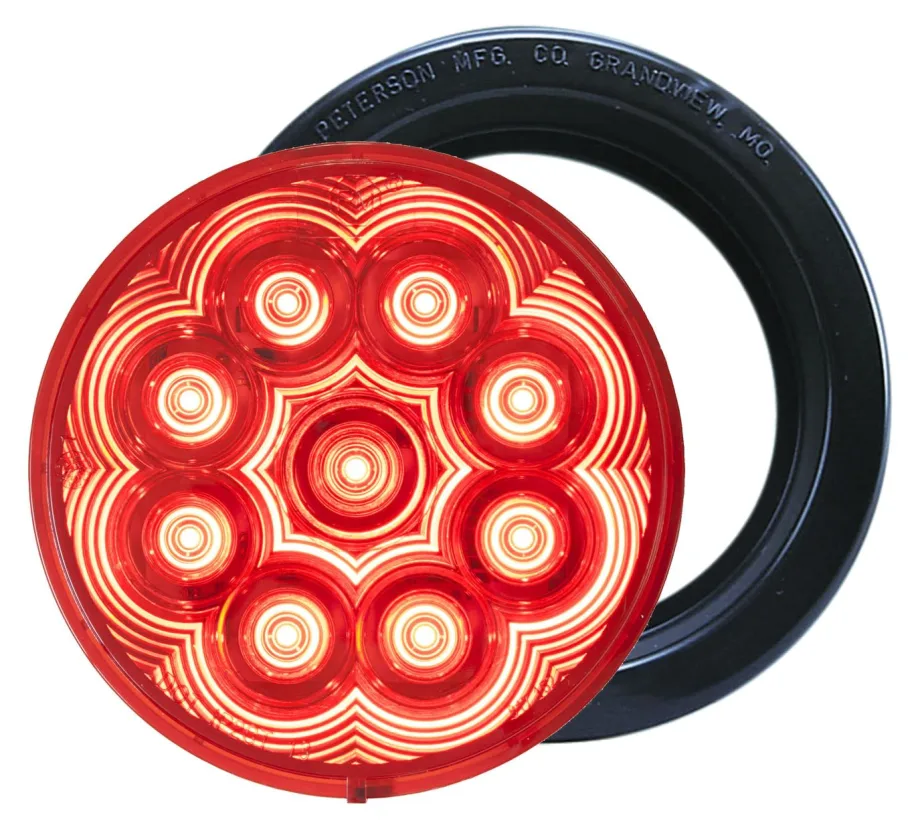
Peterson's Genesis light has been redesigned to maintain consistent illumination and eliminate partial-failure scenarios.
Peterson Manufacturing
Peterson Manufacturing is set to unveil a new commercial vehicle lighting technology designed to eliminate one of the trucking industry’s long-standing reliability concerns.
The company announced it will debut its Genesis Truck and Trailer Light during press conferences at both NTEA Work Truck Week and the Technology & Maintenance Council (TMC) Spring Meeting.
The OE said the new light represents a “fundamental shift” in commercial vehicle lighting reliability.
According to Peterson, the Genesis light is engineered on a fail-safe design platform intended to eliminate partial failure, a common issue with LED lighting systems where some diodes fail while others continue to operate.
Addressing Long-Standing LED Ambiguity
While LEDs have improved efficiency and durability in commercial vehicle lighting, Peterson says the industry has struggled with a persistent gray area: how many failed diodes make a light ineffective or noncompliant?
That uncertainty can create complications for fleets during roadside inspections and routine maintenance, potentially leading to downtime and inconsistent vehicle visibility.
The Genesis light was developed specifically to remove that ambiguity.
Rather than focusing on how much failure can be tolerated, Peterson said it redesigned the lighting system to maintain consistent illumination and eliminate partial-failure scenarios.
“Partial failure has always been treated as inevitable,” said Al Anderson, vice president of sales and marketing at Peterson Manufacturing. “Through our close partnerships and conversations with fleets, we heard how much uncertainty and disruption that creates. Genesis Truck and Trailer Lights were engineered to maintain full functional integrity, giving fleets confidence that their lights will perform exactly as expected every time the vehicle is in operation.”
Potential Fleet Benefits
Peterson says the Genesis design could help fleets improve operational reliability by delivering:
- Reduced compliance uncertainty
- Lower risk during roadside inspections
- Greater operational consistency
- More predictable visibility in real-world conditions
By maintaining consistent illumination, the company believes the system could help fleets focus more on uptime and safety rather than interpretation of lighting performance during inspections.
Debut at Major Industry Events
Peterson will formally introduce the Genesis light at dedicated press conferences during Work Truck Week and the TMC Spring Meeting.
Attendees will be able to view the product and discuss its potential impact on compliance standards, safety performance and fleet maintenance strategies.
The unveiling positions the new product as Peterson’s latest effort to address long-standing challenges in commercial vehicle lighting while improving visibility and reliability across truck and trailer applications.
More Equipment

How Volvo Updated Its D13 for EPA 2027 [Watch]
Volvo’s updated D13 promises lower emissions without sacrificing performance or fuel economy. Take a closer look at what changed inside the engine in this HDT Spotlight video.
Read More →
Michelin Tire Improves Efficiency and Durability for Regional Fleets
The Michelin X Multi Energy D2 is a regional haul drive tire engineered to help fleets improve fuel efficiency, durability and traction in demanding stop-and-go operations.
Read More →
ZF Expands Commercial Vehicle Push in North America
ZF is expanding its North American commercial-vehicle presence with new transmission applications, electrification, trailer technology and autonomous-driving systems.
Read More →
Tesla Wants a Self-Driving Semi. Are Cameras Enough?
Could Tesla’s camera-only autonomous driving technology work on an 80,000-pound Semi? In this commentary, HDT's Deborah Lockridge takes a look at Tesla, Cybercab, and how autonomous trucks see the road.
Read More →
Kodiak: Driverless Long-Haul Truck Launch on Track for 2026
Kodiak AI says its driverless long-haul safety case is 93% complete and it remains on track to begin commercial operations by year-end 2026.
Read More →
What DOT’s Automated Vehicle Strategy Means for Trucking
The U.S. Department of Transportation issued a new automated-vehicle strategy that outlines plans for driverless-truck regulations, cross-state freight corridors, and federal safety standards.
Read More →
East Coast Port Launches $45M Electric Truck Push
The Port Authority of New York and New Jersey announced millions in incentives for zero-emission drayage trucks, yard tractors, and new charging hubs near the port.
Read More →
PlusAI Going Public to Fund Autonomous Truck Launch
A SPAC deal could provide PlusAI with up to $300 million as it works toward a 2027 commercial launch of factory-built autonomous trucks.
Read More →
NHTSA Moves to Rewrite Truck Fuel-Economy Rules
The National Highway Traffic Safety Administration says it lacks authority to regulate medium- and heavy-duty truck engines separately from complete vehicles, but the existing standards have not yet been eliminated.
Read More →
Detroit Opens Orders for EPA 2027 Engines
Detroit isn’t starting from scratch to meet EPA 2027 diesel emissions standards. Its Gen 6 DD13 and DD15 engines keep much of today’s platform while updating the fuel and aftertreatment systems.
Read More →