





Related: Can LEDs Clean Your Truck?
Stay On Top of Your Lighting Problems
Lighting can drive any technician to drink. Some tips to stay ahead of the problems and avoid all that grief.
February 14, 2019
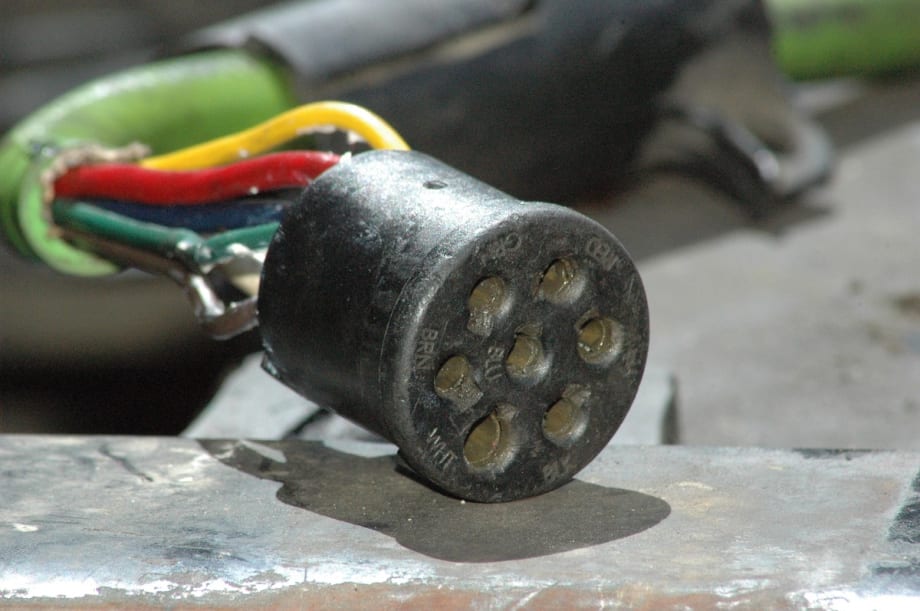
The tractor’s 7-pin connector is possibly the most abused electrical connection on the vehicle, yet many fleets buy cheap replacements by the dozen instead of investing in a top-quality connector.
Photos: Jim Park
4 min to read
LEDs have dramatically reduced the maintenance expense associated directly with lighting, but that still leaves nearly everything between the battery and lighting fixture to worry about. They still use traditional wiring, they require traditional grounds, and their connectors and cables are still subject to a variety of physical and electrical abuse that can have adverse effect on vehicle lighting.
Beef up your electrical systems beginning with the LED fixture itself. Use marker lights with weather-tight connectors, screw-on lenses, and sealed wiring throughputs, says Joe Puff, vice president of truck technology and maintenance at NationaLease. “Mounted high on a trailer, those things take a lot of tree-branch strikes that can easily pop off a snap-on lens,” he says. “It takes quite a hit to knock off a screw-on lens.”
Because they are difficult to get to for repairs, using weather-tight and sealed connectors reduces the potential for moisture incursion and thus the number of times you’ll have to put a technician on a ladder to repair them.
Wire harnesses can be a source of problems, too. While generally much higher quality than they used to be, they can still be sabotaged by poor maintenance. Even a first-class wiring harness is practically useless unless it’s protected at the front end, says Gerry Mead, executive director of innovation at Phillips Industries and former senior vice president of maintenance at truckload carrier U.S. Xpress. “Without a sealed front end, corrosion and contamination will wick their way through the front of the harness, ‘clogging the arteries’ and rendering the sealed harness virtually useless,” he says.
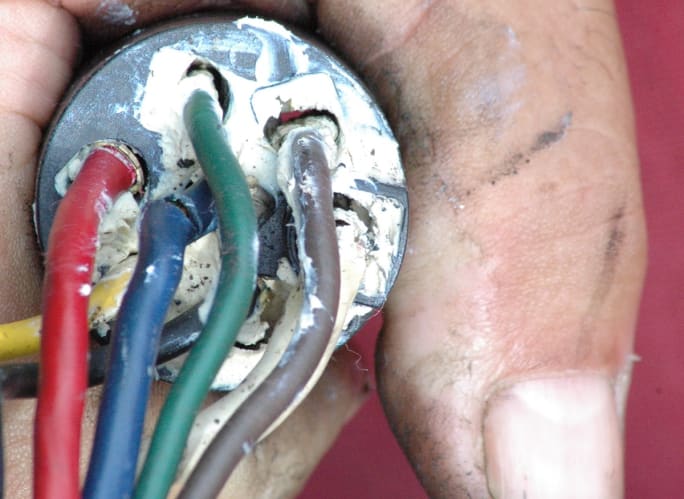
Use dielectric grease anywhere copper wiring comes into contact with air.
Anywhere moisture can enter a wiring harness is a problem, but Mead says the 7-way connector on the nose of the trailer is often a vulnerable point. “When was the last time you checked the spring tension on the 7-way receptacle locking cap?” he asks. “That spring helps keep the connector plug in place during operation, and it helps keep water and debris out of the plug when the trailer is parked.”
In fact, the 7-way connector, both on the tractor and trailer side, is a major failure point. Drivers often yank the plug out by the cable rather than gripping the connector, or leave them lying on the tractor’s rear deck rather than stowed in a receptacle when bobtailing. It’s a perfect invitation for moisture and corrosive de-icing salts to contaminate the thing. And from the plug, the contamination soon starts wicking its way through your expensive trailer wiring harness.
Fleets can spend a lot of time and money repairing and replacing the pigtail that runs between the tractor and trailer or to and from a converter dolly, so they probably warrant the extra upfront cost of a top-quality product.
Cables that are too long or too short can be easily damaged in everyday use, when making tight turns, for example, or when they are left dragging on the rear deck. Back-of-cab mounts for the electrical cables and air lines get the cable up off the deck to reduce scuffing, while high-mounted connectors are farther away from the obvious sources of contamination.
Mead recommends reading Recommended Engineering Practice RP 107C from the American Trucking Associations’ Technology & Maintenance Council. It describes how to spec the proper cable and provides advice on what to look for when buying such products.
The cable supports on the underside of the trailer is another area that probably deserves more attention. “If the airlines and cables are not properly supported, they can sag too low to the ground or be pulled too taut when the sliding axle is adjusted,” Mead says. “It’s all about protecting the integrity of the outer lay of the cable and connectors to the harness. The placement and quality of these springs matter, and there are guidelines to be considered when installing or replacing them.”
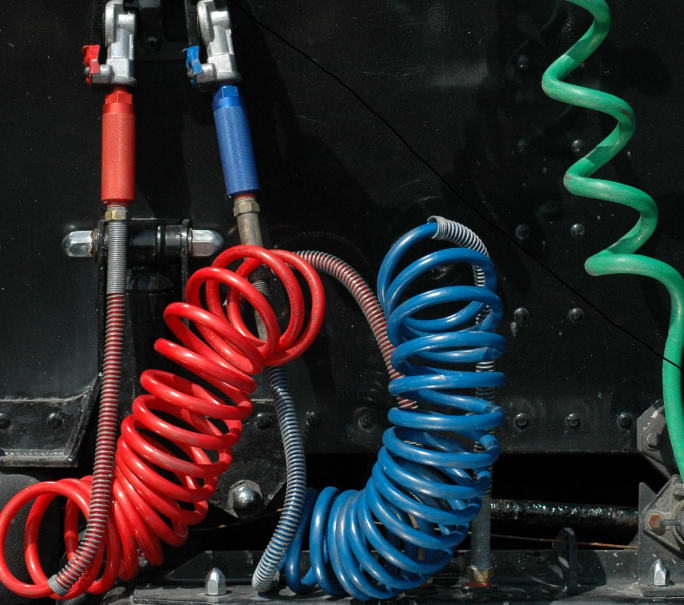
Stowage for the pigtails is a determining factor in how much contamination and scuffing they will have to endure.
One last item from a spec’ing perspective: fifth-wheel ground straps. “When you think about a tractor-trailer combination, the power has to travel through a lot of metal to complete the ground,” Puff says. At $25-$50 when spec’d new, he says, ground straps are a very economical way of improving the ground path between vehicles.
From an operational point of view, tell drivers to shut off everything electrical in the cab (fans, invertors, radios, lights, etc.) while they crank the engine at startup. According to Puff, the current spikes created when putting a big load on the batteries can be enough to damage some onboard electrical equipment.
“The high draw from the starter temporarily reduces the voltage in the batteries, say from normal 12.6 to maybe 8 or 10 volts, even for a millisecond,” Puff says. “That voltage drop and the accompanying increase in amperage through the system can damage electrical and electronic equipment. Now, OEMs take great care to prevent voltage spikes, but they do happen.”
And finally, there is more need today than ever before for technicians to be trained to make even basic electrical repairs in accordance with standard practices. They also need the proper tools for the job, which include multimeters and diagnostic tools, not just pointy-tipped circuit probes.
Lighting issues remain a top roadside compliance concern for all fleets. A properly spec’d and maintained vehicle will provide longevity and mitigate failures.
Subscribe to Our Newsletter
More Maintenance

Sponsored•September 16, 2026
Color Match Smarter: Tools That Restore & Perform
For fleet managers and collision repair professionals keeping heavy-duty trucks on the road, getting the color right the first time isn't just about appearance — it's about efficiency, turnaround time, and bottom-line results. Discover how today's digital color tools are transforming the repair process from guesswork to precision.
Read More →
Wrong Repair Prompts Recall of Freightliner, Western Star 4x2 Trucks
DTNA is recalling more than 2,400 trucks that received an incompatible software fix instead of the hardware repair required to address brake valve corrosion.
Read More →
Truck Drivers Need More Than Another Alert
Fleets have more visibility into truck health, safety events, and driver activity than ever. The next challenge is turning all that information into useful guidance for the person who has to decide what to do next.
Read More →
The Maintenance Checks Trucking Fleets Should Prioritize Before Fall Freight Picks Up
Making it through August isn’t the same as being ready for the next several months of operation. Find out what systems may have suffered from summer heat and need to be checked out before fall.
Read More →
What Three Fleets Are Doing Differently When Buying Truck Parts in 2026
With freight improving but costs still climbing, fleet maintenance executives explain how they're balancing price, quality, and supplier relationships.
Read More →
Paccar Recalls 2027 Trucks Built This Summer for Possible Electrical Problem
The nearly 6,000 Kenworth and Peterbilt trucks in the recall could potentially lose engine power, among other things.
Read More →
Will API PC-12 Oil Change Trucking Fleet Maintenance?
The new API PC-12 heavy-duty engine oil category reflects the changing demands of modern diesel engines. But fleets like Foodliner are looking to getting their own data before making decisions on adopting the new oils and questions such as extending oil drain intervals.
Read More →
Brake Safety Week to Focus on Drums and Rotors
Commercial vehicle inspectors are focusing on truck brakes during CVSA's Brake Safety Week, August 23-29.
Read More →
Possible Battery-Cable Fires Prompt Recall of 15,000+ International MV and HV Trucks
On the recalled vehicles, manufacturing variations can cause the battery interconnect cable to contact the auxiliary stud and hold down the bracket.
Read More →
Rush, MCT Team Up to Grow Refrigeration Service Network
The joint venture will operate MCT's network of Carrier Transicold dealerships and mobile service locations, with the companies promising greater service capacity and uptime for refrigerated fleets.
Read More →