




FTR Reports Class 8 Truck Orders Surged in February
FTR said preliminary Class 8 truck orders jumped 47% month over month and 159% year over year as improving freight conditions and clearer regulatory outlook boost fleet confidence.

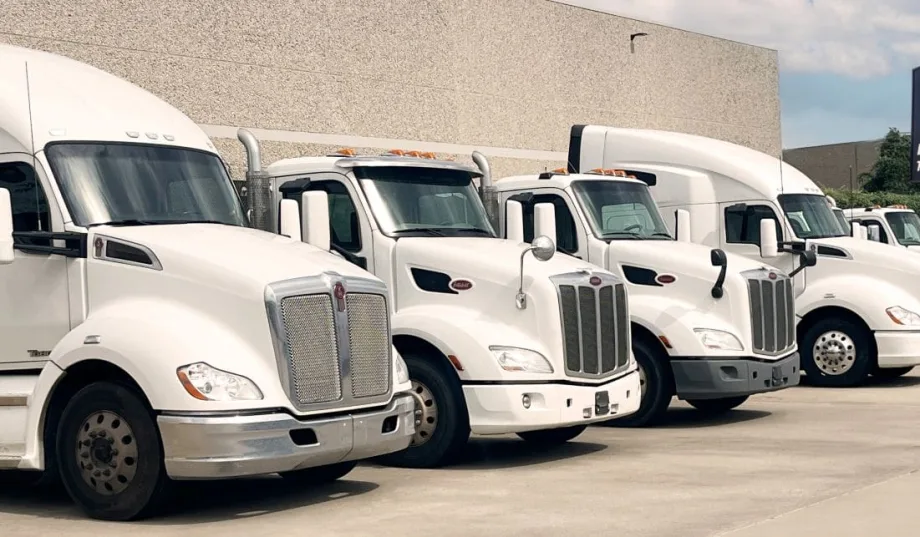
Over the past 12 months, Class 8 orders have totaled 258,466 units, according to FTR.
Paccar
North American Class 8 truck orders surged in February, reaching their highest monthly level since late 2022. The sales spike is reinforcing signs that the heavy-duty truck market may be entering the early stages of a cyclical recovery.
That is according to preliminary net orders gathered by FTR.
According to the analytic firm, new Class 8 sales totaled 47,200 units, according to data released March 3. That figure represents a 47% increase from January and a 159% jump year over year, far exceeding the 10-year February average of 24,991 units.
The strong result marks the third consecutive month of at least 20% year-over-year growth and reflects strengthening freight conditions as fleets begin to move forward with equipment purchases.
On-Highway Demand Drives Surge
The on-highway market accounted for the bulk of February’s increase, although vocational segments also contributed meaningfully to the gains both month over month and year over year.
Over the past 12 months, Class 8 orders have totaled 258,466 units, according to FTR.
February’s performance continues a recent trend of strengthening order activity that began late in 2025 as freight volumes and equipment utilization improved.
Order Cycle Showing Improvement
For the current order season -- spanning September 2025 through February 2026 -- Class 8 orders are now up 4% year over year. That represents a significant turnaround from earlier in the cycle when orders were tracking double-digit declines compared with the previous year.
FTR said the narrowing deficit and stronger freight conditions suggest the market is stabilizing and may be transitioning into the early phase of a cyclical recovery.
Freight Conditions Boosting Fleet Confidence
Dan Moyer, senior analyst of commercial vehicles at FTR, said recent order activity reflects improving freight fundamentals as well as greater clarity around regulatory and pricing issues.
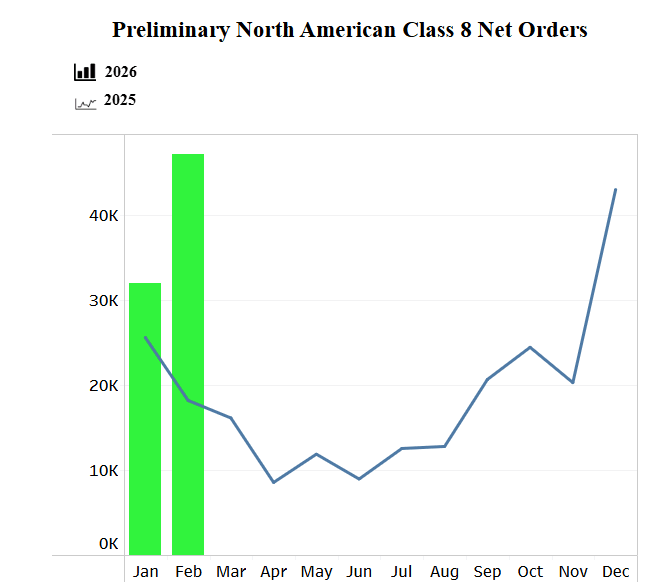
For the current order season -- spanning September 2025 through February 2026 -- Class 8 orders are now up 4% year over year.
FTR & Associates
“February’s very solid year-over-year increase in net orders extended the firmer tone that has been building since late last year,” Moyer said. “Freight volumes and utilization are trending higher, and FTR’s rate forecasts have strengthened.”
He noted that some orders still reflect deferred replacement purchases returning to the market, but the consistency and breadth of recent demand suggest that improving freight conditions are now playing a larger role.
Moyer added that greater clarity around tariff-adjusted pricing and upcoming EPA 2027 NOx regulations is also helping reduce policy uncertainty, allowing fleets to move ahead with capital spending plans.
As a result, order patterns increasingly reflect structured fleet replacement cycles and longer-term planning, rather than short-term catch-up buying.
Risks Remain
Despite the strong order performance, FTR cautioned that several risks could still affect the pace of recovery.
These include the durability of the freight rebound, persistently high financing costs, potential changes in tariffs or regulations and geopolitical uncertainty — including the new conflict in the Middle East.
Still, the continued strength in recent orders suggests that underlying demand is firming as 2026 progresses.
FTR cautioned that its February figures are preliminary. They man when the company releases its final order data later this month as part of its North American Commercial Truck & Trailer Outlook service.
More Equipment

ZF Expands Commercial Vehicle Push in North America
ZF is expanding its North American commercial-vehicle presence with new transmission applications, electrification, trailer technology and autonomous-driving systems.
Read More →
Tesla Wants a Self-Driving Semi. Are Cameras Enough?
Could Tesla’s camera-only autonomous driving technology work on an 80,000-pound Semi? In this commentary, HDT's Deborah Lockridge takes a look at Tesla, Cybercab, and how autonomous trucks see the road.
Read More →
Kodiak: Driverless Long-Haul Truck Launch on Track for 2026
Kodiak AI says its driverless long-haul safety case is 93% complete and it remains on track to begin commercial operations by year-end 2026.
Read More →
What DOT’s Automated Vehicle Strategy Means for Trucking
The U.S. Department of Transportation issued a new automated-vehicle strategy that outlines plans for driverless-truck regulations, cross-state freight corridors, and federal safety standards.
Read More →
East Coast Port Launches $45M Electric Truck Push
The Port Authority of New York and New Jersey announced millions in incentives for zero-emission drayage trucks, yard tractors, and new charging hubs near the port.
Read More →
PlusAI Going Public to Fund Autonomous Truck Launch
A SPAC deal could provide PlusAI with up to $300 million as it works toward a 2027 commercial launch of factory-built autonomous trucks.
Read More →
NHTSA Moves to Rewrite Truck Fuel-Economy Rules
The National Highway Traffic Safety Administration says it lacks authority to regulate medium- and heavy-duty truck engines separately from complete vehicles, but the existing standards have not yet been eliminated.
Read More →
Detroit Opens Orders for EPA 2027 Engines
Detroit isn’t starting from scratch to meet EPA 2027 diesel emissions standards. Its Gen 6 DD13 and DD15 engines keep much of today’s platform while updating the fuel and aftertreatment systems.
Read More →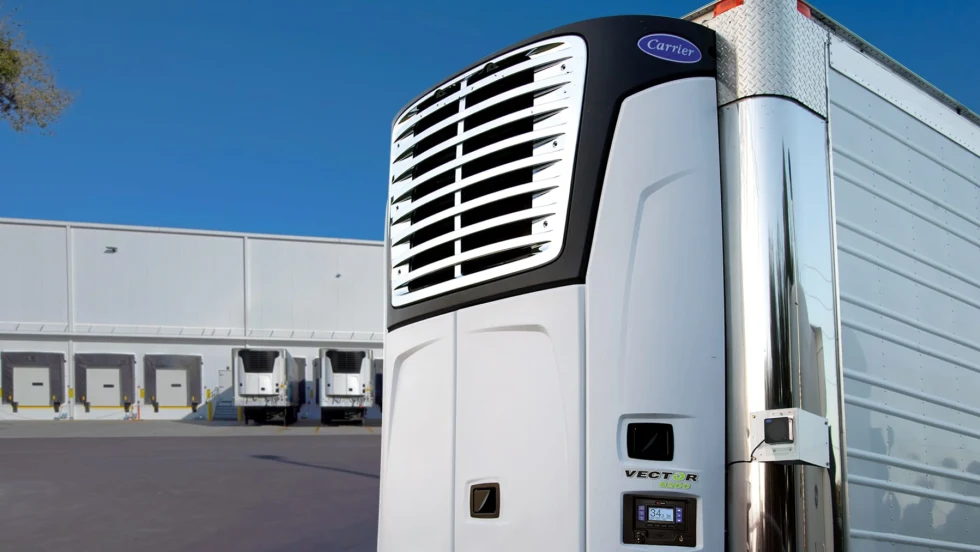
Carrier Transicold Adds All-Electric TRU for Stationary Cold Storage
Carrier Transicold’s new Vector 8200 all-electric transport refrigeration unit gives fleets a diesel-free option for temporary refrigerated and frozen trailer storage.
Read More →
A Closer Look at Kenworth’s Electric T880E Vocational Truck [Video]
Learn more about Kenworth's T880E battery-electric vocational truck at the Paccar Technical Center, including its range, applications, upfitting considerations, and PTO options, in this HDT Spotlight video.
Read More →