




Fleetio Benchmark Report: Aging Vehicles, Rising Costs Strain Fleet Maintenance
Fleetio’s analysis of 1.2 million commercial vehicles finds older assets driving outsized service spend, while most fleets remain cautious on AI adoption.

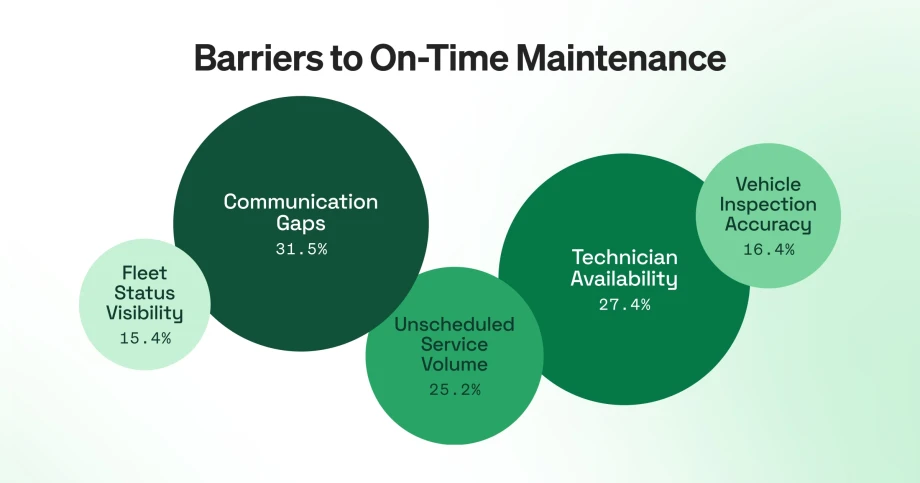
Fleetio;s latest Fleet Benchmark Report found that many fleets see room for improvement in maintenance execution, particularly around coordination and capacity planning.
Fleetio
Fleetio has released its 2026 Fleet Benchmark Report & State of Fleet Management. The report paints a clear picture of the pressures facing today’s fleet managers. These include rising costs, aging equipment, technician shortages and growing regulatory complexity. And these trends are occurring while carriers search for ways to cut downtime and control maintenance spend.
Now in its third year, the benchmark report aggregates anonymized data from 1.2 million vehicles covering 17.5 billion miles, $7 billion in service spend and 9 million work orders.
Fleetio supplemented the data with survey feedback from more than 600 fleet professionals across multiple industries.
The result is a broad snapshot of how fleets are operating -- and where they’re feeling the strain.
Rising Costs Top Fleet Concerns
When asked about their biggest challenges, fleet leaders cited cost pressures first and foremost. More than half of respondents (54.4%) pointed to rising costs as their top concern.
Regulations and emissions mandates followed at 46.1%, while 35.1% cited the transition to electric vehicles and supporting infrastructure. Technician shortages (32.5%) and parts and vehicle availability (28.9%) rounded out the list.
Taken together, the responses reflect a maintenance environment where fleets are juggling higher operating costs and tighter labor and supply constraints -- often at the same time.
Older Vehicles Driving Disproportionate Spend
One of the report’s clearest findings centers on vehicle age and its impact on maintenance budgets.
Vehicles more than 10 years old account for approximately 12.1% of total miles logged in the dataset — but consume roughly 33.5% of total service spend.
Fleetio estimates service costs average about $0.20 per mile for vehicles between zero and five years old, compared to $1.10 per mile for vehicles more than 10 years old.
That doesn’t necessarily mean older assets are a bad investment. Fleetio notes that when properly maintained, older vehicles can still make financial sense thanks to slower depreciation and deferred acquisition costs. But without tight maintenance controls, aging equipment can quickly drain budgets.
For fleet managers operating in a high-interest-rate environment, the data underscores the need for more strategic lifecycle planning. This is especially true as acquisition costs remain elevated.
Maintenance Bottlenecks Persist
The report also highlights operational friction points that can delay service and extend downtime.
Respondents cited communication gaps (31.5%), technician availability (27.4%), and unscheduled service volume (25.2%) as the leading reasons maintenance falls behind schedule.
Fleetio’s internal data shows a median time-to-start for work orders of 31 minutes, but an average of 6.7 days. This indicates that while some jobs move quickly, others linger in the queue, the company said. Those delays translate directly into asset downtime and lost productivity.
Despite these challenges, 44.3% of fleets said they perform on-time maintenance “reasonably well.” Only 9.7% reported true consistency as a clear strength.
Fleetio found that many fleets see room for improvement in maintenance execution, particularly around coordination and capacity planning.
AI Adoption Still in Early Stages
Artificial intelligence is another area where fleets are testing the waters but not diving in fully, according to the report.
Fleetio found that 53.3% of respondents said they are researching or piloting AI capabilities.
However, just 5.6% report using AI broadly across their operations.
Half of respondents cited concerns about accuracy and reliability as their primary hesitation around adoption.
That cautious approach mirrors what many fleet technology providers are seeing across the industry. There is strong interest in predictive analytics, automation and AI-driven insights, but a desire for proven, dependable tools before committing at scale.
A Data-Driven View of Fleet Operations
Fleetio positions the benchmark report as a tool to help fleets make focused, data-backed improvements.
By combining large-scale operational data with practitioner feedback, the report aims to provide context for decision-making. This includes asset replacement timing, maintenance workflows, and technology investments.
Fleetio will host a webinar panel on March 5, 2026, featuring survey respondents to discuss additional findings and outline practical steps fleets can take to strengthen operations using the data.
The full 2026 Fleet Benchmark Report & State of Fleet Management is available at fleetio.com.
More Maintenance

Wrong Repair Prompts Recall of Freightliner, Western Star 4x2 Trucks
DTNA is recalling 2,404 trucks that received an incompatible software fix instead of the hardware repair required to address brake valve corrosion.
Read More →
Truck Drivers Need More Than Another Alert
Fleets have more visibility into truck health, safety events, and driver activity than ever. The next challenge is turning all that information into useful guidance for the person who has to decide what to do next.
Read More →
The Maintenance Checks Trucking Fleets Should Prioritize Before Fall Freight Picks Up
Making it through August isn’t the same as being ready for the next several months of operation. Find out what systems may have suffered from summer heat and need to be checked out before fall.
Read More →
What Three Fleets Are Doing Differently When Buying Truck Parts in 2026
With freight improving but costs still climbing, fleet maintenance executives explain how they're balancing price, quality, and supplier relationships.
Read More →
Paccar Recalls 2027 Trucks Built This Summer for Possible Electrical Problem
The nearly 6,000 Kenworth and Peterbilt trucks in the recall could potentially lose engine power, among other things.
Read More →
Will API PC-12 Oil Change Trucking Fleet Maintenance?
The new API PC-12 heavy-duty engine oil category reflects the changing demands of modern diesel engines. But fleets like Foodliner are looking to getting their own data before making decisions on adopting the new oils and questions such as extending oil drain intervals.
Read More →
Brake Safety Week to Focus on Drums and Rotors
Commercial vehicle inspectors are focusing on truck brakes during CVSA's Brake Safety Week, August 23-29.
Read More →Possible Battery-Cable Fires Prompt Recall of 15,000+ International MV and HV Trucks
On the recalled vehicles, manufacturing variations can cause the battery interconnect cable to contact the auxiliary stud and hold down the bracket.
Read More →
Rush, MCT Team Up to Grow Refrigeration Service Network
The joint venture will operate MCT's network of Carrier Transicold dealerships and mobile service locations, with the companies promising greater service capacity and uptime for refrigerated fleets.
Read More →
ConMet Expands Aftermarket Brake Drum Lineup With TruCast
A new heavy-duty truck brake drum option in the aftermarket gives customers more flexibility within the ConMet product family.
Read More →