




FTR: Trucking Conditions Hit Four-Year High as Rates and Capacity Tighten
Improving freight rates and tighter capacity push FTR’s Trucking Conditions Index to its highest level in nearly four years.


FTR and Associates
Improving freight rates and tighter capacity push FTR’s Trucking Conditions Index to its highest level in nearly four years.
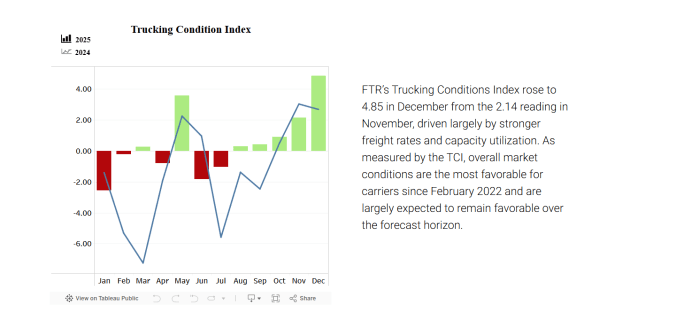
FTR’s Trucking Conditions Index (TCI) surged in December to its strongest reading in nearly four years, signaling the most favorable operating environment for carriers since early 2022.
The TCI jumped to 4.85 in December, up sharply from 2.14 in November, driven primarily by improving freight rates and stronger capacity utilization.
According to FTR, overall market conditions are now firmly positive for carriers and are expected to remain supportive through the forecast horizon.
Consistently Favorable Economic Conditions
“The TCI already indicated consistently favorable conditions for trucking companies over the next couple of years, but the latest outlook is even stronger,” said Avery Vise, FTR vice president of trucking. “FTR’s forecasts for the economy and for industrial activity improved significantly in the latest adjustment.”
FTR & Associates
Vise cautioned that some of the economic data underpinning the improved outlook is relatively recent and subject to revision. Even so, he said multiple independent indicators are reinforcing the more optimistic view of the truck freight market.
Among those signals are sharp spot rate increases following recent bouts of severe winter weather, as well as a solid January manufacturing index reading from the Institute for Supply Management.
While FTR is not forecasting a return to the extreme market conditions seen in 2021, Vise noted that a market approaching that level of strength is no longer out of the question.
“FTR is not forecasting anything like the 2021 market,” Vise said, “but something close to it no longer seems inconceivable.”
Tracking Five Key Industry Variables
The Trucking Conditions Index is designed to provide a broad, forward-looking snapshot of the industry’s health. It does so by tracking five key variables: freight volumes, freight rates, fleet capacity, fuel prices, and financing costs.
Those factors are combined into a single index number, with positive readings indicating favorable conditions for carriers and negative readings pointing to a more challenging environment.
Readings near zero reflect neutral conditions, while double-digit values in either direction suggest significant shifts in the operating landscape.
Additional detail on December’s TCI reading and the factors behind FTR’s revised freight outlook are included in the February issue of FTR’s Trucking Update, published Jan. 30. The report includes analysis of load volumes, capacity trends, rates, and broader economic conditions shaping the U.S. truck freight market.
More Fleet Management

Color Match Smarter: Tools That Restore & Perform
For fleet managers and collision repair professionals keeping heavy-duty trucks on the road, getting the color right the first time isn't just about appearance — it's about efficiency, turnaround time, and bottom-line results. Discover how today's digital color tools are transforming the repair process from guesswork to precision.
Read More →
FMCSA Pauses Biennial-Update Enforcement Amid Motus Transition
Carriers whose updates were due on or after June 1 have more time, while FMCSA works to stabilize its new registration system and warns of phishing sites impersonating its new carrier registration system, Motus.
Read More →
2026 Blueprint for Countering Smarter Supply Chain Theft
Cargo theft is no longer just the cost of doing business. It's a multi-billion-dollar criminal enterprise exploiting vulnerabilities across your fleet, drivers, and supply chain.
Read More →


How Telematics Improves Visibility, Control, and Performance in Refrigerated Fleets
Explore how telematics help refrigerated fleets improve visibility, uptime, efficiency, compliance, and cargo protection across connected cold chain operations.
Read More →
What the U.S.-Canada Trade War Means for Trucking
Escalating U.S.-Canada tariffs could disrupt cross-border freight, reduce truck volumes, raise costs, and create new uncertainty for carriers on both sides of the border.
Read More →
What Are Trucking’s Top Concerns for 2026?
The American Transportation Research Institute wants to know what's worrying trucking fleet managers, drivers, and other stakeholders in its annual Industry Issues survey.
Read More →
American Trucking Associations Looks for a New Leader
ATA President and CEO Chris Spear abruptly left his job at the association on August 21, at a pivotal time for the trucking industry.
Read More →
Public Wi-Fi Cybersecurity Risks: How Truck Drivers and Fleets Can Protect Their Data
Public Wi-Fi can expose truck drivers and fleets to credential theft, malware, and other cyber threats. Here’s how to reduce the risk on the road.
Read More →
For Nicky Cupp, Fleet Innovation Starts With Frustration
HDT Truck Fleet Innovator Nicky Cupp turns everyday pain points at Fraley & Schilling into opportunities for better technology and smarter processes.
Read More →
Adam Buttgenbach’s Approach to Electric Trucks: Start With Where They Fit
HDT Truck Fleet Innovator Adam Buttgenbach helped PepsiCo build one of North America’s largest EV fleets by focusing on where electric trucks make operational sense.
Read More →