




Cargo Theft Incidents Fall in Q1, but Organized Crime and Impersonation Drive New Risks
CargoNet reports fewer supply chain crime events to start 2026. But losses hold steady as organized crime shifts tactics toward impersonation schemes and high-value goods.

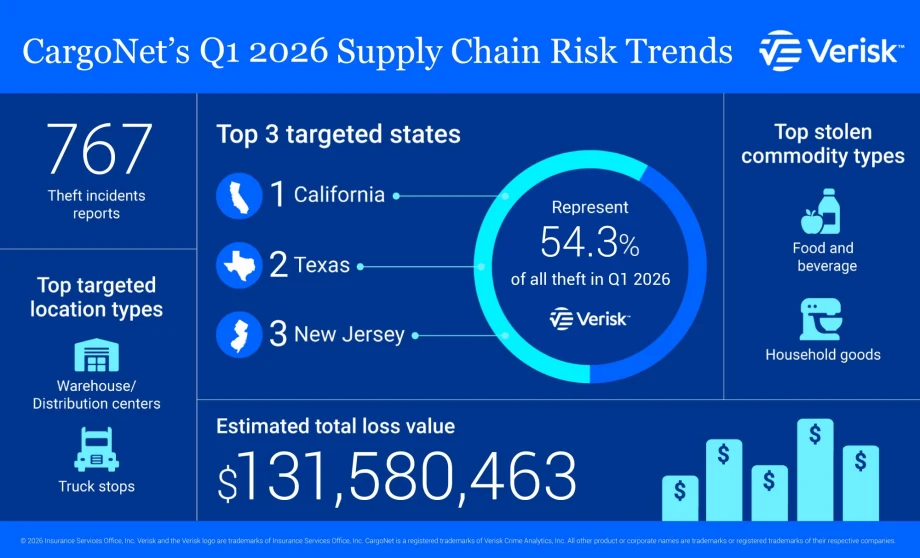
According to CargoNet, opportunistic theft cargo may be declining. But more targeted and verifiable crimes are becoming a larger share of criminal activity.
CargoNet
Cargo theft and supply chain crime incidents across the U.S. and Canada dipped in the first quarter of 2026. But the threat environment is evolving in ways that should concern fleets and logistics providers.
That’s according to Verisk CargoNet, which just released results from its review of the first quarter of 2026.
CargoNet recorded 767 supply chain crime events in Q1. The company said that is a 5.3% decrease from the same period a year ago and a 12.2% drop from the previous quarter.
Despite the decline in overall incidents, estimated losses totaled $131.58 million --essentially flat year over year.
At the same time, confirmed cargo theft reports increased, rising by 41 incidents to 596 cases.
CargoNet said the data suggests that while opportunistic theft may be declining, more targeted crimes are becoming a larger share of activity.
Geographic Shift Reflects Organized Crime Influence
CargoNet’s analysis points to a clear geographic and structural shift in cargo theft activity, with organized crime groups playing a larger role.
California and New Jersey stood out as major growth areas. California incidents rose from 255 to 277, while New Jersey more than doubled from 27 to 59 incidents -- a 119% increase. Both states offer dense freight infrastructure and proximity to major consumer markets, making them attractive for organized theft operations.
Meanwhile, traditionally high-activity states tied to opportunistic theft saw declines. Texas, for example, dropped from 102 incidents to 80, particularly in major freight corridors like Dallas–Fort Worth and Houston.
The shift suggests domestic, opportunistic theft activity is giving way to more coordinated operations concentrated in key logistics hubs.
Targeted Commodities Replace Opportunistic Hauls
The types of freight being stolen are changing alongside the actors behind the crimes.
Personal care and beauty products saw the sharpest increase, jumping 178% year over year from 18 to 50 incidents, driven largely by cosmetic and fragrance thefts in the Northeast. These products are easy to resell through online marketplaces, making them attractive targets.
Food and beverage remained the top category overall with 144 incidents, though the mix changed. Beverage theft declined while seafood theft rose sharply.
At the same time, traditionally targeted categories such as building materials, apparel, and vehicle-related shipments all declined. These goods tend to be bulkier, less standardized, or harder to quickly resell at scale -- factors that make them less appealing to organized networks.
Impersonation Schemes Become Dominant Tactic
The most significant development in Q1 may be the rapid evolution of impersonation-based cargo theft.
CargoNet reports that criminal networks are increasingly impersonating legitimate carriers and brokers using two primary methods: credential theft and outright acquisition of trucking companies.
Credential harvesting involves phishing attacks and malware designed to compromise business email accounts, phone systems, and load board or brokerage platforms. Once inside, criminals can pose as legitimate carriers, accept loads, and redirect shipments under trusted identities.
In parallel, some groups are purchasing legitimate motor carriers through online marketplaces and brokerage services. These acquisitions allow criminals to operate under valid authorities, making detection more difficult.
According to CargoNet, the rise in impersonation schemes is partly a response to improved anti-fraud controls at the load tender stage.
“The anti-fraud tools the industry has deployed are working—they’re forcing criminals to invest more in elaborate schemes,” said Keith Lewis, vice president of operations at Verisk CargoNet.
However, he warned that focusing solely on tender-stage verification is no longer sufficient. Instead, the industry needs identity verification measures that extend across the full shipment lifecycle, from booking through final delivery.
Outlook: Organized, Tech-Enabled Theft will Persist
CargoNet expects impersonation-based fraud and the exploitation of legitimate carrier identities to remain central to cargo theft activity in the coming quarters.
Organized crime groups are likely to continue focusing on high-value, easily redistributed goods while concentrating operations in major logistics hubs that enable fast movement and resale.
For fleets, brokers, and shippers, the takeaway is clear: fewer theft incidents do not mean lower risk. The threat is becoming more sophisticated and harder to detect.
More Fleet Management

Geotab Links Fleet Card to Vehicle Data
The new card combines fuel discounts with telematics-based purchase controls. Geotab’s analysis also points to potential savings from choosing lower-priced fuel stops.
Read More →
How MFA Helps Protect Trucking Fleets
Multi-factor authentication adds protection when passwords are stolen. Here’s how it works and where fleets should start.
Read More →
How Better Freight Data Helps Trucking Teams Get Ahead of Disruption
Trucking and logistics teams have plenty of data. The problem is getting the right information in front of the right people soon enough to act. Better-connected data can help teams spot trouble earlier and make smarter decisions before small problems become big ones.
Read More →

Trimble: Taking Artificial Intelligence in Trucking Beyond Faster Tasks
At Insight 2026, Trimble executives argued that fleets may need to redesign workflows to get more from AI as it introduced new products and enhancements. AI’s value will depend on how fleets combine automation with their people's knowledge.
Read More →
Build a bulletproof fleet: Uniting ELDs and dash cams for total compliance
An ELD can prove compliance, but it cannot always prove what happened on the road. Discover how uniting accurate ELD data with AI-powered dash cam video can help your fleet strengthen compliance, defend against liability, protect drivers and reduce operational costs.
Read More →
Nominations Open for HDT Emerging Leaders
Heavy Duty Trucking is looking for accomplished trucking fleet professionals under 40 who are making an impact and helping lead the industry forward.
Read More →
Why Private Fleets Are Taking More Freight
Private fleets are putting their own trucks on demanding customers and high-cost lanes as companies seek greater control over service, costs, and capacity.
Read More →
Color Match Smarter: Tools That Restore & Perform
For fleet managers and collision repair professionals keeping heavy-duty trucks on the road, getting the color right the first time isn't just about appearance — it's about efficiency, turnaround time, and bottom-line results. Discover how today's digital color tools are transforming the repair process from guesswork to precision.
Read More →
FMCSA Pauses Biennial-Update Enforcement Amid Motus Transition
Carriers whose updates were due on or after June 1 have more time, while FMCSA works to stabilize its new registration system and warns of phishing sites impersonating its new carrier registration system, Motus.
Read More →
2026 Blueprint for Countering Smarter Supply Chain Theft
Cargo theft is no longer just the cost of doing business. It's a multi-billion-dollar criminal enterprise exploiting vulnerabilities across your fleet, drivers, and supply chain.
Read More →