




Truckload Rates Hit Two-Year Highs as Diesel Costs Surge, DAT Says
Strong March freight demand combined with a spike in fuel costs pushed both spot and contract truckload rates to their highest levels in more than two years.

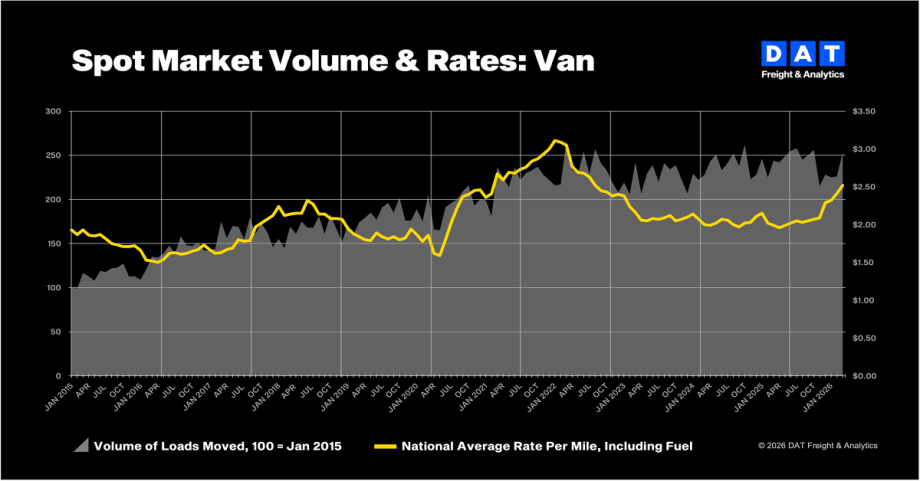
DAT reported that its Truckload Volume Index for March reflects strong, early-season freight demand.
DAT Freight & Analytics
Truckload freight volumes climbed across all major equipment types in March. However, while sharply higher diesel costs drove spot and contract rates to multi-year highs, according to DAT Freight & Analytics.
The DAT Truckload Volume Index (TVI) rose month over month, reflecting strong early-season demand tied to retail restocking, produce harvests, and construction activity.
- Van TVI: 253, up 12% from February
- Reefer TVI: 196, up 7%
- Flatbed TVI: 314, up 18%
Spot Pricing: Fuel Drives Freight Rates Higher
National average spot rates increased across all equipment types in March, largely due to fuel cost recovery rather than underlying pricing strength.
- Van: $2.52 per mile, up 11 cents
- Reefer: $2.97 per mile, up 9 cents
- Flatbed: $3.09 per mile, up 37 cents
Year over year, gains were even more pronounced, with van rates up 53 cents, reefer up 70 cents, and flatbed up 56 cents compared to March 2025.
Despite higher all-in rates, linehaul pricing -- the portion excluding fuel -- told a more nuanced story. Van and reefer linehaul rates declined month over month by 9 cents and 13 cents, respectively, while flatbed rose 13 cents.
“Linehaul rates were still under pressure through most of March, which tells you demand hasn’t fully caught up yet,” said Ken Adamo, DAT chief of analytics.
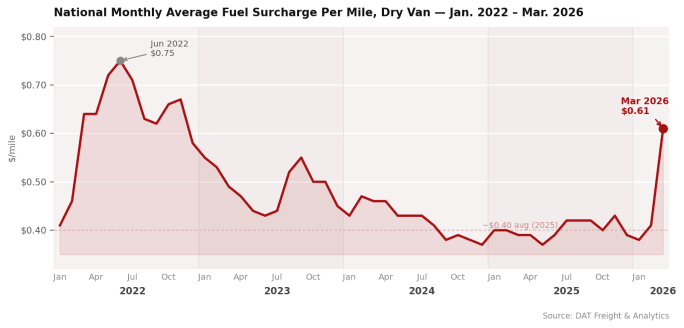
Fuel surcharges surged significantly, tightening carrier margins. The average van fuel surcharge jumped from 41 cents to 61 cents per mile. Adamo said that is the highest since late 2022. Reefer climbed to 67 cents, and flatbed reached 73 cents per mile.
“For context, monthly average van fuel surcharges averaged around 40 cents per mile throughout most of 2025,” Adamo noted. “The March reading represents a 50% increase from that baseline.”
Contract Rates: Moving Higher with Fuel
DAT Freight & Analytics
Contract rates followed a similar upward trajectory, also driven largely by fuel dynamics.
- Van: $2.72 per mile, up 20 cents
- Reefer: $3.10 per mile, up 22 cents
- Flatbed: $3.43 per mile, up 30 cents
As the industry moves through bid season, pricing strategies are evolving in response to volatility.
“Right now, the smartest players are pricing contracts based on where they believe the market is going and being transparent about those assumptions, leaving room to adjust if conditions change,” Adamo said.
About the Truckload Volume Index
The DAT Truckload Volume Index measures monthly changes in loads with a pickup date during that month, using a January 2015 baseline of 100.
It is based on data from DAT RateView within the DAT iQ platform, which tracks rates paid on actual shipments. Benchmark spot rates reflect invoice data for hauls of 250 miles or more across the U.S. and Canada.
More Fleet Management

Geotab Links Fleet Card to Vehicle Data
The new card combines fuel discounts with telematics-based purchase controls. Geotab’s analysis also points to potential savings from choosing lower-priced fuel stops.
Read More →
How MFA Helps Protect Trucking Fleets
Multi-factor authentication adds protection when passwords are stolen. Here’s how it works and where fleets should start.
Read More →
How Better Freight Data Helps Trucking Teams Get Ahead of Disruption
Trucking and logistics teams have plenty of data. The problem is getting the right information in front of the right people soon enough to act. Better-connected data can help teams spot trouble earlier and make smarter decisions before small problems become big ones.
Read More →

Trimble: Taking Artificial Intelligence in Trucking Beyond Faster Tasks
At Insight 2026, Trimble executives argued that fleets may need to redesign workflows to get more from AI as it introduced new products and enhancements. AI’s value will depend on how fleets combine automation with their people's knowledge.
Read More →
Build a bulletproof fleet: Uniting ELDs and dash cams for total compliance
An ELD can prove compliance, but it cannot always prove what happened on the road. Discover how uniting accurate ELD data with AI-powered dash cam video can help your fleet strengthen compliance, defend against liability, protect drivers and reduce operational costs.
Read More →
Nominations Open for HDT Emerging Leaders
Heavy Duty Trucking is looking for accomplished trucking fleet professionals under 40 who are making an impact and helping lead the industry forward.
Read More →
Why Private Fleets Are Taking More Freight
Private fleets are putting their own trucks on demanding customers and high-cost lanes as companies seek greater control over service, costs, and capacity.
Read More →
Color Match Smarter: Tools That Restore & Perform
For fleet managers and collision repair professionals keeping heavy-duty trucks on the road, getting the color right the first time isn't just about appearance — it's about efficiency, turnaround time, and bottom-line results. Discover how today's digital color tools are transforming the repair process from guesswork to precision.
Read More →
FMCSA Pauses Biennial-Update Enforcement Amid Motus Transition
Carriers whose updates were due on or after June 1 have more time, while FMCSA works to stabilize its new registration system and warns of phishing sites impersonating its new carrier registration system, Motus.
Read More →
2026 Blueprint for Countering Smarter Supply Chain Theft
Cargo theft is no longer just the cost of doing business. It's a multi-billion-dollar criminal enterprise exploiting vulnerabilities across your fleet, drivers, and supply chain.
Read More →