





Is your fleet a fuel-economy champ? Heavy Duty Trucking is Searching for the Top Green Fleets of 2026
Diesel Prices Surge Toward Record Highs as Oil Price Volatility Intensifies
Prices jumped another 24 cents in a week, with California topping $7.50 and new data showing fleet fuel costs may already be at record levels.
April 7, 2026
Another sharp weekly increase pushed diesel prices closer to record levels, both at the pump and what fleets actually pay.
Credit:
HDT Graphic
3 min to read
- Diesel prices have increased by 24 cents in just one week, highlighting volatility in the oil market.
- In California, diesel prices have surpassed $7.50, marking some of the highest levels in the nation.
- New data suggests that fleet fuel expenses might have already reached record-setting figures.
*Summarized by AI
The average retail price of diesel rose to $5.643 per gallon as of April 6, according to the Department of Energy, up 24.2 cents from the previous week.
Prices are now just over $2 higher than a year ago and $1.582 above levels seen two years ago.
Average prices are nearing $6 per gallon in several regions, including New England and the Central Atlantic.
West Coast prices continue to be the highest in the country. California diesel prices jumped nearly 70 cents in two weeks to $7.567 per gallon.
The lowest prices were in the Midwest at $5.304 per gallon.
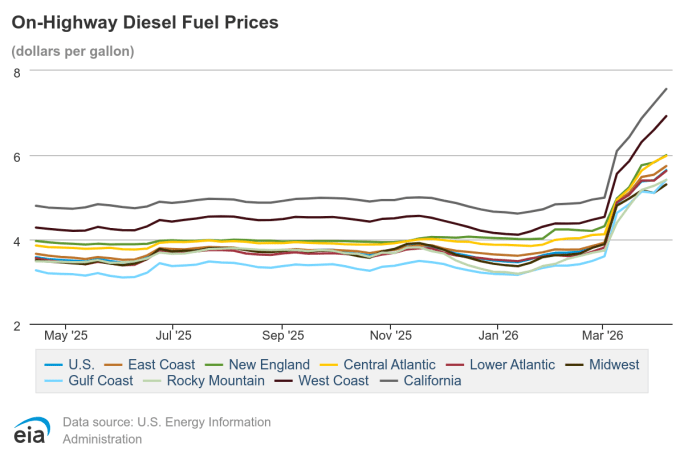
Diesel prices have been rising faster and farther than gasoline prices.
Credit:
U.S. Energy Information Administration
New Index Tracks What Fleets Actually Pay
A separate fuel index suggests diesel costs may already be exceeding 2022 peak levels, briefly surpassing the June 2022 energy-crisis high of $5.50 per gallon last week.
The new Samsara Fuel Spend Index uses the fleet technology provider’s transaction-level data to show what fleets are actually spending on fuel after negotiated rates, discounts, and surcharges.
(By comparison, Energy Information Administration data tracks the average retail price at the pump, including taxes.)
Samsara’s Weekly Fuel Market Briefing for the week of March 30 noted that diesel had surged to $5.31 per gallon, and that it had was up by 25% between March 9 and March 30.
“52.1% of the total diesel cost increase since Dec. 29 has been packed into just … three weeks,” wrote Samsara’s Kelly Soderlund.
And Samsara’s preliminary numbers for week 14 showed diesel hitting $5.59, surpassing its previous high of $5.50 per gallon in 2022.
The 2022 peak was a sharp supply-shock spike that reversed within weeks, Soderlund wrote, but that’s not expected to happen this time.
“The question is no longer where costs settle. It's how far past the 2022 record they go.”
Middle East Conflict Driving Oil Volatility
Driving all this are the volatile crude oil prices triggered by the war in the Middle East. Since the February 28 attack on Iran, virtually no traffic has been transiting through the Strait of Hormuz, through which about one-fifth of the world’s oil and natural gas flows.
Even though the U.S. in 2025 set a new record for crude oil production, driven by production in the Permian basin in West Texas, the Middle East Gulf was nevertheless the source for 8% of 2025 U.S. crude oil imports, according to the Department of Energy.
Much of the crude oil produced in the U.S. is exported. Most U.S. crude is “light sweet” crude, but most U.S. refineries were built to handle the heavier crude oil that is imported.
The DOE's Energy Information Administration reported that Brent crude futures rose from $61 per barrel at the start of the year to $118 by the end of the first quarter — the largest inflation-adjusted quarterly increase since 1988.
More Fuel Smarts

Wex Adds Cardless Fuel Payments for Over-the-Road Customers
A new fuel card feature for Wex customers offers convenience and security.
Read More →
New California Law Could Shed Light on Electric Truck Prices
Why do battery-electric Class 8 trucks remain so expensive? A California bill signed by Gov. Gavin Newsom would give fleets and state agencies more visibility into what manufacturers charge.
Read More →
How Volvo Updated Its D13 for EPA 2027 [Watch]
Volvo’s updated D13 promises lower emissions without sacrificing performance or fuel economy. Take a closer look at what changed inside the engine in this HDT Spotlight video.
Read More →

Diesel Price Spike Shortens Payback for Natural Gas Trucks, Report Says
Energy Vision estimates fleets could recover the higher purchase price of an RNG-fueled Class 8 tractor in 1.3 to 2.8 years under current fuel-price scenarios.
Read More →
Calstart Becomes Catalyst Mobility, Reflecting Broader Focus
Calstart is now Catalyst Mobility, reflecting the nonprofit’s growing national role in clean transportation, including zero-emission trucks, infrastructure and incentive programs.
Read More →
Record Diesel Prices Squeeze Trucking Fleets
Average U.S. diesel prices have climbed to nearly $6 a gallon, surpassing the 2022 record as tight refinery capacity and Middle East disruptions keep fuel costs elevated.
Read More →
Sponsored•September 9, 2026
How Fuel Delivery Shapes Engine Performance
Fuel delivery depends on more than what happens at the injector. For fleet, maintenance and technical professionals, looking at the full path from pump to injector can provide useful context for understanding engine performance.
Read More →
East Coast Port Launches $45M Electric Truck Push
The Port Authority of New York and New Jersey announced millions in incentives for zero-emission drayage trucks, yard tractors, and new charging hubs near the port.
Read More →
Detroit Opens Orders for EPA 2027 Engines
Detroit isn’t starting from scratch to meet EPA 2027 diesel emissions standards. Its Gen 6 DD13 and DD15 engines keep much of today’s platform while updating the fuel and aftertreatment systems.
Read More →
Zero-Emission Truck Corridor Planned for West Coast
California, Oregon, Washington, British Columbia and Baja California are coordinating plans for truck charging and hydrogen fueling from Canada to Mexico.
Read More →