





NACFE: Fleets Need to Recalibrate TCO Strategies as Electric Trucks Gain a Long-Term Edge
'TCO’s Here.' Tesla Says Electric Semi Economics Are Ready for the Mainstream
Tesla’s Semi chief at ACT Expo outlined production growth, lower-cost models, charging expansion, and why the company believes fleets are leaving money on the table by waiting on electric trucks.
May 7, 2026
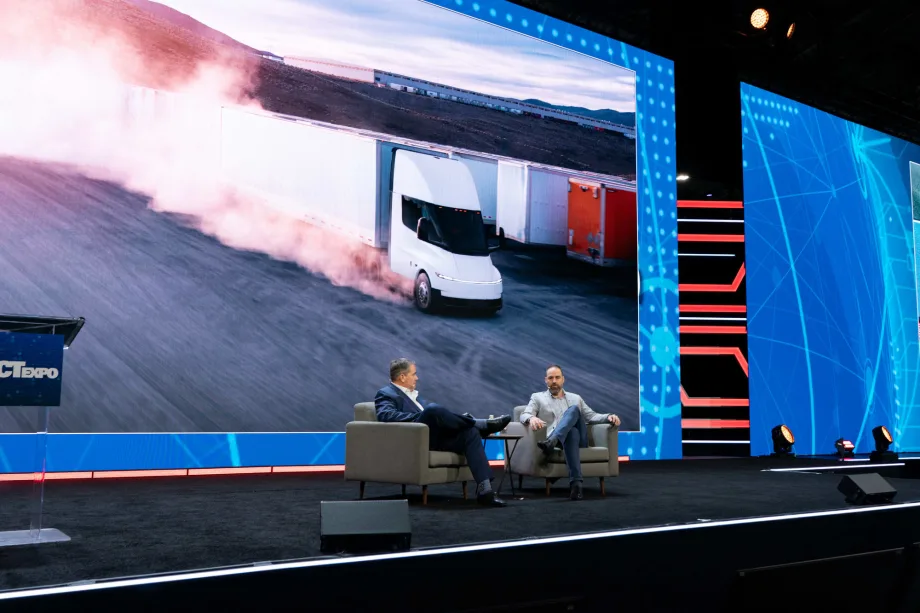
Tesla's Dan Priestley, right, shares an update on the Tesla Semi in an executive conversation with TRC's Eric Neandross.
Credit:
TRC/ACT Expo
7 min to read
- Tesla's Semi chief highlighted production growth and lower-cost models, signaling readiness for mainstream adoption.
- An expansion in charging infrastructure is integral to Tesla's strategy for supporting electric truck deployment.
- The company argues that fleets are missing financial benefits by delaying the transition to electric trucks.
*Summarized by AI
No EV funding? No problem! Tesla Semi chief Dan Priestley believes the company’s heavy-duty battery-electric truck can prove itself through total cost of ownership, even in parts of the country that don’t offer funding incentives for zero-emission vehicles.
That was a large part of the message he shared with the audience at ACT Expo in Las Vegas May 6, in an “executive dialogue” session with ACT Expo’s Eric Neandross.
This is the third year Priestley, director of Semi Truck engineering, has spoken at the show. Last year, in a keynote session, he told the crowd the company was building a 1.7-million-square-foot factory in Nevada with a capacity of 50,000 units a year. He reiterated Tesla’s commitment to scaling Semi production at its new Nevada factory, years after the truck’s much-publicized 2017 unveiling and repeated production delays.
This year, just a week before this year’s show, Tesla posted on social media that the first Semi had rolled off the high-volume production line at the new factory. But it’s unlikely it will be up to full-scale production this year.
First Semi off high volume line pic.twitter.com/fI1AdQrJFH
— Tesla Semi (@tesla_semi) April 29, 2026
Priestley called the new factory “awesome,” saying it implements lessons learned from Tesla’s other factories and is heavily vertically integrated. For customers, “less cost in the factory means less cost for the truck,” he said.
Asked about production for the rest of the year, Priestley said it was difficult to determine because “it’s a bit of an S-curve. So when you’re talking about a short time horizon, exact dates and quantities, it’s all about the area under the curve.”
Right now, he said, Tesla is focused on making sure the plant is truly ready for high-volume production – ironing out processes, balancing the lines and the stations, making sure the equipment is running optimally.
“Then it’s just ramp like hell.”
Tesla is targeting production in the thousands this year, Priestley said, adding that most of that output is already spoken for.
Considering there are fewer than 3,000 Class 7 and 8 electric trucks registered in the U.S. and Canada, according to Neandross, even that could easily double the registration numbers this year alone.
The day before at ACT Expo, WattEV announced an award for 370 Tesla Semis with delivery of the first 50 units scheduled for this year. And Tesla landed a 60-truck order from port drayage fleets in California through Forum Mobility.
“Our target is still about 50,000 a year,” Priestley said. “The TCO is there, and we see a good chance to realize that full factory capacity.”
So What About that TCO?
Asked about the importance of funding grants and incentives, Priestley said, they help fleets get started adding electric trucks to their fleet, and “they open the gate for their next truck. They might take advantage of incentives now … but for their next 100 or hundreds, that’s where they realize this works, I don’t need the incentives.
“We really see them as a big reduction of risk for the industry. We help customers get incentives, but that’s not what we built the business on the back of.”
Neandross said he has seen estimates that the cost to operate a Semi is about 25 cents per mile, compared to a diesel at about 80 cents per mile.
Priestley, however, pointed out that the actual cost per mile is going to be highly regional, as electricity prices vary by state and utilities.
But he did note that at the beginning of this year, before diesel prices spiked due to the Iran war, “more than half the country had a payback period of less than 5 years” for the Semi.
Higher diesel prices, of course, mean a faster payback. But he said the real value may be not in the immediate fuel savings, but in addressing the overall volatility of diesel prices.
“Moving to electric, you really remove or reduce that volatility in pricing,” he said.
Improvements in uptime have also helped improve the payback on a Tesla Semi. In 2025, Tesla’s fleet had 97% uptime, Priestley said. And when there was an incident, the service team was able to get the truck back in customer hands within 24 hours more than 90% of the time.
Updates to the Tesla Semi
Last year, Tesla showed a refreshed Semi design, with a reworked chassis, revised lighting, and aerodynamic improvements, which Priestley referred to as “a little facelift” in the ACT Expo session.
Many of the changes were sparked by feedback from its early customers. One big one? Side windows that actually roll or slide down rather than the small pop-out window in the previous version. Cupholders have been moved, and the side-view cameras have been repositioned for better visibility.
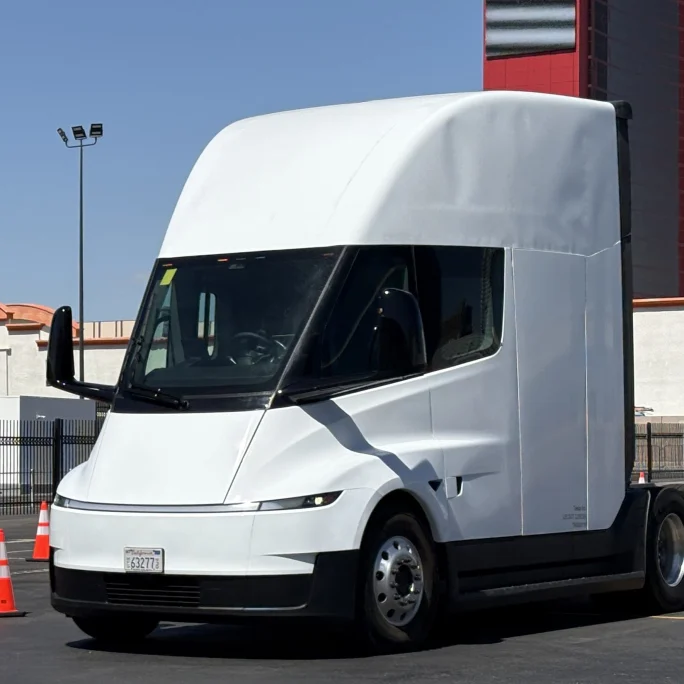
The new version of the Tesla Semi was featured in the ACT Expo ride-and-drive in Las Vegas in
Credit:
Deborah Lockridge
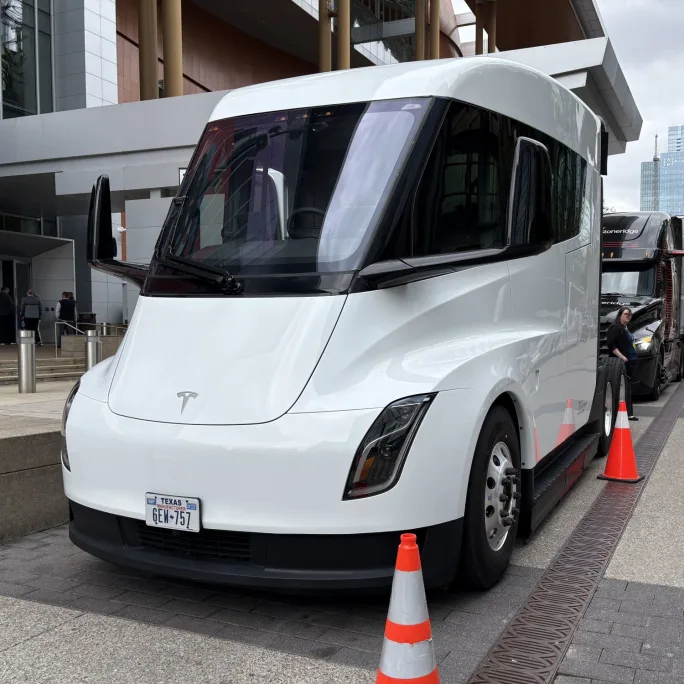
This is the previous version of the Tesla Semi, exhibited as recently as the Technology & Maintenance Council show in March.
Credit:
Deborah Lockridge
In February, Tesla published long-awaited official Tesla Semi specifications on its product page.
There are now two models available.
The one we’ve seen in pre-production form running with fleets such as PepsiCo the past couple of years are the Tesla Semi Long Range with a 500-mile range. There were long lines outside at the ride-and-drive to experience this model.
New is the Tesla Semi Standard Range, with a 325-mile range, which was on the ACT Expo show floor hooked up to an electric refrigerated trailer.
Both variants, according to Tesla’s website, feature 1.7 kWh per mile efficiency, 800 kW drive power, MCS 3.2 charging, and up to 1.2 MW fast charging.
Priestley said the new 325-mile version “is really going to be a jack of all trades for a lot of customers. It’s a drop-in replacement for diesel for a lot of local, drayage, and regional haul. It’s a highly capable truck.”
The standard range is also lighter, about 20,000 pounds tare weight not including the 2,000- pound weight exemption for battery-electric trucks. It can handle about a 48,000 pound payload with a traditional dry van application, he said, “and it’s a significant cost reduction from the long range as well.”
He predicted that the new standard range will make up a big part of the Tesla Semi volume when it gets introduced later this year.
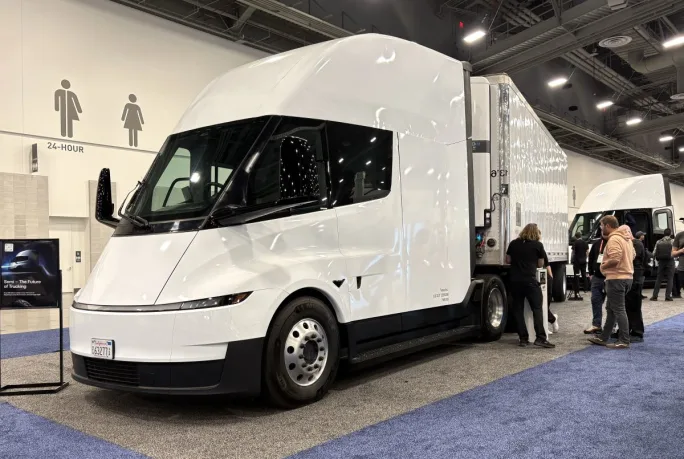
The new short-range version of the Tesla Semi was on display at ACT Expo with an electric refrigerated trailer and an ePTO
Credit:
Deborah Lockridge
Charging Options
Also part of making the Semi a better fit for fleet operations are new charging options. Tesla increased the power and speed of its Megacharger to 1.2 megawatts, but it also added a new version for fleets deploying charging infrastructure at facilities that takes up less space and is available at lower cost.
“We really saw the need for a lower cost [charger] that you could deploy in increments of one for overnight or off-shift charging. It’s available for $20,000, so that’s a great entry point. It could be you have just one truck, or it could be part of a mix of off-shift charging as well as the high-speed charging on site.”
But “behind the fence” charging is not enough, and Tesla has been pushing to build public charging stations, both on its own and in partnership with truckstop companies such as Pilot.
It has 50 stations in progress right now, with more than half to be open by the end of 2026, the first two in southern California this summer.
“We’re going to go where we need to go,” he said. “We have to make sure every truck that gets sold and delivered has a charging solution.”
“We understand the need for public charging,” Priestley said. “For some folks it will be their primary charging method. For others it’s a range extension. Or it’s something that will complement the charging they have at their home base. We really are leaning into it because we understand that it’s necessary for all parts of the industry.”
What’s Next for the Tesla Semi?
While the Tesla Semi so far has been deployed mostly in California, where funding incentives such as those from the state’s HVIP program help offset higher purchase costs of cleaner trucks, Priestley said Tesla has some big expansion plans in other states and even outside the U.S.
“We’re starting in regions with a large number of trucks as well as solid TCO because that’s where there’s a lot of demand,” Priestley said. California not only has been pushing zero-emission trucks, but for Tesla, what’s important is that it’s the largest truck market “and the economics are really strong.”
But “there are other parts of the country where TCO is really great too,” he said. The company sees a lot of growth opportunity in Texas, for instance, but also Georgia, New York, New Jersey, Illinois, and the Pacific Northwest. It’s planning to expand into Canada in 2027 and it’s looking to Europe as well.
“We’re starting where we have really strong demand signals, but as we ramp up, costs come down, it’s going to unlock more and more markets, and we’re going to go everywhere.”
Tesla’s newest versions of the Semi, he said, are lighter, cheaper, and have more capability on both the truck and on the charging side.
“And all of the downstream pieces are being deployed to support you in the field – that’s charging, that’s service… we have a whole ecosystem coming in a large way and at scale to make sure we can have an impact on the industry and the world.
“TCO’s here. It really is,” Priestley said. And for many applications, “every day your business is not running electric is a day you’re leaving money on the table.”
More Fuel Smarts

Wex Adds Cardless Fuel Payments for Over-the-Road Customers
A new fuel card feature for Wex customers offers convenience and security.
Read More →
New California Law Could Shed Light on Electric Truck Prices
Why do battery-electric Class 8 trucks remain so expensive? A California bill signed by Gov. Gavin Newsom would give fleets and state agencies more visibility into what manufacturers charge.
Read More →
How Volvo Updated Its D13 for EPA 2027 [Watch]
Volvo’s updated D13 promises lower emissions without sacrificing performance or fuel economy. Take a closer look at what changed inside the engine in this HDT Spotlight video.
Read More →

Diesel Price Spike Shortens Payback for Natural Gas Trucks, Report Says
Energy Vision estimates fleets could recover the higher purchase price of an RNG-fueled Class 8 tractor in 1.3 to 2.8 years under current fuel-price scenarios.
Read More →
Calstart Becomes Catalyst Mobility, Reflecting Broader Focus
Calstart is now Catalyst Mobility, reflecting the nonprofit’s growing national role in clean transportation, including zero-emission trucks, infrastructure and incentive programs.
Read More →
Record Diesel Prices Squeeze Trucking Fleets
Average U.S. diesel prices have climbed to nearly $6 a gallon, surpassing the 2022 record as tight refinery capacity and Middle East disruptions keep fuel costs elevated.
Read More →
Sponsored•September 9, 2026
How Fuel Delivery Shapes Engine Performance
Fuel delivery depends on more than what happens at the injector. For fleet, maintenance and technical professionals, looking at the full path from pump to injector can provide useful context for understanding engine performance.
Read More →
East Coast Port Launches $45M Electric Truck Push
The Port Authority of New York and New Jersey announced millions in incentives for zero-emission drayage trucks, yard tractors, and new charging hubs near the port.
Read More →
Detroit Opens Orders for EPA 2027 Engines
Detroit isn’t starting from scratch to meet EPA 2027 diesel emissions standards. Its Gen 6 DD13 and DD15 engines keep much of today’s platform while updating the fuel and aftertreatment systems.
Read More →
Zero-Emission Truck Corridor Planned for West Coast
California, Oregon, Washington, British Columbia and Baja California are coordinating plans for truck charging and hydrogen fueling from Canada to Mexico.
Read More →