New High-Horsepower Natural Gas Engine Could Expand Fleet Options
Westport and Volvo are demonstrating a 500-hp truck with diesel-like efficiency — one that also offers what Westport says is a better pathway to using hydrogen fuel in trucks.
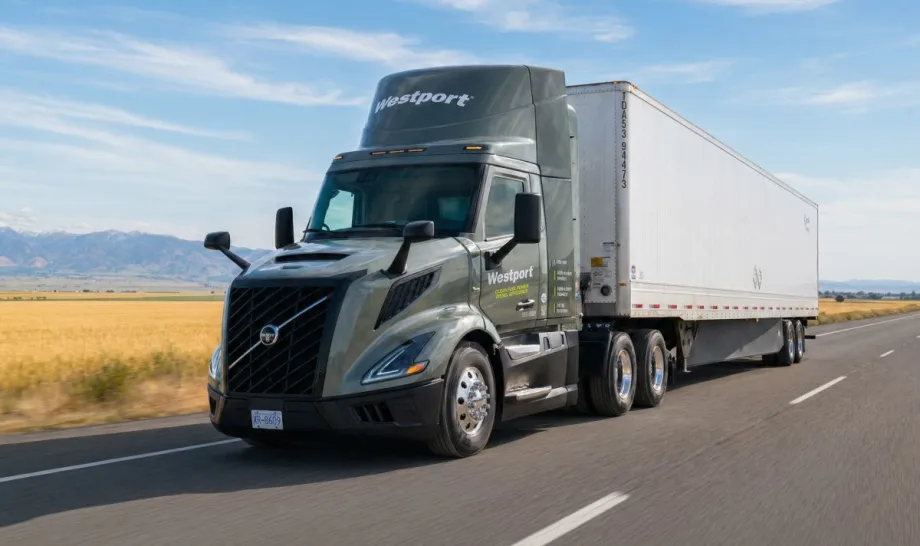
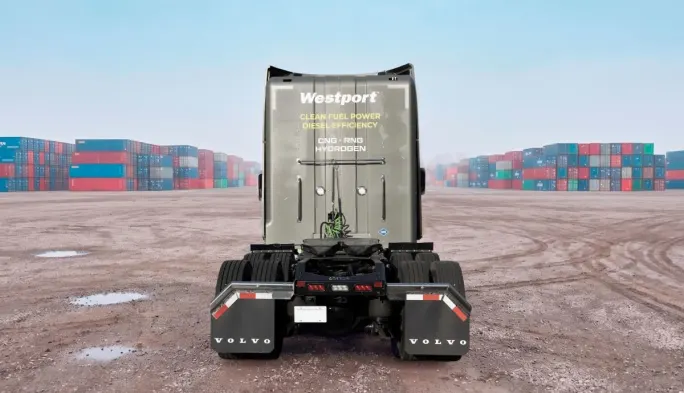
Westport is debuting its high-pressure CNG fuel system with Cespira HPDI technology on a Volvo VNL 300 at ACT Expo.
Credit:
Westport
3 min to read
Westport and Volvo introduced a high-performance truck engine capable of delivering 500 horsepower using natural gas.
The engine is designed to achieve fuel efficiency similar to diesel engines.
This development opens avenues for adapting the engine for hydrogen fuel.
*Summarized by AI
Another high-horsepower natural-gas engine system may soon be available from Westport and Volvo, with fuel efficiency comparable to diesel and the potential to run on hydrogen in the future.
At the Advanced Clean Transportation Expo in Las Vegas May 4-7, Westport is showcasing the first North American demo of its compressed natural gas storage system paired with Cespira’s on-engine HPDI fuel system.
Ad Loading...
Cespira is the joint venture between Volvo and Westport.
Why is HPDI Significant for Natural Gas Fuel Adoption?
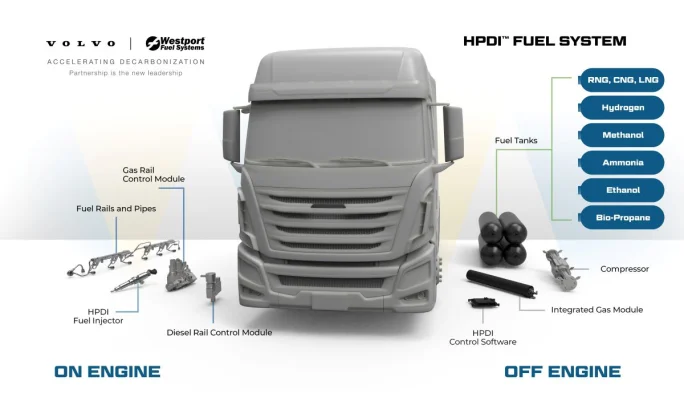
HPDI, High Pressure Direct Injection, is a technology where a small amount of ignition fuel is injected at high pressure to enable compression ignition before gaseous fuels such as natural gas or hydrogen are added. The components are designed to handle CNG as well as natural gas-hydrogen blends.
About Cespira
In 2023, Volvo Group and Westport Fuel Systems announced plans to team up to drive the adoption of Westport’s HPDI fuel system technology to help cut emissions using alternative fuels.
The joint venture closed in July 2024 and announced the new name, Cespira, in September 2024. The name combines "espira," meaning "breathe out," with C for "clean."
Cespira’s goal is to partner with multiple OEMs.
In contrast, current natural gas engines use spark ignition.
Ad Loading...
Westport's technology only requires changes to the HPDI injectors and the associated fuel system. No modifications are needed to the engine, transmission, or cooling system, and there are no changes to maintenance schedules.
With Cespira’s HPDI, fleets can achieve efficiency comparable to the latest generation of diesel trucks while running on CNG or renewable natural gas (RNG), according to the company — up to 10 mpg equivalent, with a driving range of more than 600 miles.
For the first time, Westport is showcasing the system in real‑world operation in a demonstration truck.
Credit:
Westport
The latest Westport system is installed on a latest-generation Volvo VNL 300 truck with 500 horsepower and 1,850 lb-ft of torque. Fuel efficiency on CNG is comparable to that of the VNL running on diesel fuel, according to the company.
Westport said in a news release that this marks “a critical step toward adoption of HPDI technology for the North American heavy‑duty market.”
Ad Loading...
It also noted that CNG prices are lower and more stable than fluctuating diesel prices.
More About the Technology
At ACT Expo, Westport will highlight the performance capabilities of its CNG system for heavy-duty commercial applications, including:
Lower emissions
Diesel performance and efficiency using CNG
Engine ratings of at least 500 horsepower and 1,850 lb-ft of torque
Up to 10 mpg equivalent, with a driving range of more than 600 miles
Maintenance schedules comparable to standard diesel engines
Westport’s CNG solution uses advanced high-pressure storage technology to maximize the performance that HPDI fuel systems are capable of. The fuel storage system maximizes usable fuel mass to extend driving range.
The high‑pressure (~700 bar) CNG platform is engineered for diesel combustion engines that require in‑cylinder, high‑pressure gaseous fuel injection, including engines equipped with Cespira’s HPDI fuel system.
While HPDI is commercially available in more than 30 countries, powering over 10,000 trucks worldwide using liquefied natural gas, North America’s preference for CNG has limited adoption in this market.
Westport’s new CNG fuel storage system removes that barrier, according to the company.
Ad Loading...
A New Pathway for Hydrogen
The HPDI engine can run on a variety of fuels, including natural gas, hydrogen, or a blend of both.
That means truck makers can integrate natural-gas HPDI in the near term and later leverage those HPDI engineering and manufacturing investments to extend the technology to other fuels.
Westport believes that the fuel adaptability of the HPDI on-engine fuel system will provide a more practical path for the use of hydrogen in heavy-duty transportation.
In HPDI, High Pressure Direct Injection, a small amount of ignition fuel is injected with high pressure to enable compression ignition before gaseous fuels such as natural gas or hydrogen are added.
Credit:
Westport
Unlike fuel cells, an engine equipped with the HPDI fuel system does not require hydrogen to be 99.999% pure, according to Westport. This means hydrogen for HPDI-equipped engines does not need a dedicated, super-clean distribution system and can avoid the high cost of liquefying hydrogen and transporting it in cryogenic trailers.
That also means trucking fleets could start running on low-cost CNG or renewable natural gas, Westport said, then introduce hydrogen as desired in the future. Hydrogen could be gradually adopted, initially as a blend with natural gas, then evolving to 100% hydrogen as the fuel becomes increasingly affordable.
ACT Research expects costs, charging infrastructure, and technology improvements to drive zero-emission commercial vehicle adoption as federal regulations and incentives retreat.
Why do battery-electric Class 8 trucks remain so expensive? A California bill signed by Gov. Gavin Newsom would give fleets and state agencies more visibility into what manufacturers charge.
Volvo’s updated D13 promises lower emissions without sacrificing performance or fuel economy. Take a closer look at what changed inside the engine in this HDT Spotlight video.
Energy Vision estimates fleets could recover the higher purchase price of an RNG-fueled Class 8 tractor in 1.3 to 2.8 years under current fuel-price scenarios.
Calstart is now Catalyst Mobility, reflecting the nonprofit’s growing national role in clean transportation, including zero-emission trucks, infrastructure and incentive programs.
Average U.S. diesel prices have climbed to nearly $6 a gallon, surpassing the 2022 record as tight refinery capacity and Middle East disruptions keep fuel costs elevated.
Fuel delivery depends on more than what happens at the injector. For fleet, maintenance and technical professionals, looking at the full path from pump to injector can provide useful context for understanding engine performance.
The Port Authority of New York and New Jersey announced millions in incentives for zero-emission drayage trucks, yard tractors, and new charging hubs near the port.
Detroit isn’t starting from scratch to meet EPA 2027 diesel emissions standards. Its Gen 6 DD13 and DD15 engines keep much of today’s platform while updating the fuel and aftertreatment systems.