





Toyota’s Entry Into Cellcentric Signals Push to Accelerate Hydrogen Truck Adoption
Volvo Testing Hydrogen-Fueled Internal Combustion Engines on Trucks in Europe
Hydrogen combustion engine trucks will be especially suitable over longer distances and in regions where there is limited charging infrastructure or time for recharging of battery-electric trucks, according to the company.
April 1, 2026
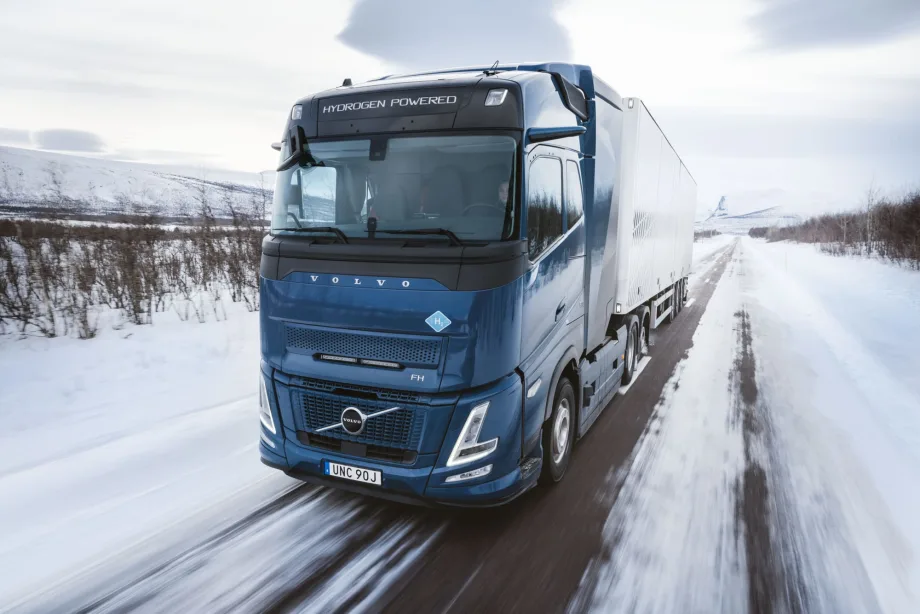
Volvo’s hydrogen-powered trucks are being developed to provide higher energy efficiency, lower fuel consumption and increased engine power compared to conventional hydrogen combustion engine technology.
Credit:
Volvo Trucks
2 min to read
Volvo has begun on-road testing of heavy-duty trucks powered by hydrogen-fueled internal combustion engines.
The company's advanced hydrogen engine technology is derived from its diesel powertrain, delivering diesel-like performance while substantially cutting CO2 emissions.
The commercial launch of Volvo’s hydrogen solution is planned in Europe before 2030.
Volvo’s hydrogen-powered trucks are being developed to provide higher energy efficiency, lower fuel consumption, and increased engine power compared to conventional hydrogen combustion engine technology, according to the company.
Why Are Volvo's Hydrogen Combustion Engines Different?
These trucks use High Pressure Direct Injection (HPDI), a technology where a small amount of ignition fuel is injected with high pressure to enable compression ignition before hydrogen is added.
Volvo is already using this technology in its natural-gas-powered trucks, with more than 10,000 units using HPDI sold globally.
“On-road testing is an important milestone for our hydrogen combustion engine trucks,” said Jan Hjelmgren, head of product management at Volvo Trucks, in a news release. “Customers will be able to operate them just like diesel trucks.
Hydrogen combustion engine trucks will be especially suitable over longer distances and in regions where there is limited charging infrastructure or time for recharging of battery-electric trucks, according to the company.
Volvo trucks with combustion engines powered by green hydrogen have the potential to deliver net-zero CO2 well-to-wheel when using renewable diesel as ignition fuel.
Volvo’s Multiple Paths to Decarbonization
This reflects Volvo Trucks’ three-path approach to decarbonization:
- Battery-electric trucks
- Fuel-cell electric trucks
- Trucks that run on renewable fuels such as biogas and renewable diesel
The hydrogen-powered combustion engine trucks will complement the company’s broader portfolio of solutions to support the transition to zero-tailpipe-emission transport across global markets.
Regulatory classifications and incentives for hydrogen-powered vehicles vary by region, including in North America. A large-scale deployment of hydrogen-powered trucks will require the rollout of hydrogen fuel infrastructure and a competitive price on hydrogen.
More Fuel Smarts

Fleet Economics Shape Electric Truck Outlook
ACT Research expects costs, charging infrastructure, and technology improvements to drive zero-emission commercial vehicle adoption as federal regulations and incentives retreat.
Read More →
Wex Adds Cardless Fuel Payments for Over-the-Road Customers
A new fuel card feature for Wex customers offers convenience and security.
Read More →
New California Law Could Shed Light on Electric Truck Prices
Why do battery-electric Class 8 trucks remain so expensive? A California bill signed by Gov. Gavin Newsom would give fleets and state agencies more visibility into what manufacturers charge.
Read More →

How Volvo Updated Its D13 for EPA 2027 [Watch]
Volvo’s updated D13 promises lower emissions without sacrificing performance or fuel economy. Take a closer look at what changed inside the engine in this HDT Spotlight video.
Read More →
Diesel Price Spike Shortens Payback for Natural Gas Trucks, Report Says
Energy Vision estimates fleets could recover the higher purchase price of an RNG-fueled Class 8 tractor in 1.3 to 2.8 years under current fuel-price scenarios.
Read More →
Calstart Becomes Catalyst Mobility, Reflecting Broader Focus
Calstart is now Catalyst Mobility, reflecting the nonprofit’s growing national role in clean transportation, including zero-emission trucks, infrastructure and incentive programs.
Read More →
Record Diesel Prices Squeeze Trucking Fleets
Average U.S. diesel prices have climbed to nearly $6 a gallon, surpassing the 2022 record as tight refinery capacity and Middle East disruptions keep fuel costs elevated.
Read More →
Sponsored•September 9, 2026
How Fuel Delivery Shapes Engine Performance
Fuel delivery depends on more than what happens at the injector. For fleet, maintenance and technical professionals, looking at the full path from pump to injector can provide useful context for understanding engine performance.
Read More →
East Coast Port Launches $45M Electric Truck Push
The Port Authority of New York and New Jersey announced millions in incentives for zero-emission drayage trucks, yard tractors, and new charging hubs near the port.
Read More →
Detroit Opens Orders for EPA 2027 Engines
Detroit isn’t starting from scratch to meet EPA 2027 diesel emissions standards. Its Gen 6 DD13 and DD15 engines keep much of today’s platform while updating the fuel and aftertreatment systems.
Read More →