




Toyota’s Entry Into Cellcentric Signals Push to Accelerate Hydrogen Truck Adoption
By joining Daimler Truck and Volvo, Toyota brings fuel cell expertise to a joint effort aimed at making hydrogen viable for heavy-duty transport.

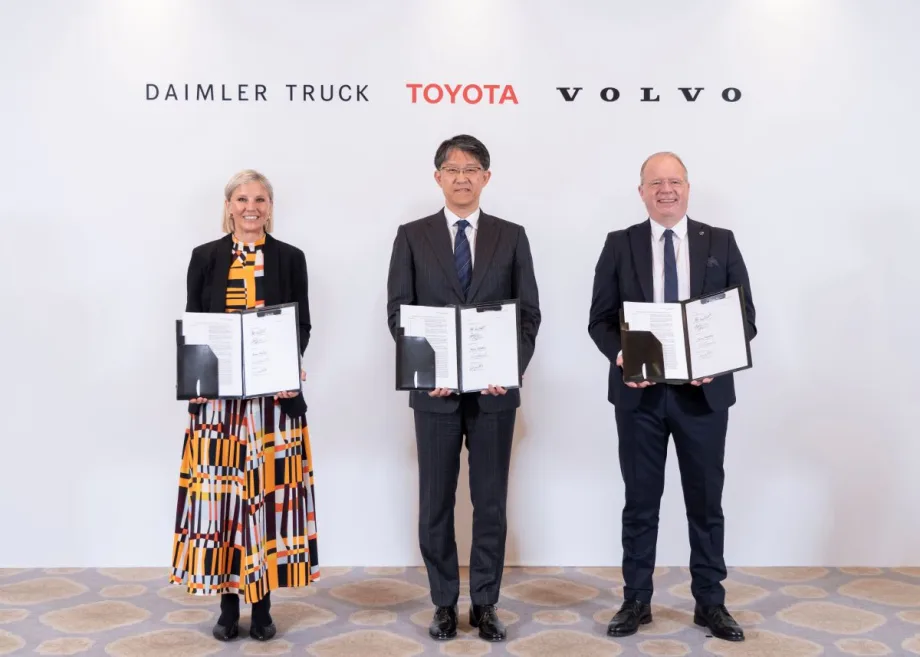
Left to right: Karin Rådström, President and CEO of Daimler Truck; Koji Sato, President of Toyota Motor Corporation; and Martin Lundstedt, President and CEO of Volvo Group, show off the memorandum of understanding.
Cellcentric
Toyota is preparing to join forces with Daimler Truck and Volvo Group in a move aimed at accelerating the development of hydrogen fuel cell technology for heavy-duty trucks.
The three global manufacturers have signed a non-binding memorandum of understanding that would make Toyota an equal partner in Cellcentric, the fuel cell joint venture Daimler Truck and Volvo launched in 2021.
If finalized, the deal would bring together Daimler and Volvo’s commercial-vehicle expertise with Toyota’s decades of fuel-cell development.
Together with like-minded partners, the parties intend to share technological developments and address common challenges, with the aim of achieving sustainable and effective implementation of fuel cell systems for heavy-duty applications.
The companies said this type of collaboration is critical to scaling hydrogen-powered transport.
Building Scale for Hydrogen
Cellcentric was created to develop and manufacture fuel cell systems for heavy-duty applications, including on- and off-road trucks. Bringing Toyota into the fold is intended to strengthen both the technology and the business case for hydrogen.
The companies say combining their capabilities will help them move faster toward commercialization, which remains a challenge for hydrogen trucking due to cost, infrastructure, and production hurdles.
Toyota, a long-time leader in fuel cell technology in passenger vehicles, would contribute its experience in fuel cell stack development and manufacturing. It would also work with Cellcentric on core components such as fuel cell unit cells and related systems architecture.
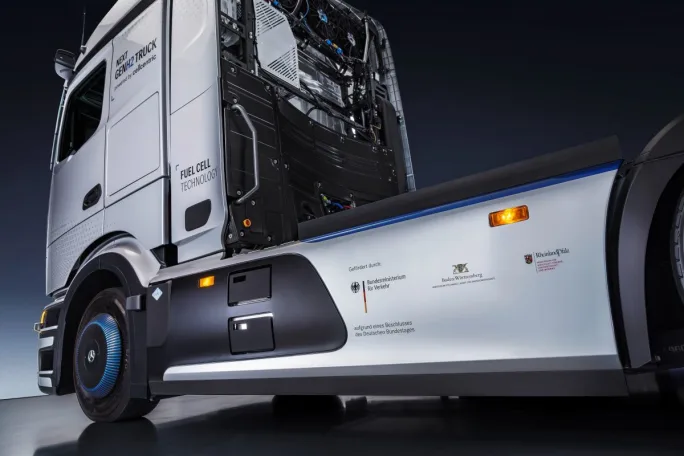
Earlier this year, Daimler Truck unveiled the Mercedes-Benz NextGenH2 Truck. In a small-series production run at the Mercedes-Benz plant in Wörth, Germany, 100 units will be manufactured and deployed with various customers starting near the end of 2026.
Daimler Truck
A Complement to Battery-Electric
For Daimler Truck and Volvo, trucks powered by hydrogen fuel cells are seen as complementary to battery-electric trucks. While batteries are expected to dominate shorter-haul applications, fuel cells are widely viewed as a solution for long-haul and high-load operations where range and refueling time are critical.
Karin Rådström, CEO of Daimler Truck, said adding Toyota would help scale hydrogen technology more quickly, noting it “complements battery-electric drives in decarbonizing transport.”
Volvo Group CEO Martin Lundstedt emphasized the importance of collaboration to "accelerate and create critical mass for hydrogen applications."
Bringing major players together sends a strong signal to the broader ecosystem, including suppliers and infrastructure developers, he pointed out.
Hydrogen Trucks in the U.S.
Momentum for hydrogen fuel cell trucks in the United States seems to have largely stalled with the exit of Nikola and Hyzon from the market early last year.
Hyundai, however, continues to work on bringing its fuel-cell-powered Xcient to the U.S. Last year introduced the newest version of its Xcient Fuel Cell Class 8 heavy-duty truck at the Advanced Clean Transportation Expo, as well as plans for a hydrogen production and dispensing facility in Georgia.
Last fall, it announced that its trailer and body subsidiary Hyundai Translead will serve as the official distributor of Hyundai’s Xcient Fuel Cell Trucks in North America.
It Takes More Than Trucks and Fuel Cells
Beyond product development, the Cellcentric partnership reflects a broader strategy: building out the hydrogen ecosystem itself.
The companies said they will work with partners across the hydrogen value chain to support the development of fueling infrastructure, which is an essential piece that lags behind vehicle technology.
That ecosystem approach has been a recurring theme in hydrogen discussions across the trucking industry, where lack of fueling availability remains one of the biggest barriers to adoption.
Hydrogen-fuel advocates around the world say policymakers need to act to make fueling infrastructure happen.
What Happens Next
The agreement is currently non-binding. The companies will continue negotiations toward a definitive deal, subject to regulatory approvals and board sign-offs.
If completed, Toyota would invest in Cellcentric through a capital increase, resulting in equal ownership among the three partners. The joint venture would remain an independent entity, supplying fuel cell systems to a broad range of customers, not just its parent companies.
The move underscores a growing consensus among truck manufacturers: No single company can shoulder the cost and complexity of developing hydrogen technology alone.
Koji, Sato, President and CEO, Toyota, said the company will "continue to contribute to realizing a hydrogen society alongside like-minded partners.”
By pooling resources, Daimler Truck, Volvo, and Toyota are betting they can accelerate timelines, reduce costs, and make hydrogen a viable zero-emission option for heavy-duty transport.
More Fuel Smarts

Wex Adds Cardless Fuel Payments for Over-the-Road Customers
A new fuel card feature for Wex customers offers convenience and security.
Read More →
New California Law Could Shed Light on Electric Truck Prices
Why do battery-electric Class 8 trucks remain so expensive? A California bill signed by Gov. Gavin Newsom would give fleets and state agencies more visibility into what manufacturers charge.
Read More →
How Volvo Updated Its D13 for EPA 2027 [Watch]
Volvo’s updated D13 promises lower emissions without sacrificing performance or fuel economy. Take a closer look at what changed inside the engine in this HDT Spotlight video.
Read More →

Diesel Price Spike Shortens Payback for Natural Gas Trucks, Report Says
Energy Vision estimates fleets could recover the higher purchase price of an RNG-fueled Class 8 tractor in 1.3 to 2.8 years under current fuel-price scenarios.
Read More →
Calstart Becomes Catalyst Mobility, Reflecting Broader Focus
Calstart is now Catalyst Mobility, reflecting the nonprofit’s growing national role in clean transportation, including zero-emission trucks, infrastructure and incentive programs.
Read More →
Record Diesel Prices Squeeze Trucking Fleets
Average U.S. diesel prices have climbed to nearly $6 a gallon, surpassing the 2022 record as tight refinery capacity and Middle East disruptions keep fuel costs elevated.
Read More →
How Fuel Delivery Shapes Engine Performance
Fuel delivery depends on more than what happens at the injector. For fleet, maintenance and technical professionals, looking at the full path from pump to injector can provide useful context for understanding engine performance.
Read More →
East Coast Port Launches $45M Electric Truck Push
The Port Authority of New York and New Jersey announced millions in incentives for zero-emission drayage trucks, yard tractors, and new charging hubs near the port.
Read More →
Detroit Opens Orders for EPA 2027 Engines
Detroit isn’t starting from scratch to meet EPA 2027 diesel emissions standards. Its Gen 6 DD13 and DD15 engines keep much of today’s platform while updating the fuel and aftertreatment systems.
Read More →
Zero-Emission Truck Corridor Planned for West Coast
California, Oregon, Washington, British Columbia and Baja California are coordinating plans for truck charging and hydrogen fueling from Canada to Mexico.
Read More →