




Daimler, Volvo Form Fuel-Cell Truck Joint Venture
The cellcentric joint venture will develop, produce and commercialize fuel-cell systems for long-haul trucking.

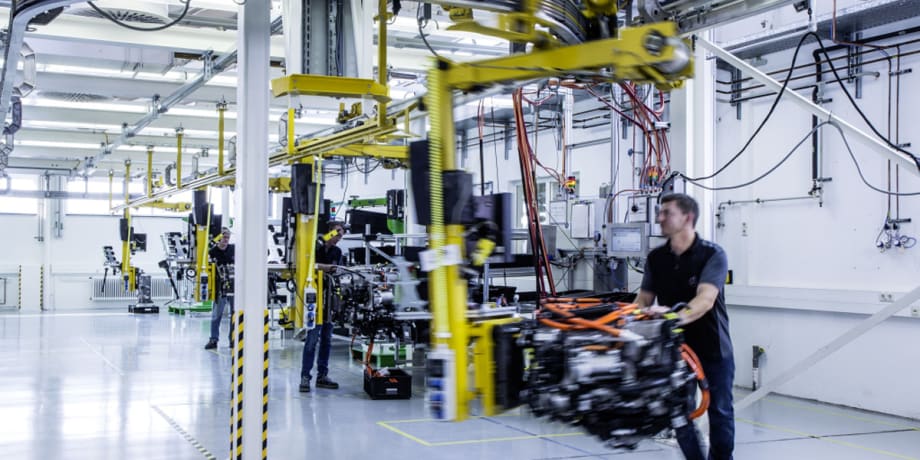
Shown, components being assembled into a finished fuel-cell system in Nabern, Germany.
Photo: Daimler
As part of a commitment to accelerate the use of hydrogen-based fuel cells for long-haul trucks, Daimler Truck AG and Volvo Group have outlined their roadmap for a new fuel-cell joint venture called cellcentric.
The joint venture will build one of Europe’s largest planned series production of fuel-cell systems, with operation planned to commence in 2025. Designed to help meet the 2050 targets of sustainable transport and a carbon-neutral Europe as part of the European Green Deal, cellcentric will develop, produce and commercialize fuel-cell systems for both long-haul trucking and other applications.
To accelerate the rollout of hydrogen-based fuel-cells, the two shareholders call for a harmonized EU hydrogen policy framework to support the technology in becoming a viable commercial solution, Volvo officials said in a press release.
Currently, cellcentric is conceptualizing the plans for its large-scale series production. More details and a decision on the location will be revealed over the course of 2022. As a significant step towards series production, preparations for pre-series production are taking place at a new site in Esslingen near Stuttgart.
Daimler and Volvo’s goal is to start with customer tests of fuel-cell trucks in about three years and to be in series production of fuel-cell trucks during the second half of this decade. All vehicle-related activities are carried out independently from each other, as both companies remain competitors in all vehicle and product ranges, and particularly in fuel-cell integration solutions for all products, Volvo officials said.
According to Daimler and Volvo, purely battery-electric and hydrogen-based fuel-cell trucks will complement each other depending on the individual customer use case. Battery power will be rather used for lower cargo weights and for shorter distances, while fuel-cell power will tend to be the preferred option for heavier loads and longer distances.
“Our united ambition is to meet the targets in the Paris agreement of becoming CO2-neutral by 2050 at the latest,” said Martin Lundstedt, CEO of Volvo Group. “We are convinced that hydrogen fuel-cell technology plays an essential role in helping us reach that milestone. But we know there is so much more to achieve than just the electrification of machines and vehicles. There needs to be greater cooperation between public and private stakeholders to develop the necessary technology and infrastructure, which is why we are calling for united action from policymakers and governments around the world in helping us make hydrogen fuel-cell technology a success.”
The major truck manufacturers in Europe, also backed by Daimler Truck AG and Volvo Group, are therefore calling for the setup of around 300 high-performance hydrogen refueling stations suitable for heavy-duty vehicles by 2025 and of around 1,000 hydrogen refueling stations no later than 2030 in Europe. This joint initiative, using hydrogen as a carrier of green electricity to power electric trucks in long-haul operations, is one important part of decarbonizing road transport.
As CO2-neutral trucks are currently significantly more expensive than conventional vehicles, a policy framework is needed to ensure demand and affordability. According to Daimler and Volvo, this should include incentives for CO2-neutral technologies and a taxation system based on carbon and energy content. An emissions trading system could be an additional option.
More Fuel Smarts

How Volvo Updated Its D13 for EPA 2027 [Watch]
Volvo’s updated D13 promises lower emissions without sacrificing performance or fuel economy. Take a closer look at what changed inside the engine in this HDT Spotlight video.
Read More →
Diesel Price Spike Shortens Payback for Natural Gas Trucks, Report Says
Energy Vision estimates fleets could recover the higher purchase price of an RNG-fueled Class 8 tractor in 1.3 to 2.8 years under current fuel-price scenarios.
Read More →
Calstart Becomes Catalyst Mobility, Reflecting Broader Focus
Calstart is now Catalyst Mobility, reflecting the nonprofit’s growing national role in clean transportation, including zero-emission trucks, infrastructure and incentive programs.
Read More →

Record Diesel Prices Squeeze Trucking Fleets
Average U.S. diesel prices have climbed to nearly $6 a gallon, surpassing the 2022 record as tight refinery capacity and Middle East disruptions keep fuel costs elevated.
Read More →
How Fuel Delivery Shapes Engine Performance
Fuel delivery depends on more than what happens at the injector. For fleet, maintenance and technical professionals, looking at the full path from pump to injector can provide useful context for understanding engine performance.
Read More →
East Coast Port Launches $45M Electric Truck Push
The Port Authority of New York and New Jersey announced millions in incentives for zero-emission drayage trucks, yard tractors, and new charging hubs near the port.
Read More →
California Bill Could Shed Light on Electric Truck Prices
Why do battery-electric Class 8 trucks remain so expensive? A California bill headed to Gov. Gavin Newsom would give fleets and state agencies more visibility into what manufacturers charge.
Read More →
Detroit Opens Orders for EPA 2027 Engines
Detroit isn’t starting from scratch to meet EPA 2027 diesel emissions standards. Its Gen 6 DD13 and DD15 engines keep much of today’s platform while updating the fuel and aftertreatment systems.
Read More →
Zero-Emission Truck Corridor Planned for West Coast
California, Oregon, Washington, British Columbia and Baja California are coordinating plans for truck charging and hydrogen fueling from Canada to Mexico.
Read More →
A Closer Look at Kenworth’s Electric T880E Vocational Truck [Video]
Learn more about Kenworth's T880E battery-electric vocational truck at the Paccar Technical Center, including its range, applications, upfitting considerations, and PTO options, in this HDT Spotlight video.
Read More →