




Nikola Files for Bankruptcy
Years of scandal and mismanagement at Nikola Motors finally come to a head as the battery-electric and hydrogen-fuel-cell truck maker files for Chapter 11 bankruptcy.

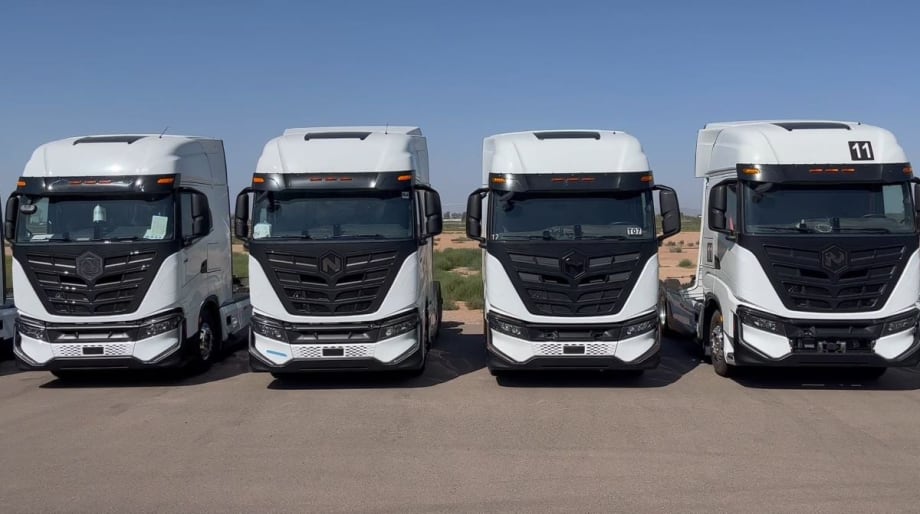
Following years of scandals and mismanagement, Nikola Motors has filed for Chapter 11 bankruptcy.
Photo: Jim Park
Zero-emission truck maker Nikola has reached the end of its brief and bumpy road.
Once the darling of environmentalist groups pushing to bring zero-emission powertrain technology to heavy trucks, the OEM announced Feb. 19 that it has filed for Chapter 11 bankruptcy protection.
Long plagued by financial and organizational woes, Nikola said it failed to find a buyer or secure additional funds to maintain operations.
A 10-Year Push for Zero Emissions Heavy Trucks
Nikola was founded in 2015, at the very onset of the push to transition North America trucks away from fossil fuels and toward zero-emission powertrains.
The company was an early and vocal proponent of hydrogen fuel cell technology for long-haul transport.
It later developed a complementary line of battery-electric heavy trucks as it continued developing its hydrogen-fuel-cell technology.
Nikola struck a deal with Italian truck OEM Iveco to use its Class 8 cabover truck chassis. The trucks were powered by Nikola’s proprietary ZEV technologies.
Nikola was among the first of many new, green truck OEMs that sprung up a decade ago as the move to create a green trucking industry gained traction.
In 2020, when the company went public, Nikola was valued at a stunning $30 billion.
But a series of scandals involving its founder and former CEO Trevor Milton put the company into a tailspin from which it was never able to recover.
There were also highly publicized technology development issues that generated negative headlines for the OEM.
Nikola Assets to be Sold at Auction
Now, the OEM has announced that it plans to go to auction with its assets, pending court approval, according to a regulatory filing.
“Like other companies in the electric vehicle industry, we have faced various market and macroeconomic factors that have impacted our ability to operate,” Steve Girsky, president and CEO of Nikola, said in a statement.
“In recent months, we have taken numerous actions to raise capital, reduce our liabilities, clean up our balance sheet and preserve cash to sustain our operations. Unfortunately, our very best efforts have not been enough to overcome these significant challenges, and the board has determined that Chapter 11 represents the best possible path forward under the circumstances for the company and its stakeholders.”
According to reports, Nikola currently has about $47 million in cash on hand to financing the pending bankruptcy process.
Nikola’s proposed bidding process would allow interested parties to submit binding offers to acquire Nikola’s assets, independent of the company’s debt or liabilities.
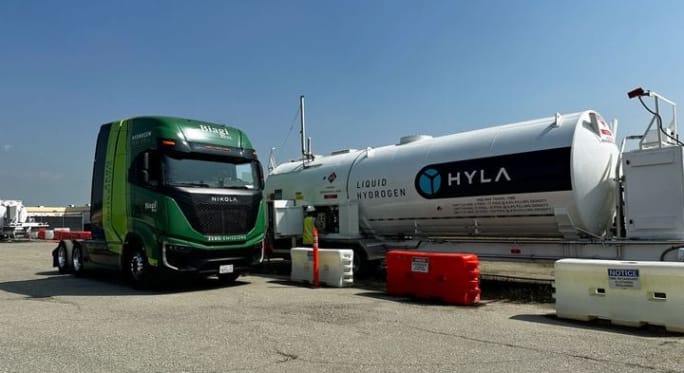
Nikola had been in the process of developing a HYLA hydrogen refueling highway in California.
Photo: Hyla
Some of those assets would include Nikola’s Class 8 hydrogen fuel cell electric trucks and battery electric truck platforms.
Nikola had also been in the process of developing a Hyla hydrogen refueling highway in California.
Nikola's Long, Slow, Fall from Grace
In the beginning, Nikola appeared to be on the cutting-edge of an entirely new generation of environmentally friendly long-haul trucks.
At one point, it even inked a multi-billion-dollar strategic partnership deal with General Motors to develop fuel-cell-powered pickup trucks by the end of 2022.
Nikola’s future seemed bright — until founder Trevor Milton was accused of fraud for making exaggerated claims about the company’s electric truck technology. Prosecutors in the case against him claimed that he had deceived investors since 2019.
Among the charges levied against him, prosecutors said Milton lied about Nikola having built a truck from the “ground up.” They also alleged that Nikola’s proprietary batteries were actually developed by and purchased from other companies.
There was also a Nikola marketing video with a truck appearing to drive on its own power. In reality, prosecutors said, the truck was simply rolling down a hill.
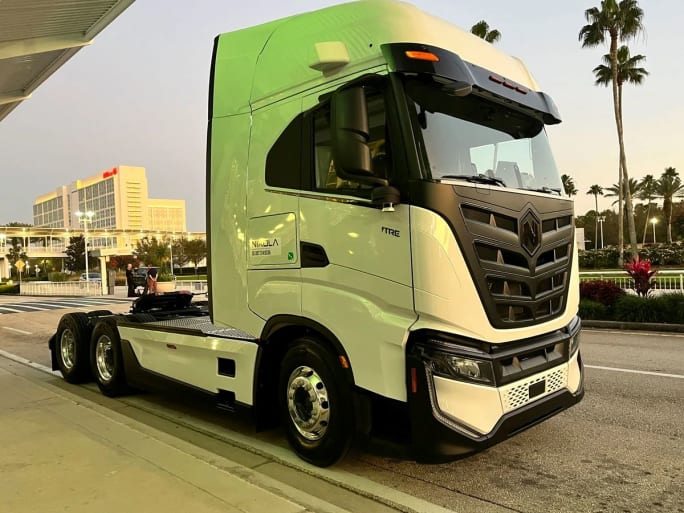
Nikola's journey began as on the cutting-edge of an entirely new generation of environmentally friendly long-haul trucks.
Photo: Jack Roberts
The fallout from the video was disastrous for the OEM. The Hindenburg Research stock analyst company called the company a fraud in a report.
Milton stepped down in September 2020. He was eventually convicted of wire and securities fraud in 2022. He is currently out on bail while he appeals his four-year prison sentence.
Milton's ouster led to a revolving door of CEOs at the company, which further hampered its recovery efforts.
Nikola eventually paid a $125 million penalty in a settlement with the U.S. Securities and Exchange Commission.
But the company’s stock collapsed and never recovered. The result was serious losses for investors. And the company found itself severely constrained in its efforts to recover its footing.
The OEM has been engaged in a never-ending struggle to raise funds to continue operations ever since.
In the third quarter of last year, Nikola warned investors that it only had enough cash on hard to sustain operations into the first quarter of 2025.
In December, Nikola attempted to raise $100 million in a common stock sale to repay its debts and raise equity. But those efforts — hampered by years of scandal and mismanagement — were not enough to save the company from bankruptcy.
Troubled Times for EV Manufacturers
Top bankruptcy analyst Sarah Foss, head of legal at Debtwire, said she sees the Nikola filing as another sign of the ongoing struggle facing electric vehicle manufacturers.
“The electric vehicle industry has continued to struggle amid increasing competition, operational challenges and high costs, leading most EV manufacturers that turn to Chapter 11 to look towards an asset sale, or even a liquidation, rather than a reorganization of the business,” she said.
Foss noted that Nikola is following a similar path in bankruptcy as other electric vehicle manufacturers. These include electric vehicle startup Fisker, which declared bankruptcy in June 2024, and Lordstown Motor, which entered Chapter 11 in June 2023. Lordstown eventually sold the majority of its assets to a vehicle of the company’s former CEO and Proterra – which eventually went to bankruptcy in August 2023.
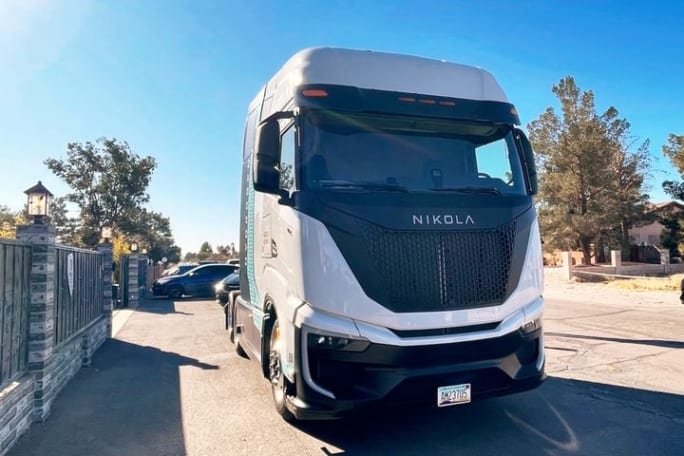
Although its focus was initially on hydrogen fuel cell trucks, Nikola eventually introduced a battery-electric Class 8 model.
Photo: Jack Roberts
A few electric vehicle start-ups are still in business. And all long-established truck OEMs are developing a wide range of ZEV powertrain options for both medium- and heavy-duty trucks.
However, analysts note, the business climate for EV startups has turned brutal. Share prices have fallen. And it is not clear when, or even if, they will be able to become profitable.
Electric pickup truck and sport-utility vehicle OEM Rivian, for example, has had trouble ramping up production levels. Its stock currently trades at under $13 a share — a tenth of where it was in late 2021.
However, Rivian inked a partnership with Volkswagen last year. The German OEM has taken over a big stake in the EV startup.
“Like other companies in the electric vehicle industry, we have faced various market and macroeconomic factors that have impacted our ability to operate,” Girsky said. “Unfortunately, our very best efforts have not been enough to overcome these significant challenges.”
More Fuel Smarts

How Volvo Updated Its D13 for EPA 2027 [Watch]
Volvo’s updated D13 promises lower emissions without sacrificing performance or fuel economy. Take a closer look at what changed inside the engine in this HDT Spotlight video.
Read More →
Diesel Price Spike Shortens Payback for Natural Gas Trucks, Report Says
Energy Vision estimates fleets could recover the higher purchase price of an RNG-fueled Class 8 tractor in 1.3 to 2.8 years under current fuel-price scenarios.
Read More →
Calstart Becomes Catalyst Mobility, Reflecting Broader Focus
Calstart is now Catalyst Mobility, reflecting the nonprofit’s growing national role in clean transportation, including zero-emission trucks, infrastructure and incentive programs.
Read More →

Record Diesel Prices Squeeze Trucking Fleets
Average U.S. diesel prices have climbed to nearly $6 a gallon, surpassing the 2022 record as tight refinery capacity and Middle East disruptions keep fuel costs elevated.
Read More →
How Fuel Delivery Shapes Engine Performance
Fuel delivery depends on more than what happens at the injector. For fleet, maintenance and technical professionals, looking at the full path from pump to injector can provide useful context for understanding engine performance.
Read More →
East Coast Port Launches $45M Electric Truck Push
The Port Authority of New York and New Jersey announced millions in incentives for zero-emission drayage trucks, yard tractors, and new charging hubs near the port.
Read More →
California Bill Could Shed Light on Electric Truck Prices
Why do battery-electric Class 8 trucks remain so expensive? A California bill headed to Gov. Gavin Newsom would give fleets and state agencies more visibility into what manufacturers charge.
Read More →
Detroit Opens Orders for EPA 2027 Engines
Detroit isn’t starting from scratch to meet EPA 2027 diesel emissions standards. Its Gen 6 DD13 and DD15 engines keep much of today’s platform while updating the fuel and aftertreatment systems.
Read More →
Zero-Emission Truck Corridor Planned for West Coast
California, Oregon, Washington, British Columbia and Baja California are coordinating plans for truck charging and hydrogen fueling from Canada to Mexico.
Read More →
A Closer Look at Kenworth’s Electric T880E Vocational Truck [Video]
Learn more about Kenworth's T880E battery-electric vocational truck at the Paccar Technical Center, including its range, applications, upfitting considerations, and PTO options, in this HDT Spotlight video.
Read More →