Disquiet over the emissions regulations for heavy trucks boiled over into something like an outright revolt this past year. Here’s a look back at what happened.
2024 saw the cold war between environmental regulatory agencies and the North American Trucking Industry turn hot.
Image: HDT graphic
8 min to read
Perhaps THE news story in trucking for 2024 was the near-revolt that erupted over the looming diesel exhaust emissions regulations coming at heavy trucks.
In addition, new federal NOx (Nitrogen Oxides) reduction mandates from the Environmental Protection Agency kick in effectively in 2026 with the model-year 2027 heavy-duty trucks. NOx emissions must be cut to 0.035 grams per horsepower-hour (also expressed as 35 milligrams) during normal operation, 0.05 grams at low load, and 10 grams at idle.
Both mandates are extremely tough emissions standards for diesel trucks to meet.
And while neither of these federal rules specifically mandates zero-emission trucks (unlike California), many believe that in reality they are pushing the trucking industry into zero-emission vehicles propelled by battery-electric and hydrogen fuel cell powertrains.
As Daniel Gage of The Transport Project explained in a recent guest blog, regulators argue that the Phase 3 GHG regulation is technology-neutral and performance-based.
Ad Loading...
"And this, they say, allows each manufacturer to choose what set of emissions control technologies is best suited to meet the standards and the needs of their customers.
"But this rule effectively places the federal government’s finger on the scale for battery electric to the detriment of any other solution."
And then there is California, which has its Advanced Clean Trucks and Advanced Clean Fleets rules specifically requiring zero-emission trucks, along with its own NOx Omnibus rules that the EPA recently cleared the California Air Resources Board to start enforcing.
The Long-Haul Dilemma
But there’s a problem with the push to zero emissions: Long-haul trucks.
Truck and engine makers have moved heaven and earth over the past decade to develop viable ZEV truck options for fleets. And they deserve tremendous credit for their efforts.
Ad Loading...
But new battery-electric trucks and hydrogen fuel cell trucks in particular, remain vastly more expensive than diesel-powered units. There are also massive infrastructure issues that are just now beginning to be resolved.
But the far greater problem boils down to application.
ZEV trucks work just fine in short- and regional-haul applications. Long haul is a completely different story.
To put it bluntly, there are no viable ZEV trucking options on the table right now for long-haul fleets. And there won’t be any options available in 2027. And there probably won’t be any viable options available in 2032.
And I’m not even talking about acquisition costs or infrastructure. I'm speaking simply in terms of pure operational capabilities – range and refueling/recharging times. There are currently no trucks available that can compete with diesel trucks in long-haul applications on an apples-to-apples operational basis.
Ad Loading...
Out of Touch Regulatory Agencies
I think it’s fair to say that North American trucking fleets have been patient over the past decade. They’ve given the industry a fair chance to develop new ZEV technology. And to be clear, I also think that the pushback that began in 2024 is directed 100% at governmental regulatory agencies: CARB and the EPA in particular.
It was a pushback that began early in the year. And one that gained significant steam as the months passed.
By mid-year, for example, Allen Schaffer, executive director of the Engine Technology Forum, stated publicly that, “renewable fuel standards are out of touch with current conditions.”
Schaffer went on to call for a serious revision of renewable fuel standards. Moreover, he made the case that in their zeal to force ZEV technology onto the North American trucking industry, regulatory agencies were missing an opportunity to make meaningful progress on climate goals today.
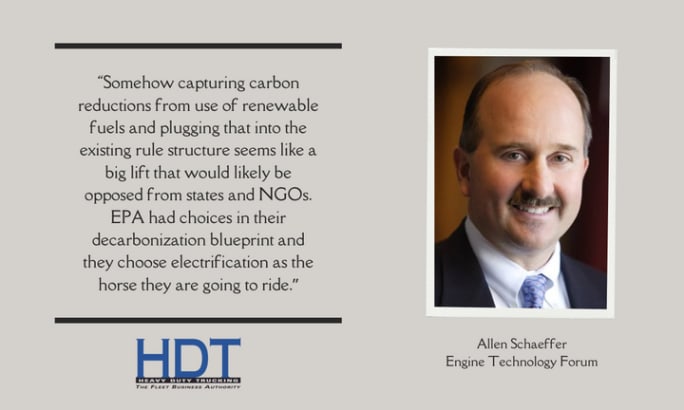
In June, Allen Schaeffer of the Engine Technology Forum called for EPA and CARB to give real regulatory support to renewable fuels.
Image: HDT graphic
Trucking’s Moonshot
In March, the Clean Freight Coalition rattled the industry with the release of its Realistic Forecast for Commercial Vehicle Electrification Infrastructure Report.
The study found that the proposed regulatory pathway toward zero-emission vehicles will cost the U.S. trucking industry $1 trillion.
As I’ve noted, that’s essentially the same cost today as funding the Manhattan Project or the Apollo Program.
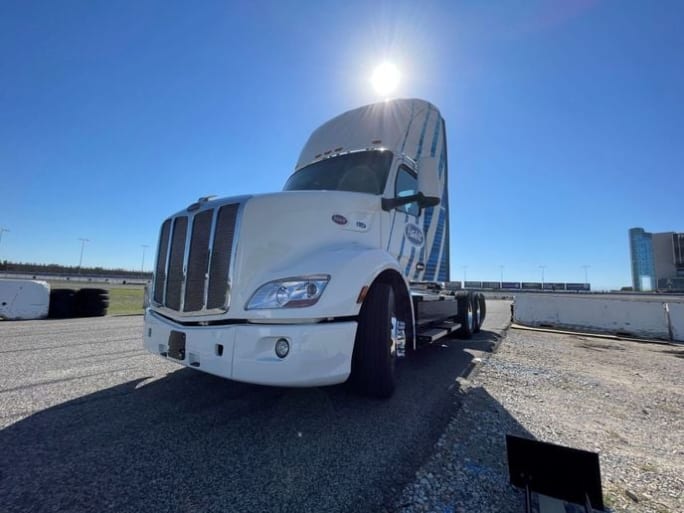
A study by The Clean Freight Coalition found that transitioning the U.S. trucking industry over to battery-electric vehicles will cost $1 trillion.
Photo: Jack Roberts
Volvo Commits to Internal Combustion Engines
The first rumblings of life for downtrodden diesel ICEs came in April from the Volvo Group.
Ad Loading...
To be sure, the Swedish truck OEM has been a vocal and enthusiastic supporter and developer of zero-emission truck technologies.
But Volvo is also a highly pragmatic company. It understands its customers and their needs. And it understands that there are still ways to make diesel engines cleaner -- and that ICEs burning fuels other than diesel will play an important role in long-haul fleet operations for many years to come.
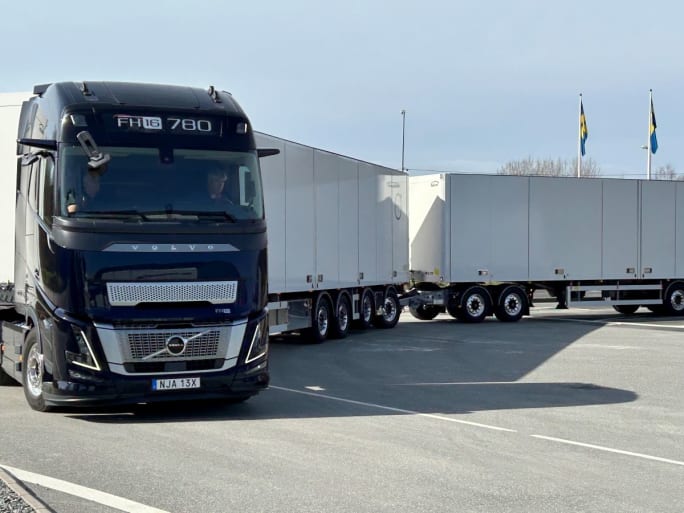
High-horsepower engines burning synthetic diesel fuel will have definite role in future zero-emission trucking solutions, according to Volvo.
Photo: Jack Roberts
Renewable Diesel in the Headlines
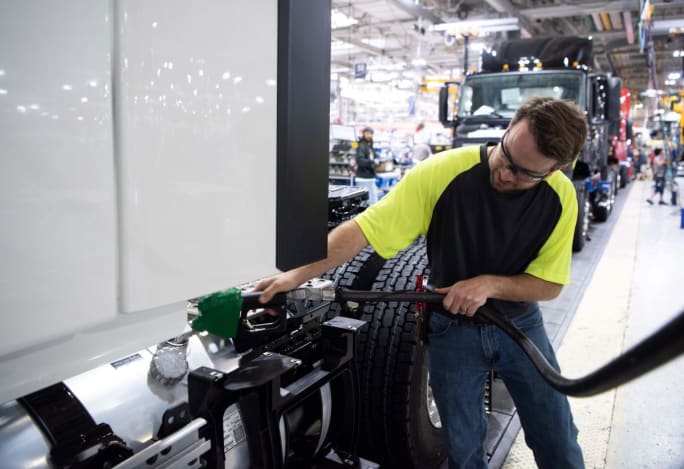
And Volvo put its money where its mouth is. That same month, the OEM announced that the first fill for all new Volvo and Mack trucks coming off the assembly line would be with renewable diesel fuel.
In April, Volvo announced all new Volvo and Mack trucks would receive a first fill of renewable diesel fuel at the factory.
Photo: Volvo Trucks North America
The following month saw a high-profile report from the American Transport Research Institute touting the benefits of renewable diesel fuel as well.
The report noted that an industry-wide switch to renewable diesel fuel in long-haul operations would be six times cheaper than converting to BEVs. Even better, such a switch would deliver and substantial emissions reductions nationwide.
An ATRI study found that widespread use of renewable diesel fuel would be a cheaper and faster means of reducing greenhouse gas emissions than switching to electric and hydrogen fuel cell trucks.
Image: HDT graphic
And later in the year, the Engine Technology Forum officially called on both state and federal legislators to recognize renewable diesel as a certified renewable fuel.
In May, HDT took its own deep dive look at renewable diesel and why many fleets think it's an ideal intermediate step toward zero-emission powertrains in the future.
Increased interest in renewable diesel fuel is rapidly take hold across North America.
Photo: Neste
Two Industry Giants Speak Out
A more direct pushback against the current slate of diesel emission regulations came out of the blue in May at the Advanced Clean Transportation Expo (ACT Expo) in Las Vegas, when two of the heaviest hitters in the North American trucking industry sounded the alarm bells on current ZEV technology and long-haul applications.
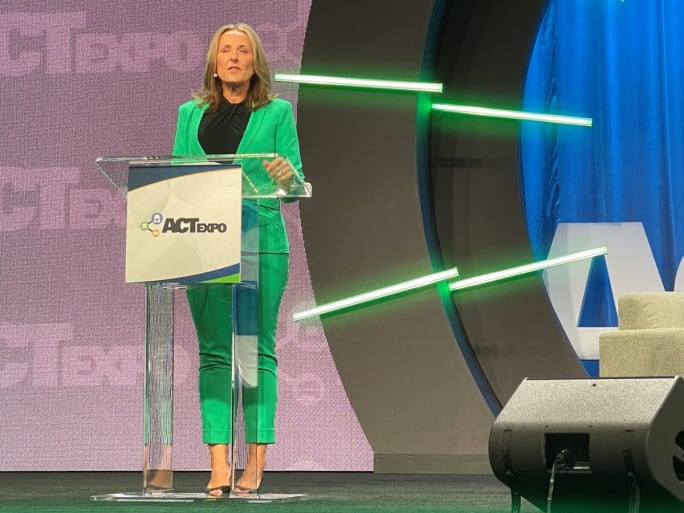
First up was Shelley Simpson, president of J.B. Hunt Transportation Services.
Speaking on the main stage on the opening day of the Expo, Simpson bluntly told attendees that currently, battery electric trucks are too expensive and uncompetitive and inefficient when compared with diesel-powered units -- and talked about the sustainability improvements her company has achieved without relying on ZEVs.
J.B. Hunt President Shelley Simpson shocked ACT Expo attendees, saying that zero-emissions truck technology is not ready for fleet operations today.
Photo: Jack Roberts
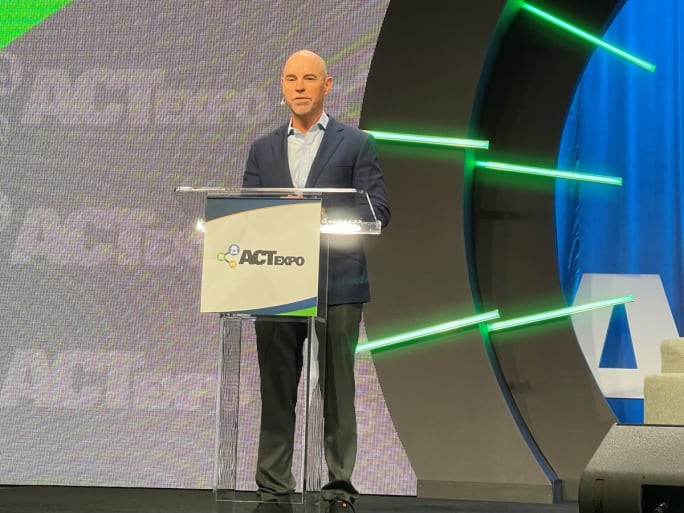
Robert Shanchez, the CEO and chairman of Ryder System doubled down on that theme, the very next day. Speaking from the same stage, he delivered a sobering address, noting that operating costs for electric trucks were far higher than Ryder expected to see initially.
Robert Sanchez told ACT Expo attendees that while Ryder System expected to see cost increases for adopting BEVs instead of conventional diesel trucks, they did not expect the magnitude of those costs to be so large.
Photo: Jack Roberts
Can Hydrogen Engines Step Up?
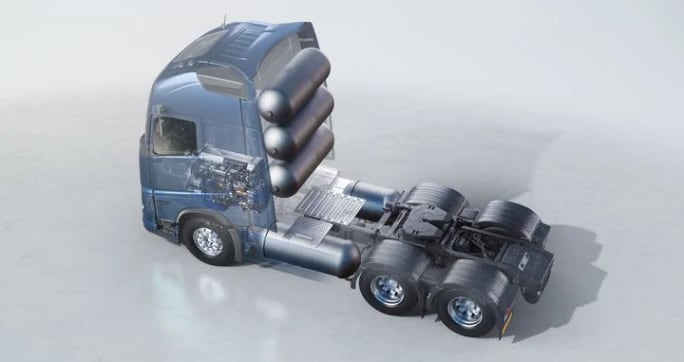
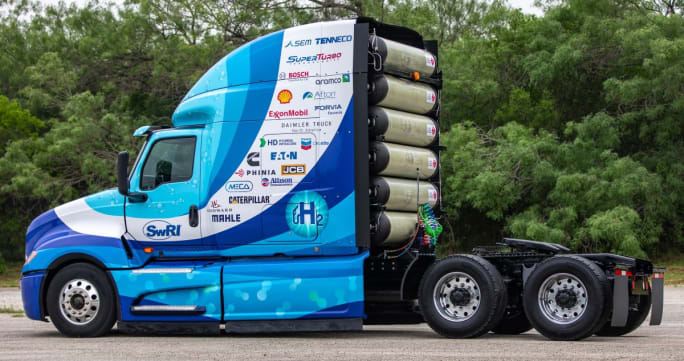
Hydrogen made headlines once again in 2024. But this time, instead of being used in fuel cells, the talk centered on the development of liquid hydrogen burned in internal combustion truck engines.
Volvo announced in May that it has plans to launch hydrogen-powered ICEs by the end of the decade.
More than 20 trucking OEMs, led by Bosch, are working to develop a liquid hydrogen engine for long-haul trucking applications.
Photo: Southwest Research Institute
RNG: The Me Too! Truck Fuel
Late in the year, proponents of renewable natural gas as a clean truck fuel began to make their voices heard, as well.
Currently, CARB and other regulatory agencies do not recognize RNG as a zero-emission fuel. That’s because it still emits .35 grams of NOx when burned as a fuel.
However, that’s 95% of the way toward a completely zero-emission fuel. Moreover, RNG is a fuel that already delivers diesel-like range, power and performance.
Why are regulators ignoring the benefits of renewable natural gas as a truck fuel?
Image: HDT graphic
All of which makes me (and many others) wonder if CARB and EPA are overlooking RNG in their zeal to do away with internal combustion engines forever.
All of which has a lot of industry observers wondering why RNG doesn’t make sense as a short-term, very-low emission fuel for long-haul trucking fleets today.
One argument for the use of renewable natural case in trucking is that its infrastructure and fueling network is already well established on a national level.
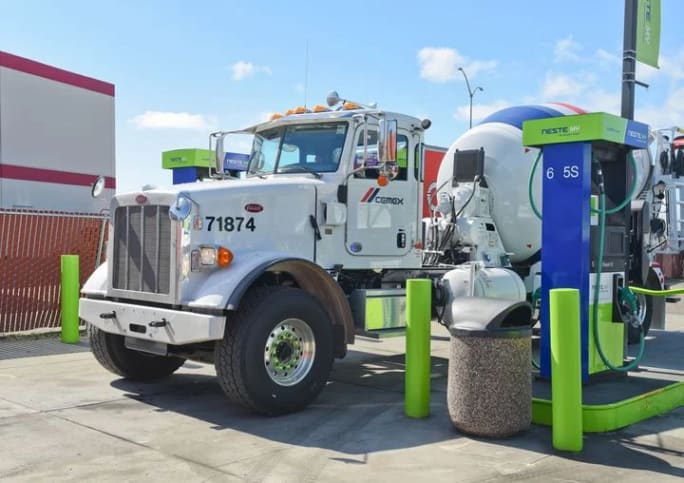
Photo: Clean Energy
Hope for Sensible Solutions?
It seems fair to say that 2024 will be remembered as the year the North American trucking industry stepped up and voiced its concerns about the diesel emissions regulations that lay just over the horizon.
Ad Loading...
I think it’s important to note that these are not unhinged demands that everything simply return to the way the industry has always done things.
In every instance cited above, the trucking industry has voiced reasonable and measured concerns. Moreover, in every instance, the trucking industry has offered logical, real-world solutions to complement those concerns.
As I’ve often observed, our global economy is literally riding on getting trucking’s transition to net zero absolutely right.
As this HDT 2024 roundup clearly shows, no one understands that better than North American fleet executives. They are calling for sensible, proactive, and environmentally sustainable changes that will keep freight moving and our economy strong.
Hopefully, legislators and regulators are listening.
Volvo’s updated D13 promises lower emissions without sacrificing performance or fuel economy. Take a closer look at what changed inside the engine in this HDT Spotlight video.
Energy Vision estimates fleets could recover the higher purchase price of an RNG-fueled Class 8 tractor in 1.3 to 2.8 years under current fuel-price scenarios.
Calstart is now Catalyst Mobility, reflecting the nonprofit’s growing national role in clean transportation, including zero-emission trucks, infrastructure and incentive programs.
Average U.S. diesel prices have climbed to nearly $6 a gallon, surpassing the 2022 record as tight refinery capacity and Middle East disruptions keep fuel costs elevated.
Fuel delivery depends on more than what happens at the injector. For fleet, maintenance and technical professionals, looking at the full path from pump to injector can provide useful context for understanding engine performance.
The Port Authority of New York and New Jersey announced millions in incentives for zero-emission drayage trucks, yard tractors, and new charging hubs near the port.
Why do battery-electric Class 8 trucks remain so expensive? A California bill headed to Gov. Gavin Newsom would give fleets and state agencies more visibility into what manufacturers charge.
Detroit isn’t starting from scratch to meet EPA 2027 diesel emissions standards. Its Gen 6 DD13 and DD15 engines keep much of today’s platform while updating the fuel and aftertreatment systems.
California, Oregon, Washington, British Columbia and Baja California are coordinating plans for truck charging and hydrogen fueling from Canada to Mexico.
Learn more about Kenworth's T880E battery-electric vocational truck at the Paccar Technical Center, including its range, applications, upfitting considerations, and PTO options, in this HDT Spotlight video.