




High Hopes for Hydrogen in Trucking
What role will hydrogen internal-combustion engines play in the decarbonization of the trucking industry? A new white paper from the Engine Technology Forum explores the topic.

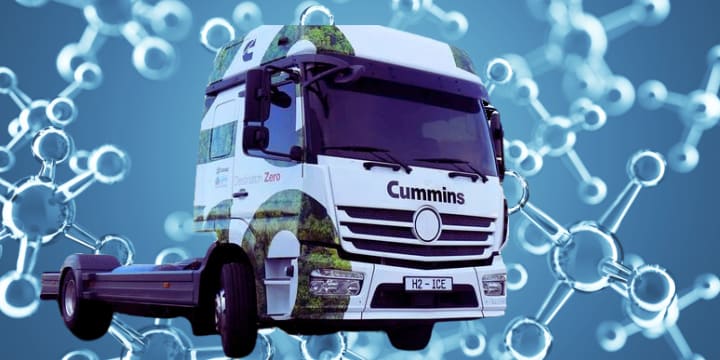
In addition to working on hydrogen infrastructure and storage technologies, Cummins has been developing hydrogen-fueled engines for over three years.
Photo: Cummins
In many ways, there is a lot of hope hanging on hydrogen in the trucking industry. Fleets are desperate for a diesel-like, zero-emission propulsion option for heavy trucks. And despite some concerns, there is widespread optimism that hydrogen could provide fleets with those capabilities burned as a liquid fuel in internal combustion engines.
On July 24, the Engine Technology Forum held a webinar to outline a new white paper, Powering On: Internal Combustion Engines & the Clean Energy Future. The purpose of the white paper is to detail where the development of hydrogen ICEs stands at the moment, and highlight what advantages this technology could eventually yield for heavy truck fleet operations.
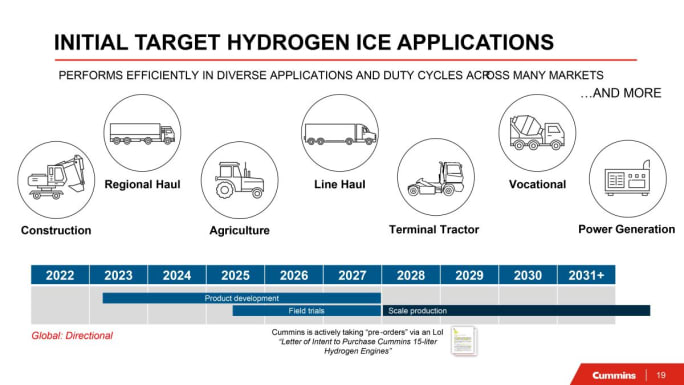
Cummins expects to see scale production of hydrogen ICEs as early as 2028.
Graphic: Cummins
Allen Schaeffer, executive director of the ETF, opened the webinar by noting that internal combustion engines are the standard, and typically the only, power option in hundreds of applications serving every corner of the globe.
Furthermore, he noted, the magnitude of the global reliance on ICEs and the extraordinary challenges of transitioning to different energy systems strongly suggests a continued role for these engines many decades into the future, even as new fuels and technologies emerge.
“Our global economy relies almost solely on internal combustion engines for all of its power and mobility needs, Schaeffer said.
“All decarbonization technologies that are being implemented, or considered, face various limits and barriers. ICEs are uniquely positioned for the future, leveraging today’s fossil-fuel based economy and adapting to tomorrow’s more sustainable one that relies on renewable fuels and dramatically reduced carbon.”
The Staying Power of the Internal Combustion Engine
According to Schaeffer, internal combustion engines will continue to thrive and dominate most sectors of the economy for decades to come for three reasons:
Near sole reliance on ICE and its supporting infrastructure across wide sectors of the global economy for which there is no suitable alternative
Continuous improvements in efficiency and lower emissions, as well as significant opportunities for using lower carbon fuels that position it to compete with emerging alternatives
Delays and uncertainties due to funding support, infrastructure, market acceptance, as well as many other factors inherent in introducing new fuels and energy systems.
“We will need an increasingly diversified energy and technology portfolio that embraces advanced internal combustion engines with a greater reliance on low-carbon renewable liquid and gaseous fuels and hydrogen,” Schaeffer said.
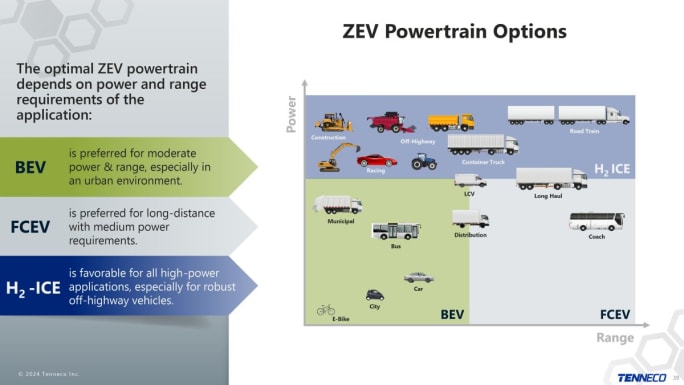
The Engine Technology Forum believes hydrogen ICEs will be ideal for zer-emission heavy truck transport applications.
Graphic: Engine Technology Forum
ICEs are expected not only to have staying power in the marketplace, but also growth for another decade or more, Schaeffer said. Various market forecasts predict combined annual growth rates as much as 9% from 2023-2030.
Though increasingly stringent future emissions standards are designed to accelerate the introduction of zero-emissions vehicles, it is still projected that ICE technology will power one third to one-half of the new vehicle fleet in 2032.
For the largest commercial vehicles, ICE technology is predicted to be the power source for 75% of the new vehicles. The staying power of advanced ICE is even more pronounced in heavy-duty off-road applications in agriculture, construction, marine, rail and power generation.
Complementary Sustainability Technologies
The path to the future for ICEs is well under way, Schaeffer said. That process involves building on past progress to meet new emissions and fuel efficiency requirements — and a considerable increase in the use of low-carbon renewable fuels such as renewable gasoline, renewable diesel, renewable natural gas, biodiesel, hydrogen, as well as e-fuels now under development.
According to the white paper, life cycle analysis shows that ultimately, the key factor to reduce emissions is the fuel rather than the powertrain. In other words, the source of the GHG emission problem is fossil fuels, not the internal combustion engine.
A group of panelists spoke to the various challenges and opportunities the shift away from fossil fuels presents for ICEs in heavy truck applications. They included:
Jim Nebergall, Executive Director – EBU Market Strategy, Cummins
Ivan Tate, Head of Technical Center, FPT Industrial
Louise Arnold, Product Line Director, Johnson Matthey
Dmitri Konson, Vice President Engineering, Tenneco Clean Air
“All OEMs have some form of hydrogen ICE development going on today,” said Ameya Joshi, vice president of ClearFlame, in introductory remarks.
“A massive amount of work is being done. As a result, engine technology has advanced quite a bit over the past few years. But there is still a lot of work to be done in improving the efficiency of a hydrogen ICE.”
Cummins has been working on hydrogen ICE technology for three years, Nebergall said in his opening remarks. “Cummins is also investing in the economic systems needed to produce and store renewable green hydrogen,” he added.
In Cummins’ view, hydrogen will be the future fuel for both ICEs and fuel cell battery electric trucks.
“We view these as complementary technologies,” he explained. “Hydrogen ICEs complement fuel cell vehicles because both approaches will allow us to build the scale and volume needed to increase demand. And having both technologies in play drives the faster creation and establishment of a hydrogen fueling infrastructure.”
The Most Diesel-Like Option Available
Most importantly, Nebergall said hydrogen ICEs aren’t a flight of fancy.
“We already know how to make engines run with hydrogen as fuel,” he said.
“And end users are excited about this technology because it can provide them with the most diesel-like, green fuel solution available to us. It provides both the power and torque they need to move heavy goods. And a hydrogen ICE can operate in the existing trucking environment and applications that we have today.”

Hydrogen-powered engines couled be a drop-in replacement for diesel in trucking, construction and industrial applications.
Graphic: Cummins
Johnson Matthey developed the hydrogen fuel cell for NASA that landed men on the Moon, Louise Arnold said.
“The great thing about hydrogen is that it can be almost a drop-in substitution for diesel fuel,” she said. “And, in the long term, it can be a great enabler that will allow us to eventually get to an even lower-carbon future in trucking.”
Battery-electric trucks are a great option for low- to medium-power requirements that don’t have range requirements beyond the battery’s technology, added Dmitri Konson with Tenneco Clean Air. BEVs also require time in the workday to pause and recharge the truck – although nighttime charging is the perfect solution for that requirement.
And fuel cell trucks pretty much follow that degree of functionality, Konson added. Fuel cell trucks have longer range than BEVs, and the processes and times required to refuel them are a lot more practical for fleets.
“But,” Konson noted, “high-power/high-range trucking applications need a propulsion technology that has good energy density, practical refueling times, and the robustness, durability and resistance to impurities that will allow it work in construction and agriculture as well as on-highway. And we believe that hydrogen ICEs are the power solution for green high-power/high-range applications.”
Green Hydrogen and Engine Aftertreatment
There are several different kinds of hydrogen available. Green hydrogen, which is produced with renewable energy, is the most desirable for long-term sustainability goals.
Arnold said that depending on where hydrogen fuel comes from and how it was produced, it can have different levels of purity. But a hydrogen engine can run any of them without any issues.
“Impurities in hydrogen as a fuel are quite low,” she added. “Which means on the emission end of things, tailpipe emissions are as close to zero as we can possibly measure. Essentially, what is coming out of the exhaust pipe is cleaner than what is going into the engine.”
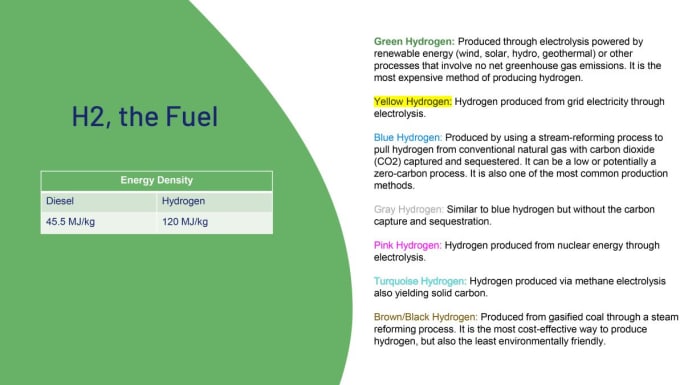
Hydrogen engines can burn any form of the fuel without any issue.
Graphic: Engine Technology Forum
“The amount of nitrogen in hydrogen is very small,” Konson added. “So there are no NOx emissions coming out of the engine.”
But, he said, burning hydrogen as an engine fuel produces water as a byproduct of the combustion process.
“That water creates some challenges for us in terms of aftertreatment systems,” he said. “But with the right thermal management in the engine, we are confident those problems can be overcome.”
At the end of the day, though, Konson said hydrogen ICEs will eventually introduce reduced complexity and cost into fleet management operations.
“I think that costs will trend down from the baseline of diesel operations today,” he said. “We still have many complex technical issues to work out. But, eventually we will reach a consensus in the engine design world as to what the combustion process will be and what form of hydrogen these engines will use as fuel. As with a smaller number of technical options in play will come decreased complexity and cost.”
The ultimate goal, Tate with FTP Industrial said, is to create hydrogen ICEs that are dollar-for-dollar, and hour-for-hour, as capable as diesel engines are today.
“And these will be all-new engines,” he added. “Although many of the components on a hydrogen engine are the same as a diesel, it costs significantly more to retrofit a diesel engine to burn hydrogen than to simply purchase a new engine.”
There is much more in the ETF white paper detailing the future of hydrogen ICE technology, which can be downloaded here: https://enginetechforum.org/internal-combustion-engine-primer.
More Fuel Smarts

How Volvo Updated Its D13 for EPA 2027 [Watch]
Volvo’s updated D13 promises lower emissions without sacrificing performance or fuel economy. Take a closer look at what changed inside the engine in this HDT Spotlight video.
Read More →
Diesel Price Spike Shortens Payback for Natural Gas Trucks, Report Says
Energy Vision estimates fleets could recover the higher purchase price of an RNG-fueled Class 8 tractor in 1.3 to 2.8 years under current fuel-price scenarios.
Read More →
Calstart Becomes Catalyst Mobility, Reflecting Broader Focus
Calstart is now Catalyst Mobility, reflecting the nonprofit’s growing national role in clean transportation, including zero-emission trucks, infrastructure and incentive programs.
Read More →

Record Diesel Prices Squeeze Trucking Fleets
Average U.S. diesel prices have climbed to nearly $6 a gallon, surpassing the 2022 record as tight refinery capacity and Middle East disruptions keep fuel costs elevated.
Read More →
How Fuel Delivery Shapes Engine Performance
Fuel delivery depends on more than what happens at the injector. For fleet, maintenance and technical professionals, looking at the full path from pump to injector can provide useful context for understanding engine performance.
Read More →
East Coast Port Launches $45M Electric Truck Push
The Port Authority of New York and New Jersey announced millions in incentives for zero-emission drayage trucks, yard tractors, and new charging hubs near the port.
Read More →
California Bill Could Shed Light on Electric Truck Prices
Why do battery-electric Class 8 trucks remain so expensive? A California bill headed to Gov. Gavin Newsom would give fleets and state agencies more visibility into what manufacturers charge.
Read More →
Detroit Opens Orders for EPA 2027 Engines
Detroit isn’t starting from scratch to meet EPA 2027 diesel emissions standards. Its Gen 6 DD13 and DD15 engines keep much of today’s platform while updating the fuel and aftertreatment systems.
Read More →
Zero-Emission Truck Corridor Planned for West Coast
California, Oregon, Washington, British Columbia and Baja California are coordinating plans for truck charging and hydrogen fueling from Canada to Mexico.
Read More →
A Closer Look at Kenworth’s Electric T880E Vocational Truck [Video]
Learn more about Kenworth's T880E battery-electric vocational truck at the Paccar Technical Center, including its range, applications, upfitting considerations, and PTO options, in this HDT Spotlight video.
Read More →