



Safety & Compliance
Marijuana and Trucking’s Drug-Testing Dilemma
Marijuana is getting stronger, laws are changing, and drug tests still can’t reliably establish impairment. What does that mean for truck drivers and the fleets that employ them?
 MENU
MENU SEARCH
Marijuana is getting stronger, laws are changing, and drug tests still can’t reliably establish impairment. What does that mean for truck drivers and the fleets that employ them?
HDT
*Summarized by AI
My husband and I, like many people our age, surreptitiously smoked some weed when we were younger. I even had a college boyfriend who grew a marijuana plant in a closet.
Honestly, it didn’t do much for me.
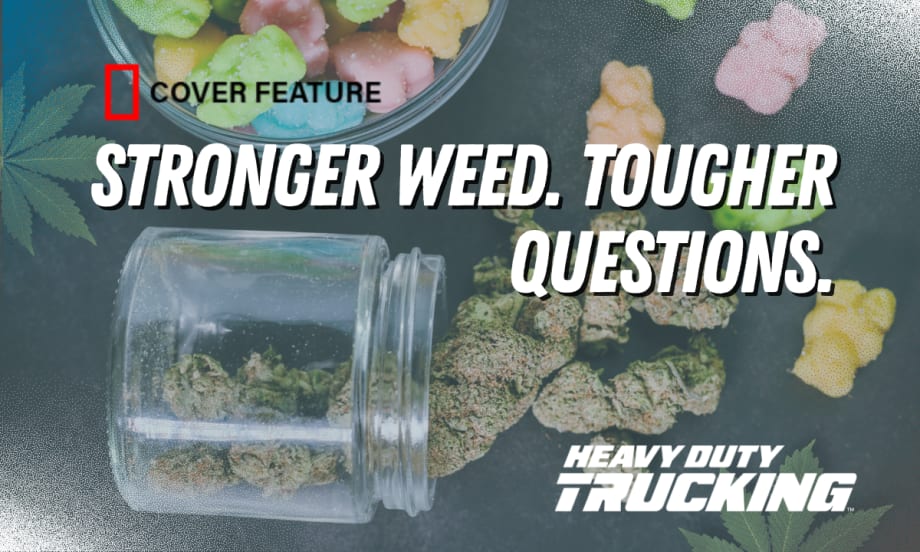
Then our adult daughter moved to California, where recreational marijuana was legal. We were surprised by the variety of products. Not just dried marijuana plant flower, but gummies, beverages, and more.
The biggest surprise was how much stronger it is than we remembered. A single toke felt more like an entire joint from our youth.
According to the National Institute on Drug Abuse, between 1995 and 2022 the delta-9 THC potency (strength) in illegal cannabis products seized by law enforcement quadrupled from 3.96% to 16.14%.
And that brings a whole nother complication to the questions surrounding the legality of cannabis and its use by commercial drivers.
I (and others) have long questioned whether marijuana belonged in the same federal Schedule I category as heroin and LSD.
That classification identifies substances with no currently accepted medical use and a high potential for abuse. There are indications that cannabis has potential medical benefits, but the Schedule 1 prohibition has made researching possible medical uses extremely difficult.
(There's a long history of how marijuana got lumped in with arguably far deadlier drugs, and not all of it is science-based. If you want to dig more into that, check out this Scientific American article.)
I explored this topic previously in a 2024 column. So why am I writing about it again now?
In the past couple of years, a number of research reports and studies have been published in an attempt to scientifically determine the effects of marijuana on driving — and to find a reliable way to measure impairment.
A positive marijuana test has long-lasting and devastating consequences for a commercial truck driver.
In 2019, HDT published a first-person account from a seasonal commercial driver who said he stopped smoking marijuana 30 days before a pre-employment test. He tested positive anyway.
His account described the expense, uncertainty, and frustration of the return-to-duty process, along with the difficulty of finding another driving job after a failed test.
In 2023 research by the American Transportation Research Institute, nearly 44% of surveyed carriers said a past positive marijuana test would automatically disqualify a driver under their company policies, even if the driver had completed return-to-duty steps.
Many drivers who live where cannabis is legal argue that it should be treated more like alcohol. Drivers can drink on their own time, subject to federal restrictions before returning to duty. But marijuana use is prohibited for drivers covered by DOT testing requirements, even when state law permits it.
I understand why that feels unfair.
A driver’s alcohol use over the weekend does not automatically disqualify that driver from working Monday. Marijuana consumed well before a shift, however, can still produce a positive urine test well after the impairing effects have passed.
One sticking point has followed this debate for years: How would we enforce an alcohol-style approach when we don't have a reliable way to test for THC impairment in drivers?
Perhaps spurred by the recent activity around reclassifying marijuana, we’ve seen a number of recent research studies trying to address the question of THC and driver impairment.
A review published this February in "Current Addiction Reports" examined 16 research articles published between 2019 and 2024. It reinforces the evidence that THC, marijuana’s primary intoxicating component, impairs driving. It also illustrates why measuring that impairment remains difficult.
One study found that people can feel ready to drive before their driving performance recovers.
In a trial involving 191 regular cannabis users, about 69% of participants receiving THC said they were ready to drive 90 minutes after smoking. Yet the group’s simulator performance had not improved from the initial post-smoking assessment.
The review found the strongest effects generally occurred in the first hour after inhalation, with recovery commonly around four to five hours. (Those findings are general research observations, not permission for regulated truck drivers to use marijuana and wait a specified number of hours before working.)
And what about all those gummies and beverages?
In another study, published August 31, researchers tested 40 regular cannabis users and found dose-related impairment in simulated driving at two and five hours after consuming THC edibles, particularly at the highest dose, 20 milligrams.
Blood THC concentrations remained below the commonly used 5 nanograms-per-milliliter legal threshold across the dose conditions. In other words, a numerical limit could miss impaired performance. (This was a simulator study, not a test of commercial truck drivers.)
That makes the alcohol comparison harder to translate into policy. A measurable amount of THC is not a dependable stand-in for a person’s ability to drive.
Meanwhile, trucking advocates have pushed for additional drug-testing methods.
DOT finalized rules allowing oral-fluid testing in 2023. But implementation requires at least two HHS-certified laboratories, and the September 2026 federal list still showed none.
Oral fluid offers a shorter detection window than urine and a collection process that can be directly observed with less intrusion. It could help identify more recent use and make specimen substitution harder.
It does not, by itself, establish impairment. Research included in the review found that THC concentrations in saliva, blood, and breath did not correlate with the measured simulator performance.
Not only is there a question of measuring marijuana impairment; in a related issue, safety advocates say the current urine testing misses a large number of drivers using marijuana and other substances.
Hair-testing advocates emphasize a longer look-back period. Some fleets already use hair tests alongside DOT-required urine tests to identify applicants whose drug use might otherwise go undetected.
In research HDT covered in 2022, participating carriers in the Alliance for Trucking Safety, known as the Trucking Alliance, reported 1,994 marijuana-positive hair results compared with 319 urine results in their applicant-testing data.
In data released earlier this year, researchers from the University of Central Arkansas and the University of Tennessee evaluated 1.22 million pre-employment screening results from motor carriers using both hair and urine testing submitted between 2017 and 2025.
According to The Trucking Alliance, the Department of Transportation claims fewer than 1% of truck drivers fail the agency’s pre-employment urine drug screening. But urine drug screens are commonly known to be easily thwarted.
The analysis showed that hair testing detection rates are significantly higher than urine — not only for marijuana, but also for cocaine, amphetamines/methamphetamines, and opioids.
And despite the Alliance's lobbying efforts, hair testing still cannot satisfy DOT testing requirements, so carriers who want to use hair testing for pre-employment screening still have to pay for the expense of doing both hair and urine.
The government in 2020 issued a proposed rule on hair testing, but because it required a urine test as a backup, the industry pushed back, saying it didn't help the situation.
An HHS report transmitted to Congress this April said revised proposed guidelines needed further review, including unresolved questions involving external contamination and forensic testing.
Federal marijuana drug classification is changing, too — but in separate steps.
President Biden launched a review of marijuana’s federal classification in 2022, followed by a formal proposal in 2024 to move it from Schedule I to the less restrictive Schedule III.
It appeared to be one of the few things that the Trump administration agreed with the Biden administration on.
Last December, President Trump signed an executive order to force the administration to move forward in reclassifying marijuana as a less-dangerous drug. However, that order did not legalize its use at the federal level, and it didn't change the status quo for safety-sensitive drug testing.
In April, the Justice Department announced it was moving FDA-approved marijuana products and qualifying state medical-marijuana products to Schedule III. DOT clarified that state medical-marijuana authorization still cannot excuse a marijuana-positive DOT test for safety-sensitive workers such as truck drivers.
The broader reclassification effort remains pending and was paused by a DEA judge on September 29 in order to consider a request to add a new Government Accountability Office report to the record. Responses are due October 13.
That GAO report found that the Drug Enforcement Administration doesn’t have clear, complete written policies spelling out who handles drug scheduling decisions and how the process should work.
And it said the FDA’s policies also leave gaps in how it evaluates drugs and recommends their classification — including how to compare one drug’s potential for abuse with another’s.
If you've read this far, you've probably realized this is a complex issue.
I still think drivers have a reasonable question when they ask why off-duty marijuana use should carry consequences that off-duty alcohol use does not.
I also think a fleet safety manager has a reasonable question when asking how an impairment-based policy could be enforced.
The newer research helps explain why both questions persist. People’s confidence can recover before their driving skills do. THC concentrations can fail to reflect impaired performance. Different products introduce different complications.
If the rules eventually change, fleets will need a way to make decisions that hold up beyond a laboratory.
Marijuana use can impair judgment, motor coordination, and reaction times, all of which are critical for safe driving. Research is focused on understanding these effects to ensure road safety.
*Summarized by AI
Loading data...

Safety & Compliance
Marijuana is getting stronger, laws are changing, and drug tests still can’t reliably establish impairment. What does that mean for truck drivers and the fleets that employ them?









Safety & Compliance
A trucking fleet can follow every rule and still make unsafe decisions. The real test comes when safety conflicts with freight, productivity, or cost.
Maintenance
New CL-4 and FB-4 engine oils are coming in 2027. Foodliner wants to know whether they could support longer oil drains, but it won’t change its maintenance schedule without data from its own trucks.
Fleet Management
As the pace of change accelerates in trucking, the fleets that adapt best have more than the latest technology. They have cultures that embrace improvement.
Drivers
After more than 20 years as a CDL holder, HDT Executive Editor Jack Roberts is letting his commercial license expire. Not because he wants to — but because trucking's nuclear verdict crisis has made the risks of public-road test drives too great for editors, manufacturers, and everyone involved.
Fleet Management
Fleets fear falling behind if they don’t adopt AI quickly enough. They also fear what happens if the technology makes the wrong decision.
Fuel Smarts
Relying on diesel alone exposes fleets to fuel price volatility. Here’s why diversification with electric, natural gas, and renewable fuels can reduce risk.
Fleet Management
Cargo theft is evolving from regional smash-and-grab operations to sophisticated fraud schemes. Strategic theft now accounts for roughly a third of cargo crime, with incidents rising sharply in recent years. Here’s how the schemes work — and what fleets can do to protect themselves.
Maintenance
With copper-free brake standards taking effect, suppliers are reengineering friction materials, and fleets are weighing what the change means for air disc brake performance on the road. Find out more in this Heavy Duty Trucking Digital Cover Story for March 2026.
Maintenance
For the first time, heavy-duty trucking fleet managers and technicians can actually partner with intelligent machines to predict failures and manage vehicle uptime.
Fleet Management
2026 looks like it could be a bumpy ride for motor carriers. Is your heavy-duty trucking fleet ready for whatever is coming your way?