Are Marijuana Drug-Testing Rules Making Truck Driver Shortage Worse?
Both motor carriers and truck drivers are frustrated with current drug testing limitations, in particular the lack of a test for marijuana impairment, according to the American Transportation Research Institute.
Marijuana is legal in nearly half of U.S. states, but it's still illegal at the federal level.
Photo: HDT/Canva
6 min to read
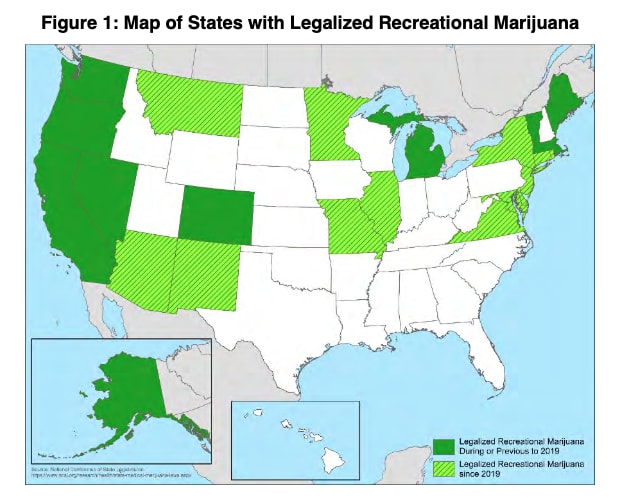
Nearly half the states now have laws legalizing recreational marijuana, with half of the general population and 41% of truck drivers now living in states where recreational marijuana use is legal.
While state-wide legalization is expanding, however, marijuana is recognized as an illegal Schedule I drug by the federal government, along with drugs such as heroin and LSD. That means any marijuana use is illegal by those in certain safety-sensitive positions, such as truck drivers.
Ad Loading...
Despite the rapid changes in state-level marijuana laws, U.S. DOT drug testing policy has generally remained unchanged. The current testing regimen identifies marijuana users who would drive impaired — but it also disqualifies drivers who use marijuana but would never drive impaired, points out the American Transportation Research Institute in its new report, “Impacts of Marijuana Legalization on the Trucking Industry.”
With the majority of the public in favor of relaxing cannabis laws, more states are likely to legalize marijuana.
Source: ATRI
ATRI previously looked at this topic in a study published in 2019. At the time, 10 states had legalized recreational marijuana. That number has more than doubled, as has the population and number of truck drivers living in these states.
For the 2022 research, ATRI asked carriers if they believe that changes in federal drug testing policies for CDL drivers are needed. The majority, 62%, indicated that a change was needed. Those indicating “yes” were asked to elaborate on what changes are needed:
Ad Loading...
Sobriety or impairment test needed: 47%
Marijuana should not be treated as a Schedule I drug: 28%
Stricter drug laws are needed or additional testing options such as hair testing should be recognized: 15%
The American Transportation Research Institute’s analysis of the impacts of marijuana legalization covers several critical topics related to state-level marijuana legalization, including:
The latest demographic trends in marijuana legalization.
Research and data related to highway safety and marijuana use.
Workforce and hiring implications for the trucking industry.
An analysis of publicly available CDL driver drug test data.
The Question of Driver Impairment
The data collected showed that drivers and carriers are equally frustrated with current drug testing limitations, in particular the lack of a test for marijuana impairment.
When motor carriers were asked if they would prefer drivers and driver-candidates be required to take a marijuana test that measured impairment or very recent use (such as within the past day) instead of the current test, which can identify use many weeks prior, 65% indicated they would prefer such a change.
Results were similar among drivers surveyed, with 65% preferring such a change. As one of the drivers commented, “FMCSA should require a marijuana ‘impairment’ test instead of the current marijuana use test. A test showing that someone used marijuana at some point, somewhere is absurdly pointless. It reveals nothing at all about the person that
is relevant to operating a commercial vehicle.”
The THC in marijuana affects areas of the brain that control the body’s movements, balance, coordination, memory and judgment. Decision-making capabilities and slowed reaction times are of particular concern for those operating a motor vehicle.
Ad Loading...
However, ATRI concludes that while “the body of research does conclude that driving under the influence of marijuana causes impairment, and highway safety is negatively impacted by that impairment…. The full impact of such impairment must still be quantified through additional scientific research.”
Is Marijuana Use Forcing Good Drivers Out of the Industry?
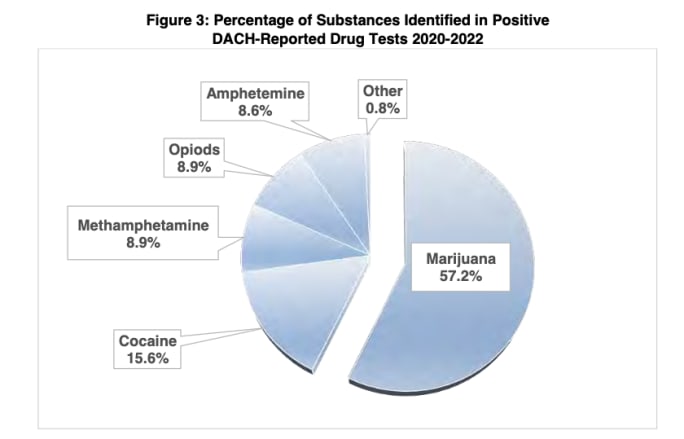
57% of positive findings for drugs were for marijuana.
73% of drivers with positive test results during that time were in prohibited status at the beginning of 2023, and 55% have not initiated the return-to-duty process.
Less than 5% of drivers with previous positive tests completed follow-up testing for RTD, indicating that drivers are more likely to leave the industry than complete the return-to-duty process.
Even for drivers who have gone through a return-to-duty process, the industry survey conducted by ATRI indicates they still will have a challenge finding a job.
When carriers were asked if a prior positive marijuana test at any time in the past automatically disqualifies a driver from employment at their company, the majority (56%) indicated a willingness to hire a driver with a prior positive drug test. However, than means 44% would not even consider truck drivers with a past positive test.
Ad Loading...
And of those who would consider it, more than half indicated that a specific time period must pass first, most commonly five years.
Some drugs are known to be far more dangerous and addictive when compared to marijuana. In light of this, carriers were asked if they treat different drug violations differently. Only 24% of respondents indicated that some drug violations were treated differently from others. Among those, comments included:
“We do not hire individuals with past drug violations other than marijuana.”
“We have begun looking more leniently at marijuana issues since there is so much confusion regarding DOT vs state laws.”
“Anything other than marijuana is a no-hire.”
Because marijuana stays in the system longer, its use is more often detected by federally. mandated drug testing.
Source: ATRI
Marijuana is detectable in DOT urine tests for weeks (up to 30 days) after use, making it far more likely for a marijuana user to test positive than a user of other drugs.
“While current marijuana testing is likely effective at removing drivers who may work while impaired, it also likely removes drivers who previously used the drug but would not operate a truck while impaired,” ATRI points out.
Ad Loading...
What About an Impairment Test?
While the majority of carriers and drivers alike would like to see an impairment test for marijuana, similar to how alcohol is treated, currently there’s no such thing in widely accepted use.
In research released in 2016, the AAA Foundation looked at data collected by drug recognition experts along with arrest data for driving under the influence. The study found that no “objective threshold exists that establish(es) impairment, based on THC concentrations measured in [blood test] specimens collected from cannabis-positive subjects placed under arrest for impaired driving.” In fact, a significant group with high THC levels were not identified as impaired, while some who were considered sober were identified as impaired.
A study published in 2021 found similar results. The researchers tested simulated driving performance of subjects who used marijuana. Blood and oral concentrations of THC were measured. The study found a “poor and inconsistent relationship between magnitude of impairment and THC concentrations in biological samples, meaning that per se limits cannot reliably discriminate between impaired [and] unimpaired drivers,” ultimately concluding that better methods for identifying impairment were needed.
Some researchers believe that a behavioral approach to documenting impairment is the most promising.
Lack of Research
Research on marijuana has been difficult in the past due to federal and state laws making the drug illegal. However, funding for research has steadily grown in recent decades, and the Infrastructure Investment and Jobs Act, passed in November 2021, may increase research and analysis of marijuana’s impacts on roadway safety. The IIJA contains a directive for the U.S. Department of Transportation to produce a report about scientific research and associated research barriers as it relates to marijuana impairment while operating a vehicle.
Ad Loading...
Beyond provisions in the IIJA, the federal Medical Marijuana and Cannabidiol Research Expansion Act, passed last December, removes certain restrictions on research involving marijuana for medical use.
The number of truck drivers living in states where marijuana is legal has more than doubled since the last ATRI study on the topic.
Source: ATRI
Two Possible Government Pathways
The ATRI study documents the strategies and implications of the two pathways the federal government can take in response to advancing legalization efforts.
The first pathway, maintaining the current prohibition policy where marijuana remains a Schedule I drug, would continue the trend of removing thousands of drivers annually from the industry through positive tests for past marijuana use, according to ATRI.
However, the second pathway, a scenario where the federal government eases restrictions and possibly removes marijuana from the Schedule I designation, has significant challenges as well. Prior to any federal legalization action, the report identifies several protections that must be in place for employers in safety-sensitive industries. These include the development of a nationally recognized marijuana impairment test and impairment standards, as well as provisions that protect a carrier’s ability to screen employees for drug use.
Carriers whose updates were due on or after June 1 have more time, while FMCSA works to stabilize its new registration system and warns of phishing sites impersonating its new carrier registration system, Motus.
ZF is expanding its North American commercial-vehicle presence with new transmission applications, electrification, trailer technology and autonomous-driving systems.
Fleets have more visibility into truck health, safety events, and driver activity than ever. The next challenge is turning all that information into useful guidance for the person who has to decide what to do next.
Could Tesla’s camera-only autonomous driving technology work on an 80,000-pound Semi? In this commentary, HDT's Deborah Lockridge takes a look at Tesla, Cybercab, and how autonomous trucks see the road.
The U.S. Department of Transportation issued a new automated-vehicle strategy that outlines plans for driverless-truck regulations, cross-state freight corridors, and federal safety standards.
New York City is expanding intelligent speed assistance and pedestrian-alert systems across its municipal fleet, moving the technologies from pilot programs into vehicle procurement and retrofit requirements.
Federal regulators also are targeting more than 160 additional training providers and launching a nationwide audit of third-party CDL skills testers as part of a broader crackdown on trucking fraud.
Two pilot programs could eventually reshape hours-of-service rules, giving truck drivers options to pause their 14-hour clock or use longer split sleeper rest periods.
Hundreds of thousands of pets travel in truck cabs. A new safety guide from Volvo Trucks and the Center for Pet Safety offers practical advice for truck drivers who bring dogs and cats along for the ride.