




Gentex Bets Big on Digital Glare Control as Headlights Get Brighter
Headlights are getting brighter. Gentex thinks new, digital in-cab technology can help.


Craig Piersma says glare -- from both headlights and sunlight -- is a consistent driver complaint.
Photo: Steve Fecht
If you want to understand where in-cab technology is really headed, it helps to ask a simple question: What are truck drivers asking for?
That’s the approach a vehicle technology company called Gentex is taking, according to Gentex vice president of marketing and communications Craig Piersma.
Piersma spoke to the House of Journalists on Jan. 5, during CES 2026.
During his talk, Piersma noted that much new automotive technology is being incorporated into vehicles by regulation, safety ratings, or the industry’s rush toward automated driving.
But glare -- plain old, everyday glare -- remains one of the few problems drivers across the globe are raising their hands about loudly and consistently.
Tackling Glare Mitigation Head-On
Gentex is the company that helped make automatic-dimming rearview mirrors mainstream.
And today, Piersma said, it thinks glare mitigation is about to take a big step forward. A step that commercial vehicles will likely benefit from sooner than many fleets might expect.
“We really try to listen to the driver,” Piersma said. “And the number one issue around the world we hear drivers complaining about glare is glare from other vehicles on the road.”
Headlight glare is not a new complaint, as anyone old enough to remember the industry switch to halogen headlamps in the 1980s can attest.
What is new, Piersma noted, is the intensity of glare today — and the way it’s adding to everything from driver fatigue to decreased roadway safety.
Piersma cited recent driver surveys showing glare frustration has reached mainstream levels.
Drivers often report squinting, tilting their heads, shielding their eyes, and even wearing sunglasses at night to mitigate headlight glare.
For trucking, the glare issue is more than a passenger-car annoyance. Higher ride heights, larger reflectors, and long night miles amplify the problem.
A Class 8 tractor is both a victim of glare (from oncoming traffic) and a contributor to it (from headlamps mounted higher than a sedan’s mirror line).
Add in wet windshields, road grime, and misaligned lamps, and the real world gets ugly fast, Piersma noted.
Smart Mirrors and Sun Visors
Gentex’s foundational technology is familiar to fleets even if they don’t always say the name out loud. The company was a pioneer in developing the automatic-dimming rear-view mirror.
Piersma said the company ships nearly 50 million auto-dimming mirror units a year and supplies systems on hundreds of vehicle nameplates globally.
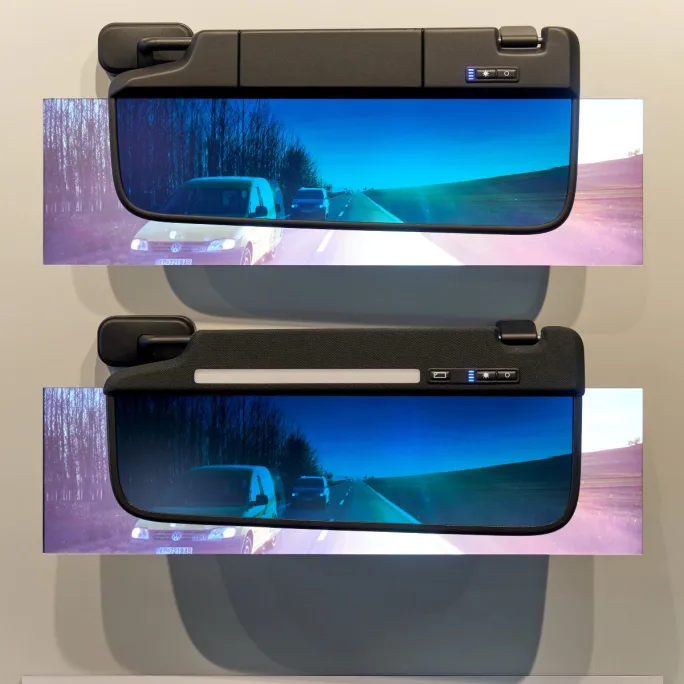
Gentex dimmable sun visors reduce glare will providing a view of the road ahead.
Photo: Steve Fecht
The “auto-dim” story matters, Piersma said, because it’s the bridge to what Gentex is pitching next: Digital glare control that goes beyond the traditional rearview mirror.
Gentex’s approach uses forward-facing ambient-light sensing plus rearward glare detection. Incoming light is processed through onboard logic that commands an electrochromic layer -- essentially a controllable gel between glass -- to darken precisely as needed.
It’s a mature technology that feels like it belongs in the modern software-defined vehicle era, Piersma said. And it solves a problem drivers immediately understand.
But Gentex believes the next big opportunity isn’t just making mirrors smarter. It’s expanding glare mitigation forward into the driver’s primary field of view.
Which is why Gentex’s new technology is focused on a “dimmable” sun visor that stays transparent even when directly facing the sun.
Gentex’s dimmable sun visor is essentially a transparent visor that can dynamically darken to block sunlight glare without blocking the driver’s view.
Instead of flipping down an opaque panel and losing visibility of traffic lights, pedestrians, signage, and lane cues, the driver gets an adjustable shading layer that maintains a clear line of sight.
In trucking, that’s a big problem, Piersma said. Anyone who has run eastbound at sunrise or westbound at sunset knows how quickly glare can turn a normal drive into a white-knuckle exercise.
Fleets train around it. Drivers adapt. Close calls happen anyway.
Gentex’s argument is simple: If you can reduce glare without forcing drivers to sacrifice visibility, you reduce fatigue and risk -- and you make the driver’s job less miserable.
Piersma said Gentex has already secured its first production program for the dimmable visor, with timing he pegged at around the 2027 model year.
Looking ahead, Piersma noted that even though the dimmable sun visor is designed for daytime sun glare, drivers may quickly discover it helps with nighttime headlight glare too.
That opens up new engineering and product questions, he said. How dark is too dark at night? Should the visors be given a dedicated “night mode”? Or do they need different tint behavior to avoid over-attenuation after sunset?
Gentex is already studying those questions to determine how drivers would actually use dimmable sun visors in nighttime driving.
Moving Beyond the Mirror
Even as Gentex pushes forward-facing glare solutions, rearward glare problems remain. If anything, Piersma said, the modern headlamp arms race makes rearview glare worse, especially for vehicles with higher-mounted lamps behind lower vehicles.
For fleets, there’s a practical takeaway: as OEMs chase cost reductions, features like auto-dimming mirrors can be removed from options lists to save money.
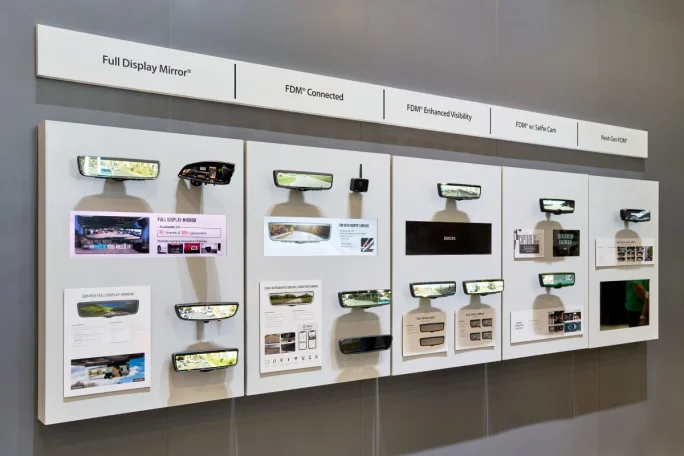
Gentex showcased it's dimmable mirror technology on the show floor at CES 2026.
Photo: Steve Fecht
Gentex sees that trend, and Piersma suggested it’s happening even as glare complaints rise.
That sets up a tension commercial vehicle buyers know well: Features that make drivers safer and less fatigued are often the first ones questioned when budgets tighten -- right up until the day a fleet wants them back.
But his core message was that glare has become a mainstream problem with mainstream frustration -- and the technology to mitigate it is finally moving beyond the mirror.
For trucking, that could mean a near-future cab where glare control becomes layered.
Automatic-dimming mirrors can manage rearward glare, while transparent, adjustable shading can manage forward sun glare -- and potentially help mitigate oncoming headlamp glare in certain use cases.
Gentex is betting the industry is ready to treat glare not as a nuisance, but as a safety hazard worth addressing.
More Safety & Compliance

FMCSA Pauses Biennial-Update Enforcement Amid Motus Transition
Carriers whose updates were due on or after June 1 have more time, while FMCSA works to stabilize its new registration system and warns of phishing sites impersonating its new carrier registration system, Motus.
Read More →
ZF Expands Commercial Vehicle Push in North America
ZF is expanding its North American commercial-vehicle presence with new transmission applications, electrification, trailer technology and autonomous-driving systems.
Read More →
Truck Drivers Need More Than Another Alert
Fleets have more visibility into truck health, safety events, and driver activity than ever. The next challenge is turning all that information into useful guidance for the person who has to decide what to do next.
Read More →
Tesla Wants a Self-Driving Semi. Are Cameras Enough?
Could Tesla’s camera-only autonomous driving technology work on an 80,000-pound Semi? In this commentary, HDT's Deborah Lockridge takes a look at Tesla, Cybercab, and how autonomous trucks see the road.
Read More →
What DOT’s Automated Vehicle Strategy Means for Trucking
The U.S. Department of Transportation issued a new automated-vehicle strategy that outlines plans for driverless-truck regulations, cross-state freight corridors, and federal safety standards.
Read More →
NYC Expands Speed, Pedestrian Safety Tech Across Fleet
New York City is expanding intelligent speed assistance and pedestrian-alert systems across its municipal fleet, moving the technologies from pilot programs into vehicle procurement and retrofit requirements.
Read More →
FMCSA Removes 110 Truck Driver Training Schools from Certified ELDT List
Federal regulators also are targeting more than 160 additional training providers and launching a nationwide audit of third-party CDL skills testers as part of a broader crackdown on trucking fraud.
Read More →
Beyond DOT Compliance: What Makes a Trucking Fleet Truly Safe?
A trucking fleet can follow every rule and still make unsafe decisions. The real test comes when safety conflicts with freight, productivity, or cost.
Read More →
Hours of Service Pilot Programs: FMCSA Readies for 2027 Rollout
Two pilot programs could eventually reshape hours-of-service rules, giving truck drivers options to pause their 14-hour clock or use longer split sleeper rest periods.
Read More →
New Guide Offers Pet Safety Tips for Truck Drivers
Hundreds of thousands of pets travel in truck cabs. A new safety guide from Volvo Trucks and the Center for Pet Safety offers practical advice for truck drivers who bring dogs and cats along for the ride.
Read More →