




How Accountability, Coaching, and Technology Turned a Safety Record Around
With a military mindset and a teacher’s heart, this 2025 HDT Truck Fleet Innovator helps drivers grow into leaders.

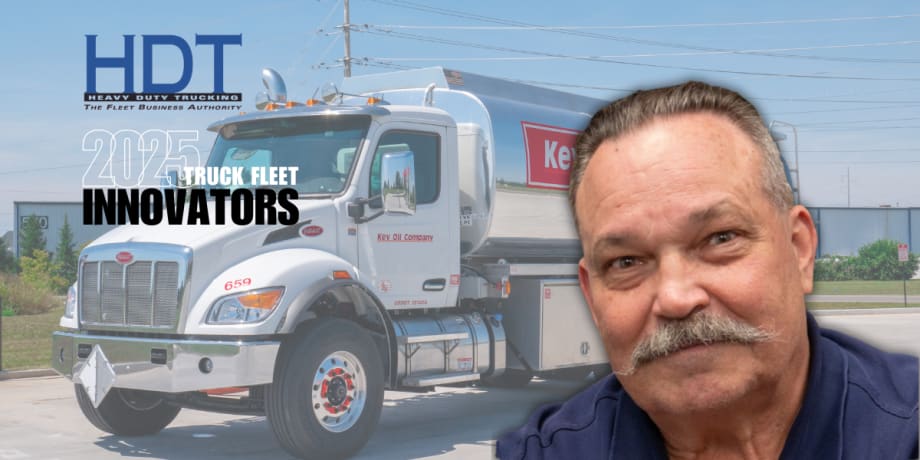
When David Murphy arrived at Keystops, it was on its insurance company's watchlist and and a CSA score riddled with alerts.
HDT Graphic/Keystops photos
When David Murphy got out of the Marine Corps at age 40, he landed a job as a manager trainee for a waste company. As part of his training, he went out on trash routes and experienced the physical challenges and dangers of jumping on and off of slow-moving garbage trucks.
That didn’t sit well with Murphy and his experience with the disciplined safety culture he knew from the military.
But when he brought up his concerns, he says, he was told, “That's the way we do it here.”
Once he became safety manager, he decided to do something about it.

He introduced physical therapists at safety meetings to lead stretching exercises and wellness education. At first, drivers were skeptical, even embarrassed, but were determined to prove themselves.
“And they went from drinking Mountain Dew and Pepsi and Coca-Cola to drinking water and using the truck to do a walk-around of stretching exercises as they did pre-trip inspections,” Murphy says.
Healthy Employees = Longtime Employees
The impact was measurable. Worker’s comp claims, once $100,000 a month, dropped dramatically, and the company went 18 months without an injury.
“I knew that if I kept good employees healthy and working, they would be promotable and they would be longtime employees,” he says.
That philosophy has guided Murphy’s career ever since.
Today, he leads safety efforts at Keystops LLC, the fleet for Key Oil. A colleague who nominated him for this award wrote: “David Murphy’s name has become synonymous with transformation, leadership, and innovation in fleet safety.
"Across four companies, he has taken fleets once known for risk and instability and turned them into safety benchmarks within their industries.”
Driving a Safety Turnaround at Key Oil
Along the way, the physical challenges for drivers became less of an issue because of advances in equipment and technology. Now the focus was on driving skills.
When Murphy joined Key Oil 13 years ago, the fleet was in trouble. Its captive insurance provider had put the company on a watch list. Its CSA scores were full of alerts. Driver turnover was high.
"It took about two years to turn it around,” he says.
In his first safety meetings, he laid down a simple mandate: “We’re going to follow the law, follow federal and state regulations, and we're going to be accountable for maintaining those.”
Eight drivers got up and left that very first meeting.
Most of them eventually returned as Keystops’ reputation for safety and driver respect grew. Today, three of the company’s DOT numbers have a crash indicator of zero, and the fourth is at six.
Keystops is no longer on the insurer’s watch list and has been named to its President’s Circle for three years in a row.
Coaching Drivers Using Technology
Murphy has long believed in the power of coaching and peer accountability. At a previous job, he created a program where at-risk drivers met on weekends to analyze their mistakes, then practiced defensive driving (using the SMITH system) with feedback from their peers.
“Drivers have a high level of pride and are very competitive,” Murphy says. “So when they have a chance to talk about what happened, their peers will call them out on it. This competitiveness helped break their bad habits.”
He couldn’t replicate the program at Key Oil because it’s a seven-day-a-week operation and is further-flung geographically.
Working with Safety Training Manager Dylan West (a 2024 HDT Safety & Compliance Award finalist), the two developed an in-house driver simulator.
To create a similar peer-to-peer experience, they use the simulator at safety meetings. Master drivers take their turn first in front of peers. When at-risk drivers follow, Murphy says, “they don’t want to go in there and do less."
As the at-risk drivers try to live up to the master driver's example, they show their true potential and provide insight into where they need coaching.
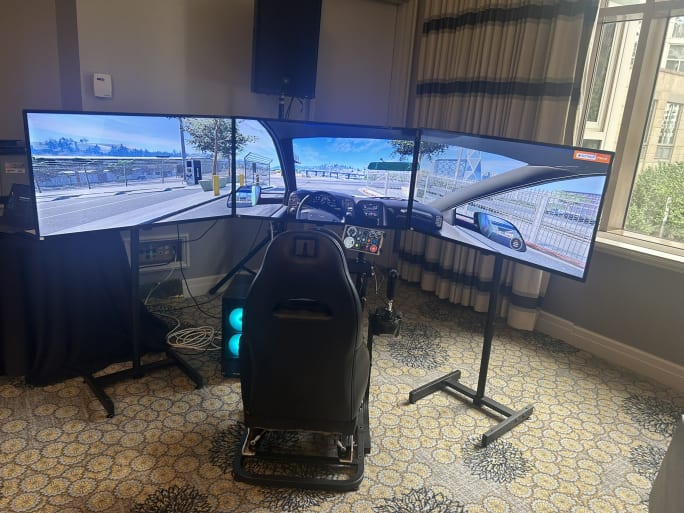
Using neuroscience and real dash cam footage, Keystops' simulator helps evaluate and coach drivers.
Photo: Keystops
How Murphy is Practicing Data-Driven Safety
Murphy is a firm believer in data-driven safety. Analyzing data tells the story of where a fleet needs to focus its attention, he says.
Keystops began using Lytx in-cab camera systems in 2017, upgrading to the 5G AI-powered version in 2021.
The data showed that the most common problems were speed and following distance.
Keystops’ insurance captive tracks key performance indicators using the in-cab camera system, and Keystops has hit four out of four benchmarks every year since 2021.
Getting Driver Buy-In for In-Cab Cameras
Drivers initially pushed back on the Lytx system, which included both inward-facing and outward-facing cameras.
Transparency and education helped change their minds. Murphy brought in attorneys, Lytx officials, and even state police to help drivers understand the benefits.
As drivers started getting used to the system, he says, “They would come in, open my door and say, ‘You know, I don’t really like them, but I find myself being a better driver.’”
Murphy says another factor in gaining driver buy-in was not overwhelming drivers with warnings in the cab.
“Keeping it focused on where you want to go is the important part, not just adding electronics and tech to the cab of the truck,” Murphy says. “It is very distracting for drivers. What they have to deal with on the road needs their attention.”
In addition to using the cameras and data for coaching, Murphy uses the system to drive bonuses and awards.
Murphy’s approach has not only turned around the company’s safety, but also its driver turnover.
“We have some locations that have had no turnover in two years,” he says.
Neuroscience and the Keystops Truck Driver Simulator
Keystops has also partnered with startup Lightship Neuroscience, which uses dash cam footage and neuroscience-based tools to create custom assessments that feel more like engaging video games than traditional training.
Lightship can use a customer’s road-facing dash camera footage to build a series of custom driver assessments and coaching tools based on that fleet’s critical exposures.
The upgraded simulator includes cameras to monitor head and eye movement, providing a deeper layer of feedback.
Results are stored in the simulator so the company can compare how they performed before and after coaching.
They can put drivers through a variety of driving courses and can even trigger real-time hazards from other vehicles, such as a sudden lane change or a blown tire, to see how a driver reacts.
Teaching and Mentoring Future Leaders
Asked what he’s most proud of in his career, Murphy says, “I would say it is the number of people that have been hired and promoted to places at my level and above.”
“There are a number of people who literally, some of them started out as truck washers at a landfill, who became area presidents because they became students of safety.”
He had a long career in the Marine Corps, he says, and always wanted to have a second career as a teacher and a coach. And that’s exactly what he’s been doing ever since.
More Safety & Compliance

FMCSA Pauses Biennial-Update Enforcement Amid Motus Transition
Carriers whose updates were due on or after June 1 have more time, while FMCSA works to stabilize its new registration system and warns of phishing sites impersonating its new carrier registration system, Motus.
Read More →
ZF Expands Commercial Vehicle Push in North America
ZF is expanding its North American commercial-vehicle presence with new transmission applications, electrification, trailer technology and autonomous-driving systems.
Read More →
Truck Drivers Need More Than Another Alert
Fleets have more visibility into truck health, safety events, and driver activity than ever. The next challenge is turning all that information into useful guidance for the person who has to decide what to do next.
Read More →
Tesla Wants a Self-Driving Semi. Are Cameras Enough?
Could Tesla’s camera-only autonomous driving technology work on an 80,000-pound Semi? In this commentary, HDT's Deborah Lockridge takes a look at Tesla, Cybercab, and how autonomous trucks see the road.
Read More →
What DOT’s Automated Vehicle Strategy Means for Trucking
The U.S. Department of Transportation issued a new automated-vehicle strategy that outlines plans for driverless-truck regulations, cross-state freight corridors, and federal safety standards.
Read More →
NYC Expands Speed, Pedestrian Safety Tech Across Fleet
New York City is expanding intelligent speed assistance and pedestrian-alert systems across its municipal fleet, moving the technologies from pilot programs into vehicle procurement and retrofit requirements.
Read More →
FMCSA Removes 110 Truck Driver Training Schools from Certified ELDT List
Federal regulators also are targeting more than 160 additional training providers and launching a nationwide audit of third-party CDL skills testers as part of a broader crackdown on trucking fraud.
Read More →
Beyond DOT Compliance: What Makes a Trucking Fleet Truly Safe?
A trucking fleet can follow every rule and still make unsafe decisions. The real test comes when safety conflicts with freight, productivity, or cost.
Read More →
Hours of Service Pilot Programs: FMCSA Readies for 2027 Rollout
Two pilot programs could eventually reshape hours-of-service rules, giving truck drivers options to pause their 14-hour clock or use longer split sleeper rest periods.
Read More →
New Guide Offers Pet Safety Tips for Truck Drivers
Hundreds of thousands of pets travel in truck cabs. A new safety guide from Volvo Trucks and the Center for Pet Safety offers practical advice for truck drivers who bring dogs and cats along for the ride.
Read More →