




Q&A: Mark Savage on ATA's Law Enforcement Advisory Board
There are some trucking issues that it's hard for the industry to address without the help of law enforcement. The American Trucking Associations' Law Enforcement Advisory Board is working on issues such as truck parking and cargo theft.

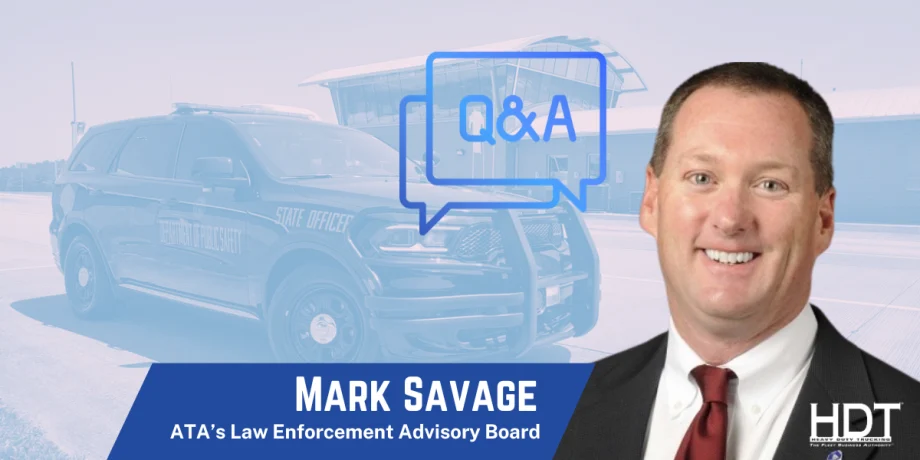
Mark Savage on how the ATA's Law Enforcement Advisory Board is tackling issues such as truck parking and human trafficking.
Image: HDT Graphic
If you believe the old Smokey and The Bandit and Convoy stereotypes, you might think that trucking and law enforcement are locked in a perpetual game of cat and mouse. However, there are ways trucking and law enforcement can work together to ensure safe roads for everyone – and there are some trucking pain points that really need the help of law enforcement to solve.
Enter the American Trucking Associations’ Law Enforcement Advisory Board. It was formed in 2021 to advise the association on ways to grow and strengthen relationships between the trucking industry and law enforcement organizations across the country.
“I think they looked closely at the state trucking associations and how [they] had a strong relationship on a local level and identified that there were some missed partnership opportunities at the federal level and decided to build a build a bridge and fill those gaps,” explains Mark Savage, current chairman of the advisory board, or LEAB.
The board meets bimonthly to provide recommendations on priority issues, such as truck parking, cargo theft, and human trafficking.
LEAB is made up of 20-30 people from around the country who are either currently involved in law enforcement or have been involved in law enforcement in the past but also are involved in commercial vehicle safety in some capacity.
Savage, for instance, retired from the Colorado State Patrol in 2020 after serving 26 years, mostly in commercial vehicle safety. Today, he's the director of connected truck solutions for Drivewyze. We talked to him for the HDT Talks Trucking video podcast about the advisory board and the issues it's addressing.
This interview has been lightly edited for length and clarity.
Deborah Lockridge: What are some things that the Law Enforcement Advisory board has accomplished over those past few years?
Savage: [In addition to] our primary function, which is to increase communication, we decided that we would address three or four critical issues every year. And of course, as you would imagine, over the course of the last four years, some of those issues have continued on into multiple years. And some of them, I wouldn't say necessarily have been accomplished, but have become less of a priority than some other issues.
We started off a couple of years ago when truck parking became a significant issue, working with the U.S. Congress, mainly through the American Trucking Associations. We were able to add context to the discussion about the need for truck parking from the law enforcement perspective.
I think our voice on the Hill … was helpful in getting some money for states to build and maintain truck parking facilities across the country.
What we said was, our officers out there on the road are encountering tired truck drivers who are not able to find a place to rest. These drivers are required to get rest after a certain time period. They can't just keep driving like I can in my personal vehicle — not that I would want to, but I could. There's no law that prohibits it. These drivers have to maintain adequate rest. They cannot be fatigued, and if they can't find a place to get that rest, they can't do it.
And so we had members of the Law Enforcement Advisory Board that shared stories about waking truck drivers up on the side of the road and saying, “Hey, you’ve got to move on,” and the driver saying, “I can't; I can't find a place to sleep.”
What do you do? It's challenging. We don't want the driver sleeping on the side of the road because that, in and of itself, is not safe. But at the same time, forcing a [tired] driver to drive to a safe location, if there isn't one or isn't space available, isn't safe either.
Because it's a challenge for us too. We didn't have an answer to that question.
Watch the full interview on HDT Talks Trucking:
Deborah Lockridge: So what did that lead to?
Savage: Congress passed a bill through the IIJA [aka the Bipartisan Infrastructure Law] that increased funding for truck parking, for truck drivers across country. And I am seeing it at the state level now, because that money gets given down to the state level, and state DOTs are using that money to build truck parking facilities and build technology that allows drivers to get information real time, information about the availability of truck parking spaces along their route.
Lockridge: What other issues has the LEAB tackled?
Savage: One of our other issues is cargo theft, and also human trafficking.
Cargo theft has been a huge issue, primarily along our southern border and in places like Florida, where we have ports.
What we were seeing was the trucking industry getting hit really hard by theft of cargo, and in some cases pretty dangerous actions by criminals taking cargo from trucks, whether they be parked at a truck stop or at a facility — or even at some point, sometimes along the road.
And what we found was law enforcement didn't really know what to do with these. If we have a hijacking of a load, that's pretty obvious. But some of these are quite nuanced and are very confusing for law enforcement officers, given the fact that they have a myriad of other duties. Sometimes officers would only take a phone report.
We partnered with local agencies and federal agencies to not only increase awareness among local officers of the importance of addressing this crime and taking a report but also giving officers resources on what they can do.
A lot of these criminal actions are not just in one jurisdiction. Some are even transnational criminal networks that occur that transfer these goods across state lines. Connecting those local officers with federal officers as well, so that a more comprehensive criminal investigation can begin. For example, it might be something that the Department of Homeland Security or FBI would be interested in.
And I know that some of those or those federal organizations in the last two years have stood up cargo theft task forces in partnership with local agencies.
So the other thing is human trafficking. We have worked with Truckers Against Trafficking and a couple other organizations to really increase awareness about this terrible crime and what not only truck drivers can do, but what law enforcement can do.
Lockridge: How can trucking companies work with law enforcement on human trafficking issues?
Savage: This advice isn't unique to human trafficking, but it's particularly effective as it relates specifically to human trafficking, and that is developing a partnership with local law enforcement where your terminals, your distribution centers are located.
We have several safety directors on the board who either have worked closely with law enforcement over the course of their careers or were law enforcement officers themselves in a former career.
And what we have found is that anti-human trafficking organizations can come in and provide training about the awareness of what to look for.
Some of these safety directors have invited local law enforcement officers to attend that training, and there have been joint trainings between law enforcement and truck drivers at these distribution center terminals, where not only can they learn together, but also can develop a one on one relationship.
Lockridge:What else can trucking companies do to build a better relationship with law enforcement?
Savage: If you are a driver and you are driving across the country, pull into the port of entries, talk to the officers that you see and develop a relationship, no matter where you go.
If you are a safety director or somebody that is in executive leadership with a trucking company, I strongly encourage those folks to not only join their state trucking association, but the American Trucking Associations, because both entities advocate for their members and advocate for drivers and companies as well.
The Colorado Trucking Association has been a great partner for the Colorado State Patrol. And in many other jurisdictions [state trucking associations and the trucking industry] have accomplished a tremendous amount together, primarily focused on safety and improving our roads.
Lockridge: When it comes to relationships with law enforcement, I think traditionally, drivers especially, have perhaps not had the best relationship with law enforcement. What are some things you've learned and some advice you might have?
Savage: I think the biggest thing I can give to both drivers and police officers is to have a better understanding of what the person you're encountering is faced with every day.
So from a law enforcement perspective, understanding what drivers actually have to do, and some of the challenges that they face in their daily routines, and how those challenges impact their ability to get their job done, interact with the public, and in some cases, may even make them a bit cranky during the day.
Just like anybody, we have challenges as the day goes on, and maybe we didn't have our cup of coffee in the morning and get a little cranky.
The same thing would go for truck drivers and understanding that this guy doing your inspection may be a little bit cranky, but it may have nothing to do with you. It might be his computer isn't working correctly, or the last person they encountered had a really challenging day and took it out on the officer. I think if we all kind of took a step back and learned to really understand that, that somebody might be just having a bad day, and try to understand where they're coming from, I think that would help a lot.
Lockridge: And that's probably good advice about any kind of interaction with people. You never know what things they're dealing with that you may not know about.
More Safety & Compliance
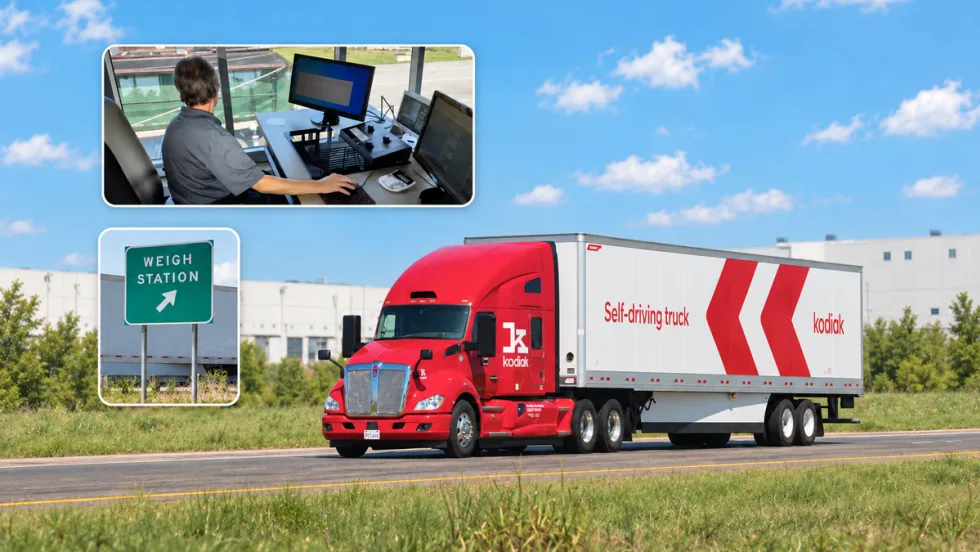
PrePass, Kodiak Connect Driverless Trucks to Roadside Enforcement
The system will allow enforcement agencies to verify Enhanced Inspection information and decide whether Kodiak’s autonomous trucks can bypass roadside screening sites.
Read More →
From One Generation to the Next: How Mentorship Builds Safer Truck Drivers
After three decades in trucking, Harold Perry shares what he's learned about driver safety, mentorship, and helping the next generation build confidence behind the wheel.
Read More →
FMCSA Pauses Biennial-Update Enforcement Amid Motus Transition
Carriers whose updates were due on or after June 1 have more time, while FMCSA works to stabilize its new registration system and warns of phishing sites impersonating its new carrier registration system, Motus.
Read More →
ZF Expands Commercial Vehicle Push in North America
ZF is expanding its North American commercial-vehicle presence with new transmission applications, electrification, trailer technology and autonomous-driving systems.
Read More →
Truck Drivers Need More Than Another Alert
Fleets have more visibility into truck health, safety events, and driver activity than ever. The next challenge is turning all that information into useful guidance for the person who has to decide what to do next.
Read More →
Tesla Wants a Self-Driving Semi. Are Cameras Enough?
Could Tesla’s camera-only autonomous driving technology work on an 80,000-pound Semi? In this commentary, HDT's Deborah Lockridge takes a look at Tesla, Cybercab, and how autonomous trucks see the road.
Read More →
What DOT’s Automated Vehicle Strategy Means for Trucking
The U.S. Department of Transportation issued a new automated-vehicle strategy that outlines plans for driverless-truck regulations, cross-state freight corridors, and federal safety standards.
Read More →
NYC Expands Speed, Pedestrian Safety Tech Across Fleet
New York City is expanding intelligent speed assistance and pedestrian-alert systems across its municipal fleet, moving the technologies from pilot programs into vehicle procurement and retrofit requirements.
Read More →
FMCSA Removes 110 Truck Driver Training Schools from Certified ELDT List
Federal regulators also are targeting more than 160 additional training providers and launching a nationwide audit of third-party CDL skills testers as part of a broader crackdown on trucking fraud.
Read More →
Beyond DOT Compliance: What Makes a Trucking Fleet Truly Safe?
A trucking fleet can follow every rule and still make unsafe decisions. The real test comes when safety conflicts with freight, productivity, or cost.
Read More →