




Dual-Facing Dashcams Gain Traction in 2025 Safety Survey
Trucking fleets are investing more in both tried-and-true safety practices and advanced technology, shows the Heavy Duty Trucking/Work Truck 2025 Safety Survey. Maintenance and safety policies remain the foundation, but dual-facing cameras and air disc brakes are reshaping the safety landscape.


The annual safety survey from Heavy Duty Trucking and Work Truck looks at truck fleet safety technology and trends.
HDT Graphic
Dual-facing in-cab cameras, which many trucking fleets have hesitated to implement due to driver pushback, are now among the fastest-growing safety technologies in trucking fleets, according to the 2025 Heavy Duty Trucking/Work Truck Safety Survey.
This is the fourth year for the survey, which found that truck maintenance and clear safety policies are still the most-used fleet safety strategies.
The survey has shown the most changes in safety technology adoption.
Fleet Safety Strategies
Well-maintained vehicles and written safety policies/procedures were the most-used safety strategies, at 82% and 80%, respectively.
Maintenance as a strategy has increased every year in the four years we have done the survey, from 72% of respondents in 2021 to 82% in 2025.
The use of written safety policies and procedures also is at its highest level since the survey began.
A notable jump was the use of in-cab cameras, which rose from about half of respondents the previous two years to 63% in 2025.
In fact, this year saw a greater percentage of respondents using every safety strategy listed.
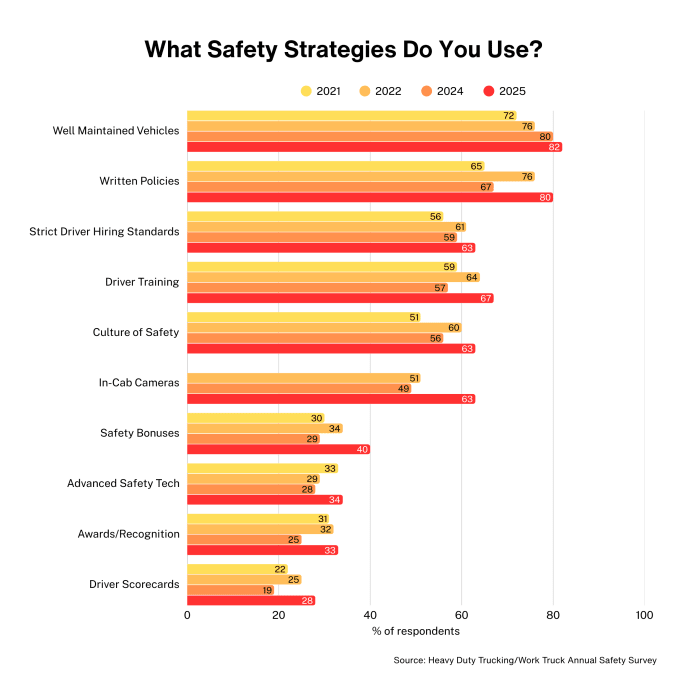
A notable jump was the use of in-cab cameras, which rose from about half of respondents the previous two years to 63% in 2025.
HDT Graphic
Shifts in Safety Technology Use
When it comes to safety technologies being used, there were some interesting shifts in this year’s safety survey.
Air disc brakes rose to the top safety tech in the survey, at 60%.
Forward collision warning rose to number two, rising to 55%.
Last year’s top safety tech, speed limiters, dropped to third place at 50%. (Although that’s about the same percentage as last year, the percentage of fleets using other technologies rose.)
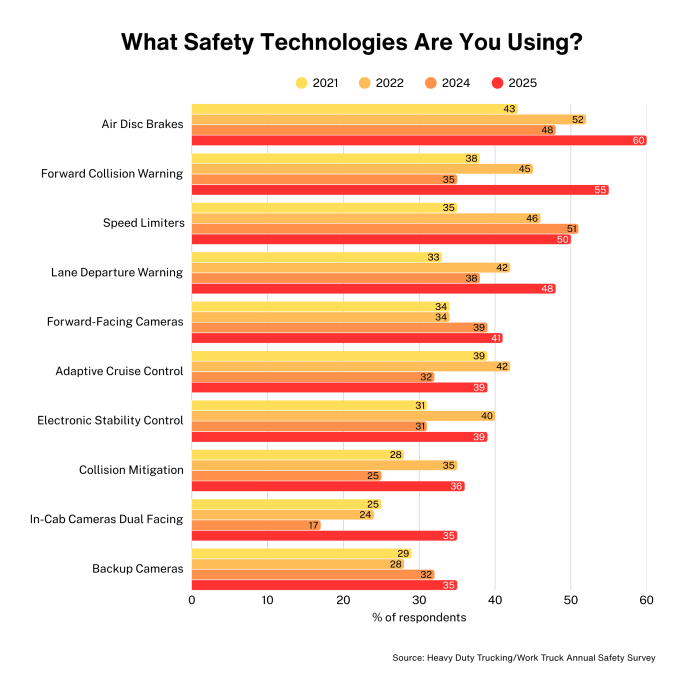
The previous three years of the survey, dual-facing in-cab cameras didn’t even make our Top 10 list of technologies, with 25% or fewer fleets reporting their use. This year that jumped to 35%.
HDT Graphic
Dual-Facing Dash Cams Gain Traction
In the previous three years of the survey, dual-facing in-cab cameras didn’t even make our Top 10 list of technologies, with 25% or fewer fleets reporting their use. This year that jumped to 35%.
Although that still put it at only the number nine spot in the top 10, when we asked what safety technologies respondents plan to implement in the next year, dual-facing in-cab cameras was number one at 14%.
Collision mitigation with automatic emergency braking, or AEB, while it has remained steady at 30% of respondents currently using for the past two years, dropped off our Top 10 list. But regular collision mitigation rose to 36%.
Distracted driving prevention technology, although it didn’t make the top 10, increased to 22%; the previous high was 15% in our 2022 survey.

When we asked what safety technologies respondents plan to implement in the next year, dual-facing in-cab cameras was number one at 14%.
HDT Graphic
Side blind spot monitoring dropped from our top 10 list this year, remaining about the same as last year, but when it comes to the technologies respondents are planning to implement in the coming year, it was second on the list at 13%.
Air disc brakes, forward-facing cameras, and backup cameras tied for third place in the future safety tech fleets are planning, at 12% each.
About one-quarter of respondents didn’t plan to implement any of the safety technologies on the list in the next year, and another quarter didn’t know or weren’t sure.
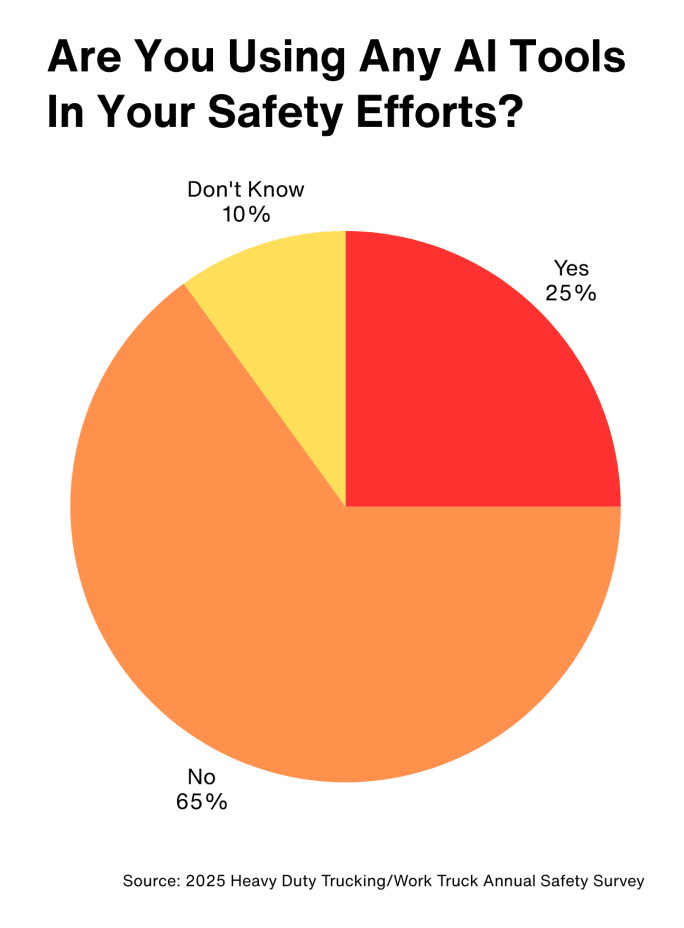
For truck fleets using artificial intelligence tools, the most common was in-cab cameras to detect unsafe behaviors and warn of distracted or even fatigued driving.
HDT Graphic
Artificial Intelligence and Truck Driver Safety
A new question this year: Are you using any artificial intelligence tools in your fleet safety efforts? 25% said they are.
We asked how those fleets were using them. The most common response be far was in in-cab cameras to detect unsafe behaviors and warn of distracted driving or even driver fatigue.
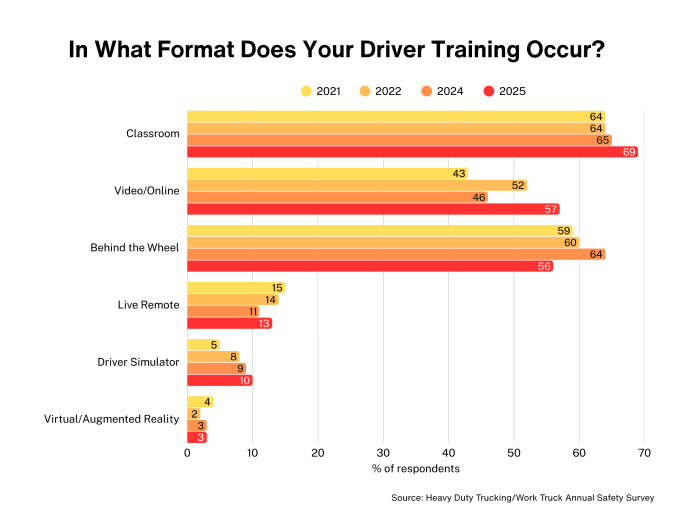
This year’s survey showed an increase in using online video training and a drop in in-person behind-the-wheel trainining among responding truck fleets.
HDT Graphic
Driver Training: How and When
When asked about the format they use for driver safety training, this year’s survey showed an increase in using remote online video training, up to 57%, and a drop in in-person behind the wheel, down to 56%.
The most common was still in-person classroom training at 69%.
Other methods mentioned included one-on-one training when needed, mentoring, and phone or in-person discussions about detected safety events.
When do those drivers get safety-related training?
The vast majority of respondents said when first bringing drivers into the company, or onboarding, at 81%.
We saw more respondents doing monthly training, 36%, up from 27% last year.
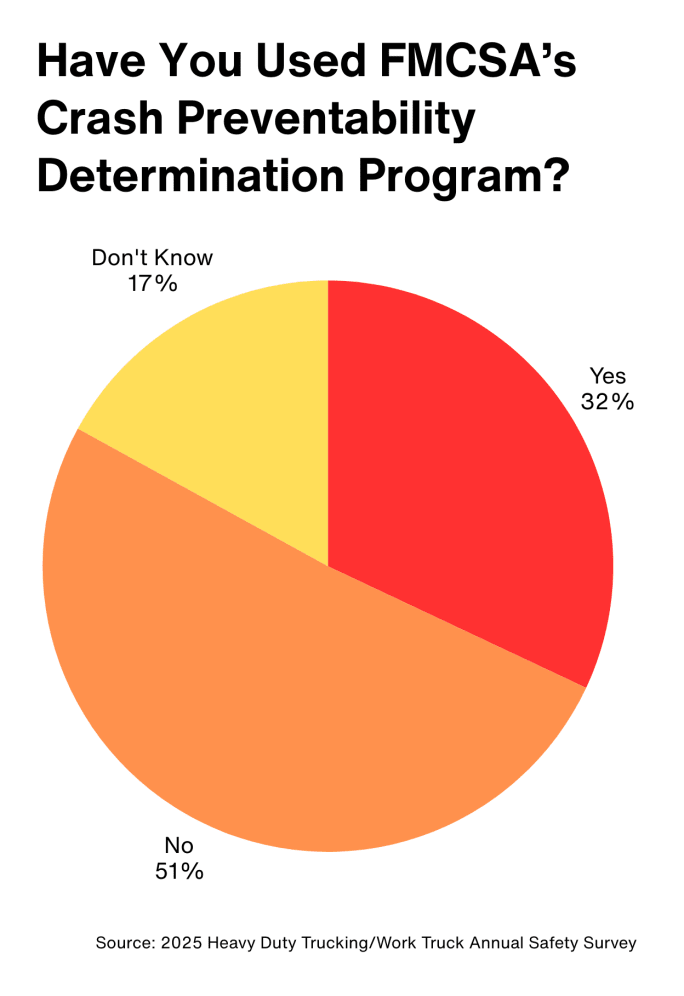
A large number of fleets have not taken advantage of the Federal Motor Carrier Safety Administration’s Crash Preventability Determination Program.
HDT Graphic
Crash Preventability Determination
A large number of fleets have not taken advantage of the Federal Motor Carrier Safety Administration’s Crash Preventability Determination Program, which allows carriers to submit a request for a review to remove non-preventable crashes from their safety scores.
Only 32% said they had; 61% had not, and 18% didn’t know or weren’t sure.
That 32% is up from last year’s results, which were 20%.
Where Do Truck Accidents Happen?
When asked to rank the location of accidents in the order in which the most accidents occur, parking lots took the number one spot for 35% of respondents. Urban streets were number two on the list. For 32% of respondents.
More than half of respondents, 54%, said a shortage of truck parking was not adversely affecting driver safety at their fleets. 39% said it does.
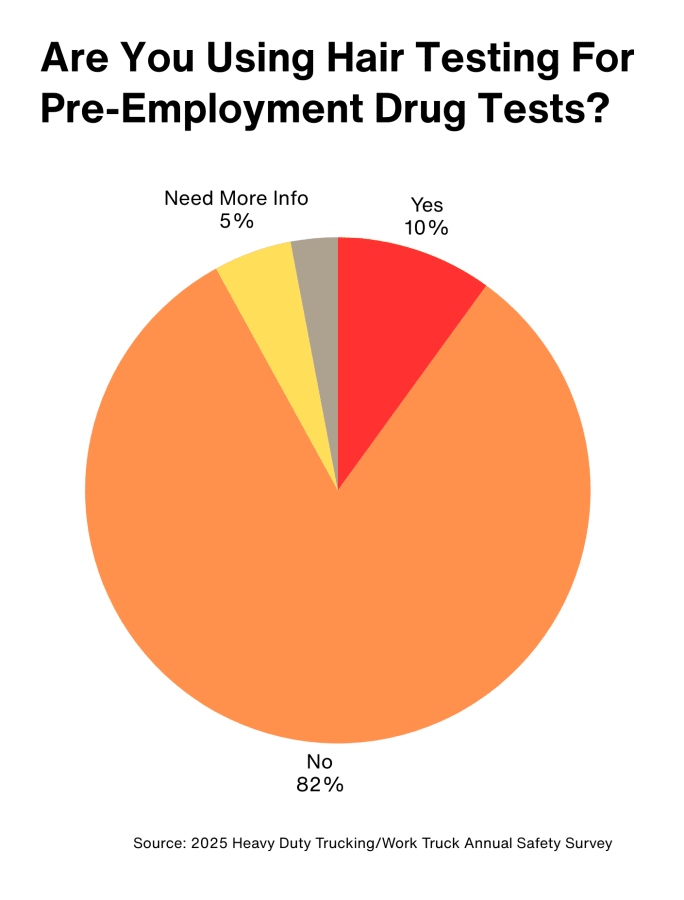
Only 10% of respondents currently use hair tests for pre-employment drug testing.
HDT Graphic
Drug Testing
86% of respondents said their companies were subject to federal drug testing regulations.
Only 10% of respondents said they are currently using hair testing for pre-employment testing of truck drivers and other safety-sensitive workers; 18% said they plan to use hair testing in the future.
Nearly one-fourth said they were waiting for more data on reliability or need more information, and 20% didn’t know or weren’t sure.
More Safety & Compliance

FMCSA Pauses Biennial-Update Enforcement Amid Motus Transition
Carriers whose updates were due on or after June 1 have more time, while FMCSA works to stabilize its new registration system and warns of phishing sites impersonating its new carrier registration system, Motus.
Read More →
ZF Expands Commercial Vehicle Push in North America
ZF is expanding its North American commercial-vehicle presence with new transmission applications, electrification, trailer technology and autonomous-driving systems.
Read More →
Truck Drivers Need More Than Another Alert
Fleets have more visibility into truck health, safety events, and driver activity than ever. The next challenge is turning all that information into useful guidance for the person who has to decide what to do next.
Read More →
Tesla Wants a Self-Driving Semi. Are Cameras Enough?
Could Tesla’s camera-only autonomous driving technology work on an 80,000-pound Semi? In this commentary, HDT's Deborah Lockridge takes a look at Tesla, Cybercab, and how autonomous trucks see the road.
Read More →
What DOT’s Automated Vehicle Strategy Means for Trucking
The U.S. Department of Transportation issued a new automated-vehicle strategy that outlines plans for driverless-truck regulations, cross-state freight corridors, and federal safety standards.
Read More →
NYC Expands Speed, Pedestrian Safety Tech Across Fleet
New York City is expanding intelligent speed assistance and pedestrian-alert systems across its municipal fleet, moving the technologies from pilot programs into vehicle procurement and retrofit requirements.
Read More →
FMCSA Removes 110 Truck Driver Training Schools from Certified ELDT List
Federal regulators also are targeting more than 160 additional training providers and launching a nationwide audit of third-party CDL skills testers as part of a broader crackdown on trucking fraud.
Read More →
Beyond DOT Compliance: What Makes a Trucking Fleet Truly Safe?
A trucking fleet can follow every rule and still make unsafe decisions. The real test comes when safety conflicts with freight, productivity, or cost.
Read More →
Hours of Service Pilot Programs: FMCSA Readies for 2027 Rollout
Two pilot programs could eventually reshape hours-of-service rules, giving truck drivers options to pause their 14-hour clock or use longer split sleeper rest periods.
Read More →
New Guide Offers Pet Safety Tips for Truck Drivers
Hundreds of thousands of pets travel in truck cabs. A new safety guide from Volvo Trucks and the Center for Pet Safety offers practical advice for truck drivers who bring dogs and cats along for the ride.
Read More →