




Brake Maintenance, Done Right
The idea of doing brake maintenance the right way could take many forms, but the ultimate proof of a successful approach to maintenance would be minimizing the number of unscheduled repairs between regularly scheduled preventive maintenance intervals.

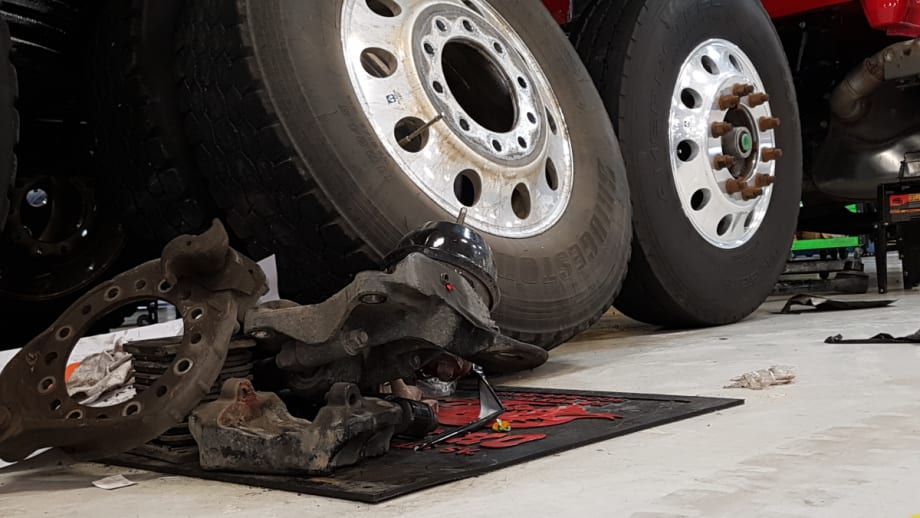
Regular brake maintenance can help prevent unscheduled repairs.
Photo: Jim Park
The idea of doing brake maintenance the right way could take many forms, but the ultimate proof of a successful approach to maintenance would be minimizing the number of unscheduled repairs between regularly scheduled preventive maintenance intervals.
“When doing a preventative maintenance inspection, so many people try to get a little more out of their brakes; run a little farther between brake jobs,” says Darry Stuart, president of DWS Fleet Management Services. “And that results in a repair in between PMs.”
That means a fleet not only has the repair to worry about, but also needs to deal with a driver out of service and what to do about getting the load where it needs to go.
“Putting off a brake job just to squeeze a few extra miles out of a part is a bad idea,” Stuart says. “With the price of trucks today who gives a rat’s tail about the cost of a brake shoe?”
The question maintenance people should be asking is not how much farther they can push the part, but will it make it to the next PM, Stuart believes. “It's really not about how long brakes last. It's about vehicle utilization.”
Avoid These Truck Brake Maintenance Mistakes
Here are a few ill-conceived ideas that might save a few bucks on a PM, but will cost significantly more in the long run:
Allowing linings, drums, cams, bushings, or slack adjusters to become worn to their limits.
Using mismatched parts or the wrong parts in the same axle or axle group.
Reusing worn-out parts.
Using lining thickness as the only gauge to determine when brake work is required.
Using cheap parts that do not fit the truck’s performance profile.
Assuming if everything at the wheel-end looks good, it probably is.
More Equipment

How Volvo Updated Its D13 for EPA 2027 [Watch]
Volvo’s updated D13 promises lower emissions without sacrificing performance or fuel economy. Take a closer look at what changed inside the engine in this HDT Spotlight video.
Read More →
Michelin Tire Improves Efficiency and Durability for Regional Fleets
The Michelin X Multi Energy D2 is a regional haul drive tire engineered to help fleets improve fuel efficiency, durability and traction in demanding stop-and-go operations.
Read More →
ZF Expands Commercial Vehicle Push in North America
ZF is expanding its North American commercial-vehicle presence with new transmission applications, electrification, trailer technology and autonomous-driving systems.
Read More →
Tesla Wants a Self-Driving Semi. Are Cameras Enough?
Could Tesla’s camera-only autonomous driving technology work on an 80,000-pound Semi? In this commentary, HDT's Deborah Lockridge takes a look at Tesla, Cybercab, and how autonomous trucks see the road.
Read More →
Kodiak: Driverless Long-Haul Truck Launch on Track for 2026
Kodiak AI says its driverless long-haul safety case is 93% complete and it remains on track to begin commercial operations by year-end 2026.
Read More →
What DOT’s Automated Vehicle Strategy Means for Trucking
The U.S. Department of Transportation issued a new automated-vehicle strategy that outlines plans for driverless-truck regulations, cross-state freight corridors, and federal safety standards.
Read More →
East Coast Port Launches $45M Electric Truck Push
The Port Authority of New York and New Jersey announced millions in incentives for zero-emission drayage trucks, yard tractors, and new charging hubs near the port.
Read More →
PlusAI Going Public to Fund Autonomous Truck Launch
A SPAC deal could provide PlusAI with up to $300 million as it works toward a 2027 commercial launch of factory-built autonomous trucks.
Read More →
NHTSA Moves to Rewrite Truck Fuel-Economy Rules
The National Highway Traffic Safety Administration says it lacks authority to regulate medium- and heavy-duty truck engines separately from complete vehicles, but the existing standards have not yet been eliminated.
Read More →
Detroit Opens Orders for EPA 2027 Engines
Detroit isn’t starting from scratch to meet EPA 2027 diesel emissions standards. Its Gen 6 DD13 and DD15 engines keep much of today’s platform while updating the fuel and aftertreatment systems.
Read More →