



Safety & Compliance
Beyond DOT Compliance: What Makes a Trucking Fleet Truly Safe?
A trucking fleet can follow every rule and still make unsafe decisions. The real test comes when safety conflicts with freight, productivity, or cost.
 MENU
MENU SEARCH
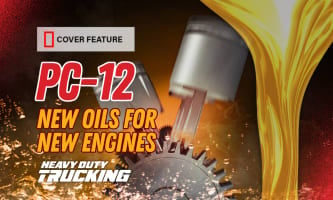
The new API PC-12 heavy-duty engine oil category reflects the changing demands of modern diesel engines. But fleets like Foodliner are looking to getting their own data before making decisions on adopting the new oils and questions such as extending oil drain intervals.
Developing a new oil category is part chemistry experiment, part balancing act.
HDT Graphic
*Summarized by AI
Two years ago, Foodliner was going 90,000 miles between oil drains. A 2024 HDT Truck Fleet Innovator, Vice President of Maintenance Kyle Neumann told me at the time he was looking at stretching them even farther for the 1,500-truck food-grade bulk carrier.
But he's not ready to move forward just yet. Neumann is waiting for another piece of the puzzle to arrive: the next generation of heavy-duty diesel engine oil and the EPA 2027 engines.
"If it weren't for the change in oil coming up soon, we'd probably look at maybe even extending it out a little bit further," he says.
Over the next year, truck makers will be rolling out engines designed to meet EPA's 2027 heavy-duty diesel emissions standards. And with that comes the next heavy-duty diesel engine oil category.
Dubbed PC-12 during the development process, API PC-12 is the new heavy-duty diesel engine oil category developed for EPA 2027 diesel engines. It will replace today's CK-4 and FA-4 categories with two new specifications: CL-4 and FB-4.
The new standard was approved earlier this year.
New diesel engine oil categories typically arrive every decade or so as engines evolve. PC-12 is no exception.
Most heavy-duty diesel engine makers have announced how they will meet 2027 emissions regulations. Cummins. International, Detroit, Mack, and Volvo have taken different engineering approaches to the challenge of strict reductions in nitrogen oxide, or NOx.
Yet they all need a new oil category.
For decades, major changes in heavy-duty diesel engines have required corresponding changes in the lubricant protecting them.
Exhaust gas recirculation, diesel particulate filters, selective catalytic reduction, hotter-running engines, and more all created new performance demands on engine oils.
PC-12 follows that same pattern.
According to the American Petroleum Institute, the new category was developed to support the next generation of heavy-duty diesel engines. Those engines are expected to operate under more demanding conditions.
That means the oil has to do more, too.
So several years ago, truck and engine manufacturers determined that the future engines would need improved oil performance. The Truck and Engine Manufacturers Association asked the American Petroleum Institute for development of a new category.
From there, the proposal moved through a series of industry committees coordinated by API and standards-organization ASTM, involving engine manufacturers, additive companies, oil marketers, and testing laboratories.
The development committee then had to develop tests and performance limits to make sure the new oils can meet those requirements.
Today's current heavy-duty engine oil categories, CK-4 and FA-4, weren't designed for those future demands. PC-12 was developed with targets for improvements in oxidation control, wear protection, aftertreatment compatibility, and material compatibility with the newest elastomers.
EPA is proposing revisions to the NOx rule that could affect what heavy-duty truck and engine manufacturers do in the future. For example, changes to the extended warranty or equipment useful life requirements are being considered.
Will that affect the rollout of the new PC-12 oils?
The American Petroleum Institute told Heavy Duty Trucking that the engines designed for the original EPA rule are already being deployed. The engine oils formulated for these engines are ready now, just waiting for first licensing.
Developing a new oil category isn't as simple as improving one characteristic.
It's part chemistry experiment, part balancing act. Additives that solve one problem can sometimes create another. The oil category developers and the formulators must figure out the best way to achieve the desired oxidation resistance, wear protection, emissions-system compatibility, fuel economy and durability.
The new category also continues the industry's move toward lower-viscosity oils for new engines.
API formally approved the next-generation PC-12 oil category in April, allowing oil companies to finalize formulations and prepare product packaging to meet the new oil specifications ahead of the January 1 licensing date.
Like the previous category, PC-12 is split into two. Oils meeting the new category spec will carry the new CL-4 and FB-4 “donut” certification marks.
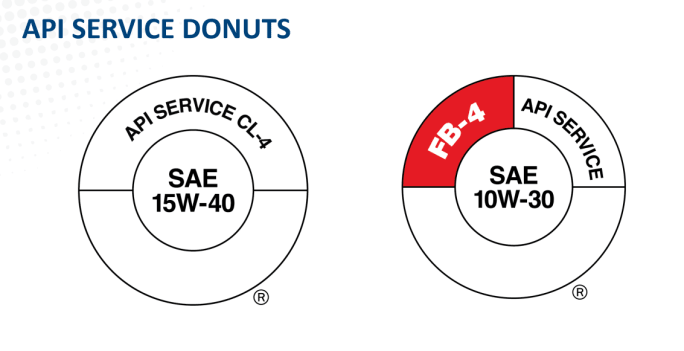
Oils meeting the new category spec will carry the new CL-4 and FB-4 “donut” certification marks.
API
The two new oil categories will serve different purposes.
API CL-4 is the successor to today's CK-4 oil. It's designed to work in existing engines while adding more protection against oxidation and wear, helping to protect emissions systems and improve compatibility with engine seals and other components. For most fleets, CL-4 will be the go-to oil for both current trucks and many older models.
API FB-4 follows the path of today's FA-4 oils. It's designed for newer engines that can take advantage of lower-viscosity oils to improve fuel economy, including xW-20 formulations. Like FA-4, however, FB-4 won't be intended for every engine, so fleets will need to follow their engine manufacturer's recommendations.
For some fleets, engine oil is just another maintenance item. Use an oil that meets the right API category and the manufacturer's recommended specification, change it at the proper interval, and move on.
Increasingly, however, the lubricant has become part of the engine's overall performance strategy.
Take oxidation, for example.
As engine oil ages, exposure to heat and contaminants gradually causes it to oxidize, thickening the oil and reducing its ability to protect engine components. Eventually, oxidation becomes one of the factors that determines when it's time for an oil change, so it’s a key factor in extending oil drain intervals.
That's one reason improved oxidation control was one of PC-12's key performance goals.
Better oxidation resistance should help oil maintain its protective properties longer under the higher temperatures and more demanding operating conditions expected in 2027 engines.
Whether that ultimately translates into longer oil drain intervals is another question, one that depends on the specific oil formulations, the truck's application and duty cycle, and a trucking fleet’s actual maintenance practices.
Neumann knows better than most that extending oil drain intervals isn't simply a matter of pouring in better oil.
Foodliner didn't jump to 90,000-mile intervals overnight. The fleet built confidence through years of oil analysis, carefully monitoring wear metals and other indicators before extending maintenance schedules.
That's exactly how Neumann expects to evaluate PC-12.
"We'll need to get some of [the new trucks] in and start really monitoring them. We may even pull some oil samples a bit quicker than we currently are, just to build more data."
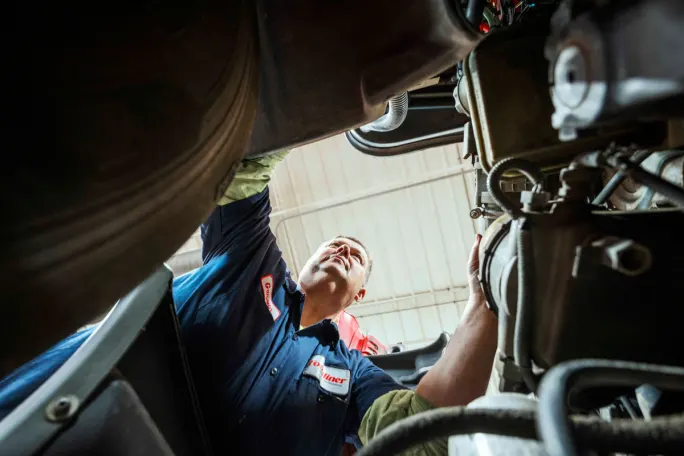
Will the new PC-12 oils allow trucking fleets to extend oil drain intervals?
Courtesy Kyle Neumann
Foodliner plans to purchase between 50 and 100 model-year 2027 trucks next year — fewer than a typical replacement cycle after accelerating purchases ahead of the new emissions standards. The staggered approach gives the fleet time to evaluate both the new engines and the new oils before making broader changes to its maintenance program.
"I think once we run it for at least one cycle, the 90,000 miles, I think we'll have some good data to be able to make a determination that yes, it is going to be able to go that far, or maybe farther," Neumann says. "I sure as heck hope it doesn't mean that we have to go backwards."
Many of the answers simply aren't available yet.
While API has outlined the performance goals for PC-12, engine manufacturers are still finalizing recommendations for their 2027 engines, and commercial oils meeting the new specification aren’t yet available.
OEM recommendations and requirements relative to PC-12 oils should become more clear in the second half of 2026.
It's likely that some manufacturers will allow lower-viscosity FB-4 oils and are likely to use them for factory fills in 2027 trucks. But not all.
CL-4 oils will likely be approved for older vehicles currently using CK-4 oils.
Meanwhile, existing CK-4 and FA-4 oils will be phased out naturally as oil manufacturers and marketers sell out their inventories and replace them with the newer PC-12 formulations.
That uncertainty is typical whenever a new engine oil category arrives.
When CK-4 and FA-4 debuted nearly a decade ago, there were plenty of questions. Fleets didn't immediately rewrite their maintenance programs. They tested, sampled, and tracked maintenance data. Expect the same process with PC-12.
Eventually, fleets will determine whether PC-12 opens the door to longer drain intervals, better fuel efficiency, greater durability, or simply new maintenance practices for their specific operations.
For Neumann, the new oil may be different, but the process for evaluating it won't be.
"I think you've got to rely on your own data."
Loading data...

Safety & Compliance
A trucking fleet can follow every rule and still make unsafe decisions. The real test comes when safety conflicts with freight, productivity, or cost.
Maintenance
The new API PC-12 heavy-duty engine oil category reflects the changing demands of modern diesel engines. But fleets like Foodliner are looking to getting their own data before making decisions on adopting the new oils and questions such as extending oil drain intervals.

Fleet Management
As the pace of change accelerates in trucking, the fleets that adapt best have more than the latest technology. They have cultures that embrace improvement.

Drivers
After more than 20 years as a CDL holder, HDT Executive Editor Jack Roberts is letting his commercial license expire. Not because he wants to — but because trucking's nuclear verdict crisis has made the risks of public-road test drives too great for editors, manufacturers, and everyone involved.

Fleet Management
Fleets fear falling behind if they don’t adopt AI quickly enough. They also fear what happens if the technology makes the wrong decision.

Fuel Smarts
Relying on diesel alone exposes fleets to fuel price volatility. Here’s why diversification with electric, natural gas, and renewable fuels can reduce risk.
Fleet Management
Cargo theft is evolving from regional smash-and-grab operations to sophisticated fraud schemes. Strategic theft now accounts for roughly a third of cargo crime, with incidents rising sharply in recent years. Here’s how the schemes work — and what fleets can do to protect themselves.

Maintenance
With copper-free brake standards taking effect, suppliers are reengineering friction materials, and fleets are weighing what the change means for air disc brake performance on the road. Find out more in this Heavy Duty Trucking Digital Cover Story for March 2026.

Maintenance
For the first time, heavy-duty trucking fleet managers and technicians can actually partner with intelligent machines to predict failures and manage vehicle uptime.

Fleet Management
2026 looks like it could be a bumpy ride for motor carriers. Is your heavy-duty trucking fleet ready for whatever is coming your way?