




HHS Hair-Testing Proposal Falls Short, Critics Say
A proposal from the Department of Health and Human Services to set up standards for the use of hair testing for drugs is not what hair-testing advocates in the trucking industry were hoping for.

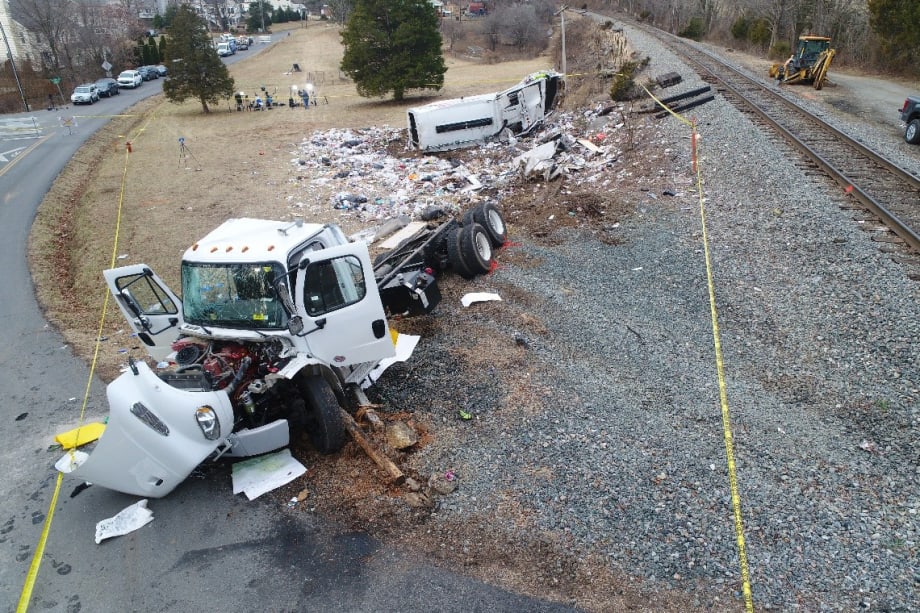
Hair-testing advocates say it could help keep lifestyle drug users off the highways. This crash made national headlines, when an Amtrak train carrying Republican congressional members hit a refuse truck stopped on a crossing. The National Transportation Safety Board determined the driver was impaired from the combined effects of marijuana and gabapentin.
Photo: NTSB
A proposal from the Department of Health and Human Services to set up standards for the use of hair testing for drugs is not what hair-testing advocates in the trucking industry were hoping for.
HHS setting hair testing standards is the first step in fleets being able to use hair testing instead of urine testing for pre-employment drug tests of safety-sensitive transportation workers such as drivers.
Currently, while many safety-focused fleets use hair testing for their own hiring standards, it may not be used to satisfy federal drug-testing requirements. Such fleets must foot the bill for double testing.
In addition, because hair testing is not included in the new federal drug and alcohol clearinghouse, hair-testing advocates say there are many drivers who are simply going down the road to a fleet that doesn’t do hair testing, but those fleets have no way to know the driver failed a hair test at another fleet.
HHS rules setting out standards for hair-testing must be in place before the Department of Transportation can change the rules to allow hair testing to be used.
But the proposal as it stands, say advocates for hair-testing in trucking, is “a tremendous disappointment,” as American Trucking Associations President and CEO Chris Spear said in a statement. “President Trump and his administration have successfully tackled difficult, contentious regulatory challenges with environmental and labor issues, yet on a top-tier priority for highway safety, the administration allowed HHS to deliver a weak and misguided proposal more than three years late.”
Why the HHS Proposal Falls Short
The notice of proposed Mandatory Guidelines for Federal Workplace Drug Testing Programs using Hair will allow federal executive branch agencies (and the entities they regulate) to collect and test a hair specimen as part of their drug testing programs, for pre-employment and random testing.
However, it says, a federal agency choosing to test hair specimens must authorize collection and testing of at least one other specimen type, such as urine or oral fluid, that is authorized under the Mandatory Guidelines for Federal Workplace Drug Testing Programs.
“This two-test approach is intended to protect federal workers from issues that have been identified as limitations of hair testing, and related legal deficiencies,” HHS said in the proposal, citing two cases indicating that an employment action taken on the basis of a positive hair test alone, without other corroborating evidence, may be vulnerable to legal challenge.
Using a urine test to corroborate isn't the answer, say critics.
“Congress required HHS to develop this rule because our urine-based drug testing system is easily defeated. Hair testing isn’t."
“Congress required HHS to develop this rule because our urine-based drug testing system is easily defeated. Hair testing isn’t,” explained P. Sean Garney, vice president, Scopelitis Transportation Consulting, in response to a query from HDT. “The problem is that this proposal really only allows the use of hair testing to identify negative tests. All positive tests must be confirmed using the system Congress was seeking to improve.”
Garney explained that hair-testing’s longer detection window “makes it a superior specimen to detect lifestyle drug users. Requiring the confirmation of a positive hair test with an alternative specimen with a shorter detection window, eliminates the benefit hair testing.”
ATA spokesperson Sean McNally explained that the association’s biggest concern is the requirement to have an “alternate specimen” for testing in the event of an initial positive hair test.
“This would undermine the effectiveness of hair testing, especially for carriers already utilizing hair testing in addition to their DOT drug testing programs. This requirement would, in addition to the burden of a redundant test, create the potential for discrepancies in testing results due to the thoroughness of hair testing," McNally explained in an email to HDT.
“In addition, these guidelines are in essence telling employers not to use a positive hair test result in their employment decision-making process. Given that we know that hair testing can be as much as five times as effective in identifying drug users because of its longer window of detection, this will have a significant impact on carriers’ ability to keep drug users out from behind the wheel of their trucks.”
"These guidelines are in essence telling employers not to use a positive hair test result in their employment decision-making process."
Lane Kidd, managing director of The Alliance for Driver Safety and Security, known as The Trucking Alliance, pointed to recently released research based on its members’ drug-testing comparisons of hair and urine testing. The Alliance is an association of safety-focused fleets and allied members who advocate for hair testing, onboard truck safety technology and other safety-focused policies.
“The University of Central Arkansas concludes in new research that about 300,000 drug impaired truck drivers are out there operating on our highways today, and that’s a danger to the public and a serious liability risk for trucking companies that don’t utilize hair testing.”
The research validated a study conducted by the Trucking Alliance last year comparing pass/fail rates for urine and hair drug screens. Using 151,662 paired pre-employment urine and hair drug test results from 15 different trucking companies, their results indicated that 949 (0.6%) applicants failed the urine test – but some 13 times as many, 12,824 (8.5%), failed or refused the hair test.
Critics contend that hair-testing results can result in false positives because certain drugs can be absorbed into the hair from the environment – and that this allegedly happens more easily with African-American hair, leading to accusations of racial bias in these tests as well.
But hair-testing advocates say those concerns are unfounded, provided the testing is done properly.
The Arkansas/Alliance research found that “comparing urine and hair pass/fail rates for various ethnic groups, our results indicate ethnic groups are significantly different irrespective of testing procedure.”
In the proposal, HHS said it is specifically “requesting comments, including support from recent peer-reviewed scientific literature, on advances in the science of hair testing that adequately address these limitations and elucidate the extent to which hair color, external contamination and other factors (e.g., hair treatments, hygiene) will affect hair tests and the interpretation of hair drug test results.”
Scopelitis' Garney said that the HHS is “focusing on a scientific debate that ignores the practical experience of carriers using hair testing. The data is clear, hair testing works. Some companies voluntarily using hair testing for pre-employment have reported their random and post-accident testing programs shrinking to a 0% positive rate.”
What’s next?
“This process has been long and painful for most involved,” Garney said. “HHS has been working on this for 20 years and this recent publication, while an important milestone, does not indicate we’re that much closer to the finish line. The trucking industry will have an opportunity to comment on this proposal before it’s finalized, hopefully with significant changes. After that, the industry will need to wait for the Department of Transportation to go through its rulemaking process to allow the use of hair testing by motor carriers. This process could take a couple years on its own.”
The proposal is scheduled to be published in the Federal Register on Sept. 10 with a 60-day comment period.
ATA and the Trucking Alliance made comments that seem to indicate that they may appeal to Congress for help. In its statement, ATA’s Spear said, “Sadly, the positive impact this rule could have had to make both highways and truckers safer will have to wait. ATA will be working again with Congress to fix what HHS has failed to do – its job.”
That was echoed by The Alliance’s Kidd. “Unless Congress steps in to allow hair test results into the Drug and Alcohol Clearinghouse, most employers will not know if a truck driver applicant has previously failed a hair test for illegal drug use,” he said.
More Safety & Compliance

ZF Expands Commercial Vehicle Push in North America
ZF is expanding its North American commercial-vehicle presence with new transmission applications, electrification, trailer technology and autonomous-driving systems.
Read More →
Truck Drivers Need More Than Another Alert
Fleets have more visibility into truck health, safety events, and driver activity than ever. The next challenge is turning all that information into useful guidance for the person who has to decide what to do next.
Read More →
Tesla Wants a Self-Driving Semi. Are Cameras Enough?
Could Tesla’s camera-only autonomous driving technology work on an 80,000-pound Semi? In this commentary, HDT's Deborah Lockridge takes a look at Tesla, Cybercab, and how autonomous trucks see the road.
Read More →
What DOT’s Automated Vehicle Strategy Means for Trucking
The U.S. Department of Transportation issued a new automated-vehicle strategy that outlines plans for driverless-truck regulations, cross-state freight corridors, and federal safety standards.
Read More →
NYC Expands Speed, Pedestrian Safety Tech Across Fleet
New York City is expanding intelligent speed assistance and pedestrian-alert systems across its municipal fleet, moving the technologies from pilot programs into vehicle procurement and retrofit requirements.
Read More →
FMCSA Removes 110 Truck Driver Training Schools from Certified ELDT List
Federal regulators also are targeting more than 160 additional training providers and launching a nationwide audit of third-party CDL skills testers as part of a broader crackdown on trucking fraud.
Read More →
Beyond DOT Compliance: What Makes a Trucking Fleet Truly Safe?
A trucking fleet can follow every rule and still make unsafe decisions. The real test comes when safety conflicts with freight, productivity, or cost.
Read More →
Hours of Service Pilot Programs: FMCSA Readies for 2027 Rollout
Two pilot programs could eventually reshape hours-of-service rules, giving truck drivers options to pause their 14-hour clock or use longer split sleeper rest periods.
Read More →
New Guide Offers Pet Safety Tips for Truck Drivers
Hundreds of thousands of pets travel in truck cabs. A new safety guide from Volvo Trucks and the Center for Pet Safety offers practical advice for truck drivers who bring dogs and cats along for the ride.
Read More →
Medical Cards, English Proficiency Reshape Roadcheck Violations
Medical-card violations jumped to the top of the driver out-of-service list during CVSA’s 2026 International Roadcheck, while English-language proficiency violations appeared among the leading violations for the first time.
Read More →