





Trucking Under the Influence, Part 1: Truckers, Drugs, and Safety
Trucking Alliance: Driver Drug Use a Top Trucking Safety Issue
A safety-focused group of trucking and logistics companies has released the results of what it calls a first-of-its-kind study showing “compelling evidence that thousands of habitual drug users are skirting a system designed to prohibit drug use in transportation.”
June 12, 2019
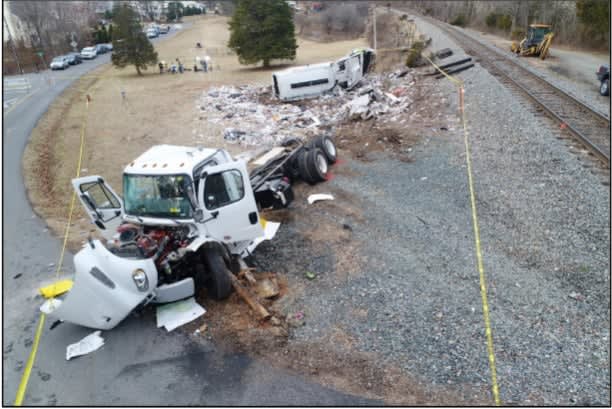
This crash made national headlines, when an Amtrak train carrying Republican congressional members hit a refuse truck stopped on a crossing. The National Transportation Safety Board determined the driver was impaired from the combined effects of marijuana and gabapentin.
Photo courtesy NTSB
3 min to read
A safety-focused group of trucking and logistics companies has released the results of what it calls a first-of-its-kind study showing “compelling evidence that thousands of habitual drug users are skirting a system designed to prohibit drug use in transportation.”
The Alliance for Driver Safety & Security, commonly known as the Trucking Alliance, contended in testimony to Congress that “the trucking industry has no greater safety issue, than to aggressively address illegal drug use among commercial truck drivers.”
During a June 12 hearing held by the U.S. House of Representatives Committee on Transportation and Infrastructure's Sub-Committee on Highways and Transit on “The State of Trucking in America,” the Trucking Alliance presented the results of a study comparing urinalysis testing and hair-testing results for pre-employment testing of truck drivers.
It found the urinalysis missed 9 out of 10 illicit drug users.
Trucker Drug-Testing
The Omnibus Transportation Employee Testing Act of 1991 requires drug and alcohol testing of “safety-sensitive” transportation workers, including truck drivers.
The U.S. Department of Transportation administers the law, using drug-test guidelines approved by the Department of Health and Human Services. DOT currently recognizes one drug test method – a urinalysis. But it allows employers to require additional drug-test methods as part of the employer’s hiring practices.
A growing number of trucking company employers, including Trucking Alliance carriers, require a second drug test, a hair analysis, as part of their pre-employment truck driver hiring policies.
The Alliance survey data compared the pre-employment drug test results of 151,662 truck driver applicants, who were asked to submit to two drug tests – a urinalysis and a hair analysis. Almost all applicants held an active commercial driver's license. Ninety-four percent (94%) of the truck driver applicants tested drug-free.
However, thousands of applicants failed either or both drug tests.
The Alliance reported that the urinalysis, the only method recognized by DOT and relied on by almost all trucking company employers, failed to identify most drug users. The urinalysis detected drugs in 949 applicants, about 1% of the population. However, 8.6%, or 8,878 truck driver applicants, either failed or refused the hair test.
“Put another way, the urinalysis missed 9 out of 10 actual illicit drug users,” said the Alliance.
The most prevalent drug was cocaine, followed by opioids and marijuana.
“Applicants who failed or refused the hair test were disqualified for employment at these companies, but likely obtained the same job elsewhere, at companies that administer only a urinalysis," said the Alliance, meaning “thousands of drug abusers are obtaining jobs as truck drivers, despite their drug use."
Congress Asked to Act on Driver Drug Use
The Alliance testified that the results represent a statistically valid sample. According to the American Trucking Associations, there are 3.5 million commercial truck drivers. The survey can project with a 99% confidence level, and a margin of error of <1%, that 301,000 commercial truck drivers would fail or refuse a hair analysis today, for illegal drug use, according to the group.
“Drug use in the trucking industry is a public safety crisis,” said the Alliance in its testimony. “This survey can project as many as 301,000 commercial drivers would fail or refuse a hair test. These illicit drug users must be identified and taken out of commercial trucks and off the nation’s highways.”
The Alliance asked Congress to urge HHS to complete hair test guidelines that are currently under development, so DOT can quickly recognize hair-testing for DOT pre-employment and random drug test protocols.
The group also pointed out that until DOT recognizes hair-analysis testing, no employer will be allowed to submit hair-test failures into the pending Drug and Alcohol Clearinghouse. The clearinghouse is intended to allow employers to know if a person applying for a truck driver job has previously failed a drug test, but without hair-testing results being included, it will miss the drivers who were able to pass a urinalysis but failed the hair test.
More Drivers

Truck Drivers Need More Than Another Alert
Fleets have more visibility into truck health, safety events, and driver activity than ever. The next challenge is turning all that information into useful guidance for the person who has to decide what to do next.
Read More →
FMCSA Removes 110 Truck Driver Training Schools from Certified ELDT List
Federal regulators also are targeting more than 160 additional training providers and launching a nationwide audit of third-party CDL skills testers as part of a broader crackdown on trucking fraud.
Read More →
Hours of Service Pilot Programs: FMCSA Readies for 2027 Rollout
Two pilot programs could eventually reshape hours-of-service rules, giving truck drivers options to pause their 14-hour clock or use longer split sleeper rest periods.
Read More →
Medical Cards, English Proficiency Reshape Roadcheck Violations
Medical-card violations jumped to the top of the driver out-of-service list during CVSA’s 2026 International Roadcheck, while English-language proficiency violations appeared among the leading violations for the first time.
Read More →
Driver Trust Can Make or Break the Success of Fleet Safety Technology
New Teletrac Navman research suggests that onboarding, transparency about driver data, and positive feedback can play a significant role in how commercial drivers respond to safety and coaching technology.
Read More →
EEOC Sues KLLM Over Alleged Sex Discrimination in Driver Training
KLLM is facing a federal sex-discrimination lawsuit over policies the EEOC alleges put female truck driver trainees at a disadvantage.
Read More →
FMCSA Moves to Codify English Language Requirements for Commercial Drivers
By changing regulations on English-language proficiency requirements for commercial drivers, rather than relying on a guidance memo, the FMCSA said future administrations won't be able to walk back the Trump administration's stricter enforcement with just a memo.
Read More →
Drivers Put Western Star Trucks to the Test at Star Nation Experience
Watch to get an inside look at the Western Star trucks, technology, and community behind the Star Nation Experience 2026!
Read More →
Trump Administration Looks to Put More Veterans Behind the Wheel
The Freedom Haulers program pulls together existing and expanded programs at several federal agencies to recruit veterans to drive commercial heavy-duty trucks and cut the red tape for them to get a CDL, training, and employment.
Read More →
Putting Mack’s Command Steer to the Test
A test drive of Mack’s Command Steer active steering system evaluates how it can make truck driving easier and less tiring.
Read More →