




Why Diesel Price Relief Efforts May Fall Short
Diesel prices have eased from September’s record high, but doubts about additional Russian supply and limits on dyed-diesel tax relief mean trucking fleets still face expensive fuel. And prices could go higher.


When the U.S. attacked Iran in February, many believed the surge in crude oil and diesel prices would be temporary. That hasn't happened, and diesel prices hit a record high in September.
HDT Graphic
- Despite a drop from September’s record high, diesel prices remain a significant cost for trucking fleets.
- Uncertainty persists about additional supply from Russia, keeping diesel prices volatile.
- Limitations on dyed-diesel tax relief contribute to the continued burden of high fuel costs.
*Summarized by AI
Trucking fleets have gotten a little breathing room at the diesel pump in recent weeks. But with diesel prices still above $6 a gallon nationally, and signs of renewed pressure in wholesale markets, that relief could be short-lived.
The Trump administration is trying to bring costs down by opening the door to more Russian diesel exports and easing restrictions on highway use of red-dyed diesel. Both moves have drawn skepticism about how much they will help truckers.
How much will fuel bills actually fall? How soon? And will any tax relief come with an obligation to pay later?
Why Are Diesel Prices so High?
Diesel prices remain high because wars in the Middle East and Ukraine have disrupted refinery operations and fuel exports, squeezing global supplies. Shipping disruptions through the Strait of Hormuz have added to the pressure.
Those shortages have drawn down inventories ahead of fall refinery maintenance and winter heating demand, keeping diesel expensive even when crude oil prices ease.
The U.S. Energy Information Administration’s latest available weekly survey put national average diesel prices at $6.179 a gallon for the week ending October 12, $2.514 higher than a year earlier.
As of October 14, AAA's daily fuel price report showed the national average price of diesel at just under $6.30 per gallon. That’s down from AAA’s record average of $6.53 recorded September 22, but oil expert Tom Kloza said in a social post that the record could be broken by the midterm elections.
U.S. diesel futures rose about 5% by midday October 13, NBC News reported, as analysts questioned whether the announced Russian supply would materialize. Generally, a jump in futures prices means higher prices at the pump are on the way.
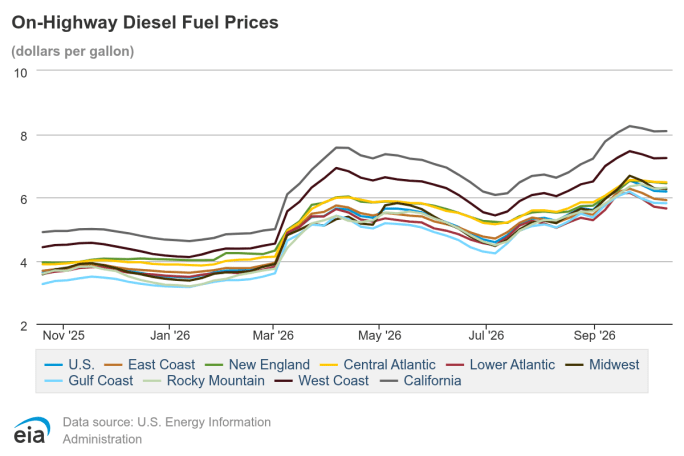
In California, average diesel prices remain more than $8 per gallon.
U.S. Department of Energy
Kloza, chief energy advisor for Gulf Oil and a longtime authority on oil and fuel prices, wrote on the social media channel X: “Absolutely stunning price spikes in wholesale diesel today…. Market clearly not believing that Russian oil is on the way.” He added: “US retail diesel price record of $6.53/gal could be topped by the midterms.”
How Much Can Russian Diesel Help?
President Trump’s agreement with Russian President Vladimir Putin would release additional diesel into global markets. But the announced volumes are small compared with demand, and questions remain about Russia’s ability to deliver them.
According to CNBC, the full announced supply would total about 36 million barrels — equivalent to roughly 10 days of U.S. demand or a little more than one day of global demand. Those barrels would be released in stages.
CNBC also reported that Goldman Sachs estimated the Russian releases planned for October and November would lower wholesale diesel prices by only $1 to $2 a barrel. That works out to roughly 2 to 5 cents a gallon at the wholesale level, before any effect on retail prices.
Additional supply could help. But those estimates suggest this particular deal may not have a huge effect on trucking fleets' fuel bills.
Dyed Diesel Comes With Complications
The administration’s other major move is closer to home: temporarily easing federal restrictions on using red-dyed diesel in highway vehicles.
Dyed diesel is normally used in off-road equipment, such as farm and construction machinery. The dye identifies fuel sold without the taxes normally collected on highway diesel.
Trump’s October 5 executive order directs the U.S. Treasury Department and the IRS to provide specified penalty relief for highway use of dyed diesel through the end of the year. It also directs Treasury to determine whether it can legally defer certain diesel tax payments and which taxpayers qualify.
The distinction matters. Deferring a tax payment means paying it later. The order calls for Treasury to explore ways to eliminate those obligations, including legislation, but does not itself forgive them. Upcoming guidance should spell out eligibility, conditions, and payment deadlines.
The federal diesel tax is 24.4 cents a gallon, or $61 on a 250-gallon purchase. The White House’s advertised savings of more than $100 per fill depends on states providing corresponding relief.
Fleets need to know whether they are getting a lasting reduction or temporarily holding money they will eventually owe.
“This is a directive for temporary penalty relief and potential tax deferral, not a blanket repeal of diesel taxes or all fuel-related requirements,” Henry Hanscom, American Trucking Associations chief advocacy and public affairs officer, told members in an email.
ATA advised carriers to wait for Treasury guidance before using dyed diesel on the road.
Crossing State Lines Adds Another Wrinkle
Federal relief also does not settle state fuel taxes or International Fuel Tax Agreement reporting.
States have issued different measures, with different dates and limits on eligible operations. Some relief applies specifically to agricultural activity. Interstate fleets need to check the rules along their routes, rather than assume permission in one state carries into the next. IFTA maintains notices and links to the individual state instructions.
Availability is another concern. As ATA’s guidance points out, carriers need to confirm that their fuel suppliers can participate, understand the reporting requirements, and keep complete fuel and mileage records.
ATA also cautioned that dye can remain in fuel systems after temporary relief expires. And it recommended checking with equipment suppliers about possible warranty implications.
There is a broader limitation, too. Changing the tax treatment of diesel does not produce more fuel.
“Every dollar helps, but this is a 24-cent answer to a $2.60 problem,” said John Tirado, a former Wall Street energy analyst who now runs commercial fuel supplier Summa Energy and also owns a trucking company.
Tirado points to constrained global refining capacity as the bigger problem. Expanding access to dyed diesel changes who can use existing gallons. It does not solve the shortage of refined diesel fuel.
The Owner-Operator Independent Drivers Association also expects "minimal relief" from the dyed-diesel initiative.
“Truckers are feeling the pain at the pump. Every $1 increase per gallon in fuel costs our members around $400 more per week, and sustained high prices will put many truck drivers out of business,” said President and CEO Todd Spencer.
Higher Freight Rates Don’t Mean Better Margins
September’s freight-rate numbers show how expensive diesel is working its way through trucking.
DAT Freight & Analytics reported that rates including fuel rose across dry van, refrigerated and flatbed markets. But after removing its estimated fuel component, van and flatbed rates fell in both spot and contract markets. Reefer rates increased.
DAT’s estimated fuel component reached records of 84 cents a mile for van, 92 cents for reefer and $1.01 for flatbed.
For a truck running 500 miles a day at 6 mpg, DAT calculated September’s average diesel price meant spending about $524 a day on fuel, compared with $310 in February — an additional $1,070 over a five-day week.
“On the spot market, where there is no separate fuel surcharge, what matters for carriers is whether the rates they negotiate can cover their higher fuel bills,” said Dean Croke, DAT’s principal industry analyst. “Rates usually take three to four weeks to catch up with rising diesel prices, and carriers have to pay for fuel in the meantime.”
That leaves carriers financing the gap. A higher rate per mile offers little comfort if the additional revenue goes straight into the fuel tank, especially when the fuel bill comes due before payment for the load.
More Fuel Smarts

Why Small Fuel Savings Matter in Trucking
Can better fuel economy help pay for driver raises? In this podcast, GP Transco explains how small efficiency gains create room to reinvest in its people.
Read More →
How GP Transco Cuts Trucking Fuel Costs, a Tenth of a Gallon at a Time
What’s another tenth of a mile per gallon worth? GP Transco shares how equipment upgrades and driver coaching turn small gains into meaningful fuel savings.
Read More →
Electric Yard Tractors Move Beyond Pilots
Operating-cost savings have overtaken sustainability goals as the leading reason surveyed fleets are adopting battery-electric terminal tractors, according to new NACFE research.
Read More →
Geotab Links Fleet Card to Vehicle Data
The new card combines fuel discounts with telematics-based purchase controls. Geotab’s analysis also points to potential savings from choosing lower-priced fuel stops.
Read More →
Fleet Economics Shape Electric Truck Outlook
ACT Research expects costs, charging infrastructure, and technology improvements to drive zero-emission commercial vehicle adoption as federal regulations and incentives retreat.
Read More →
Wex Adds Cardless Fuel Payments for Over-the-Road Customers
A new fuel card feature for Wex customers offers convenience and security.
Read More →
New California Law Could Shed Light on Electric Truck Prices
Why do battery-electric Class 8 trucks remain so expensive? A California bill signed by Gov. Gavin Newsom would give fleets and state agencies more visibility into what manufacturers charge.
Read More →
How Volvo Updated Its D13 for EPA 2027 [Watch]
Volvo’s updated D13 promises lower emissions without sacrificing performance or fuel economy. Take a closer look at what changed inside the engine in this HDT Spotlight video.
Read More →
Diesel Price Spike Shortens Payback for Natural Gas Trucks, Report Says
Energy Vision estimates fleets could recover the higher purchase price of an RNG-fueled Class 8 tractor in 1.3 to 2.8 years under current fuel-price scenarios.
Read More →
Calstart Becomes Catalyst Mobility, Reflecting Broader Focus
Calstart is now Catalyst Mobility, reflecting the nonprofit’s growing national role in clean transportation, including zero-emission trucks, infrastructure and incentive programs.
Read More →