





What we said in June: Trucking Should Prepare for Long Siege of High Fuel Prices
The Diesel Price Crisis Has No Easy Fix
Washington is trying everything from oil-reserve releases to longer driving hours for fuel haulers. None addresses all the forces keeping diesel prices high.
September 21, 2026

What can the Trump administration do to lower record high diesel prices?
Credit:
HDT Graphic/Deborah Lockridge photo
6 min to read
- Diesel prices remain high because the problem goes far beyond the cost of crude oil.
- War, shipping disruptions, scarce tankers and tight refinery capacity are squeezing global diesel supplies.
- Washington has tried several ways to lower fuel prices, but none offers trucking fleets a quick fix.
*Summarized by AI
When diesel prices first shot up after the U.S. attacked Iran, many expected the spike to be short-lived. Instead, the war has dragged on, and the fuel market has only gotten more complicated.
Oil may (or may not) be moving through the Strait of Hormuz, but other shipping routes are threatened, tankers are in short supply, refineries are stretched thin, and Russian diesel supplies have been disrupted.
Despite the administration’s promises to lower prices, there’s no quick fix.
National diesel prices hit a new record of $6.51 on September 21, according to AAA.
The status of U.S.-Iran negotiations seems to change almost daily. It doesn’t help that President Trump often appears to announce major policy developments in social media posts, only for Iran to dispute his version of events.
Even the basic question of whether the Strait of Hormuz is “open” has no simple answer. The United States says it is. Iran says it will not fully reopen the waterway until its conditions are met.
As the Washington Post put it, “In a cacophony of data, claims and assertions, the Trumpadministration figures vary significantly from those compiled by commercial maritime tracking organizations.”
The U.S. military says it has cleared mines, established a protected corridor, and helped move significant oil volumes through the strait. But Reuters estimates that flows remain about one-third below prewar levels. Some vessels are traveling under military protection, during limited transit windows or with their tracking systems turned off.
In other words, oil is moving — but hardly under normal conditions.
Meanwhile, attacks on Saudi Arabia’s East-West pipeline and growing Houthi influence near the Bab al-Mandab Strait threaten routes designed to bypass Hormuz.
The latest wrinkle is a shortage of the giant ocean tankers that are needed to transport the oil. According to the Wall Street Journal, the shipping cost recently rose to about a quarter of the price of the crude itself. Normally, those costs are a small fraction of the value of a ship full of crude oil.
Washington Has Few Quick Fixes For Diesel Prices
With no clear end to the war in sight, the federal government is looking for other ways to address high fuel prices, but few seem likely to give short-term relief from record diesel prices.
Releases from the U.S. Strategic Petroleum Reservedidn’t appear to have much effect on prices. Earlier this month, the reserve was down to 285 million barrels, nearly 30% below its level a year earlier and close to its lowest point since 1983.
The administration temporarily waived the Jones Act, allowing foreign vessels to carry oil and refined fuels between U.S. ports. Trump extended that waiver in August, with the White House saying it had increased domestic deliveries of gasoline, diesel and jet fuel.
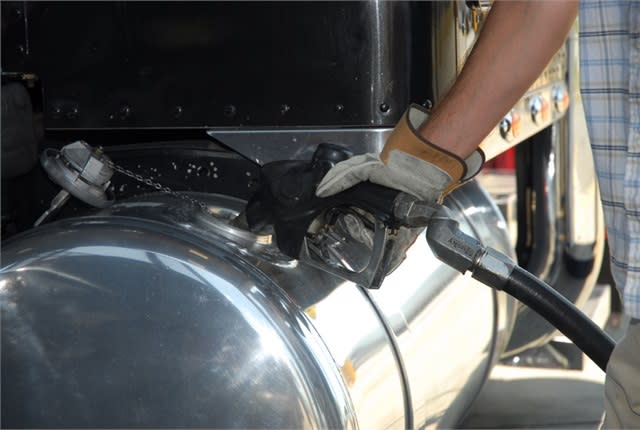
Putting diesel fuel in the tank is getting ever more painful as diesel prices continue to set records.
Jim Park
The measure makes fuel easier and potentially cheaper to move within the country, but analysts expect only a modest effect on pump prices.
The White House negotiated access to Venezuelan oil, including rights to buy part of the production from 17 oil fields at cost. The administration says some of that crude could reach U.S. refineries by the end of 2026, with larger volumes in 2027. But that is not an immediate answer.
Trump has pushed Russia and Ukraine to stop attacking each other’s energy infrastructure. The administration hopes that protecting Russian refineries could restore diesel exports and ease the global shortage, but no durable agreement appears to be in place.
It is considering using the Defense Production Act, regulatory changes, faster permitting and federal investment to expand or improve U.S. refineries. No final plan had been announced as of Sept. 11, and building significant new capacity would take time.
President Trump’s recent emergency waiver relaxing hours-of-service requirements for drivers delivering fuel won’t solve the underlying problem.
The 90-day waiver from the Federal Motor Carrier Safety Administration went into effect on September 16 and will expire on December 16. According to the FMCSA, drivers must still take a six-hour break in the sleeper berth at least once during a 24-hour period, or an eight-hour break if they are in a day cab.
But this isn’t like hurricane relief, where fuel is needed urgently in disaster-devastated areas to run hospital generators and fuel emergency vehicles. Longer driving hours can’t suddenly produce more diesel or lower the cost of crude oil, refining and ocean transportation.
More Crude Doesn’t Mean More Diesel
Getting crude oil out of the Persian Gulf is only part of the problem. More crude won’t do much for diesel prices if refineries can’t turn it into fuel fast enough. U.S. refineries have been running near full capacity, leaving little room to quickly increase diesel production.
But while Russia and the Persian Gulf countries have been building refineries in the past 10 years in pursuit of a bigger share of the global diesel market, the last major U.S. refinery was built in the 1970s.
The United States had 130 operable refineries at the beginning of 2026. Several smaller facilities have opened in recent years, including a 45,000-barrel-per-day plant in Galveston in 2022. But the newest large, full-service refinery remains Marathon’s Garyville, Louisiana, facility, which began operating in 1977.
Refineries are very much a “not in my backyard” kind of development. So most new U.S. capacity has come from expanding existing plants. That is generally faster and less contentious than permitting and building a refinery from scratch — but it also limits how quickly the industry can respond to a global diesel shortage.
Meanwhile, U.S. diesel supplies are getting tighter. EIA expects distillate inventories to fall below 100 million barrels and remain below the five-year low through the end of 2026 and most of 2027. The agency says high exports, lower international refinery production and seasonal refinery maintenance will continue putting pressure on diesel prices.
Should the U.S. Be Exporting Diesel Fuel?
Between the U.S.-Iran conflict and the ongoing war between Ukraine and Russia, global markets are looking to the U.S. for diesel and other refined products.
That’s why some politicians are calling for a ban on diesel exports – something the White House has so far rejected.
As WSJ reported, a U.S. ban on diesel exports would likely send prices for the rest of the world soaring. And other big diesel exporters such as China and India might follow suit.
While the U.S. banned crude oil exports from 1975 until 2015, refined products like diesel and gasoline were legal to export.
Although diesel was exported for decades, it took the 2006 Clean Diesel Fuel standard, which required sulfur in diesel to be reduced, to make U.S. diesel competitive abroad. Around 2010, the U.S. transitioned into an overall net exporter of petroleum products.
U.S. exports of ultralow-sulfur distillate rose from 32.8 million barrels in January to 47.7 million in May before falling to 36.9 million in June, the latest month available in EIA’s data.
That does not necessarily mean all of it was on-road diesel, but it illustrates how important U.S. refineries have become to the global distillate market.
And an export ban might not lower prices as much as proponents expect.
U.S. refineries are concentrated on the Gulf Coast and set up to serve export markets. Restricting exports could increase domestic supply, but it also could reduce refinery production if plants can’t profitably redirect all that fuel to U.S. markets.
Many of the Trump administration’s “energy dominance” policies are designed to increase crude-oil production. But today’s diesel crunch isn’t just about crude. It is also about disrupted refinery output, scarce tankers, high shipping costs and a global diesel trade thrown out of balance. Producing more U.S. oil alone won’t quickly fix any of that.
Subscribe to Our Newsletter
More Blog Posts

Beyond the Central Transport Settlement: Lessons on Hiring and Risk
The $5.5 million discrimination settlement raises broader questions about hiring practices, safety performance, and the hidden risks that can lurk in a fleet's recruiting process.
Read More →
Are Diesel Shortages Something to Worry About Again?
There’s a certain déjà vu when tensions flare in the Middle East and diesel price spikes can give you panic attacks. What parallels are there between the current situation and the 1970s energy crisis?
Read More →
NOx Isn’t Laughing Gas. Let’s Clear That Up.
A recent EPA reference mixed up NOx and nitrous oxide. It’s an easy mistake. Just not one you expect to see in emissions policy. Let’s look at the difference.
Read More →
TMC 2025 Takeaway 2: Buy... or Subscribe?
TaaS. Does that mean trucks as a service, trailers as a service, or tires as a service? HDT's Deborah Lockridge has another takeaway from the Technology & Maintenance Council meeting in her blog.
Read More →
TMC 2025 Takeaway: The Journey Toward Vertical Integration
HDT's Deborah Lockridge on how the trucking industry has moved toward "vertical integration" over the past 25 years.
Read More →
Trucks Are For Girls!
HDT Editor and Associate Publisher Deborah Lockridge is a longtime Girl Scout leader and loves to connect her passion for inspiring girls with her love of the trucking industry.
Read More →
Trucking Advocacy: Impact Beyond the 2024 Elections
No matter who wins the election, trucking continues to work to educate the people who pass the laws and make the rules that affect the industry. HDT's Deborah Lockridge shares insights from two major trucking associations in her All That's Trucking blog.
Read More →
Recharge Your Brain for Better Business
Skimping on vacation may be the worst thing you can do for your business, your career, and your mental health. In her All That's Trucking blog, Deborah Lockridge writes about the importance of giving your brain what it needs to be innovative.
Read More →
Trucker Pre-Trip Leads to Mission 'Im-paw-sible'
See what happened when a truck driver found an unexpected stowaway during his pre-trip inspection.
Read More →
HDT Editor: 2023's Most Important Trucking Topics
Read Deborah Lockridge's picks for the most significant stories we covered at HDT in 2023: freight recession, zero-emission trucks, drivers and marijuana, and more.
Read More →