




Why Diesel Is Climbing Fast—and What the Iran Conflict Has to Do With It
With global oil flows disrupted, U.S. diesel prices have topped $5 across every region, climbing sharply in the past few weeks.
March 24, 2026

The war in Iran has caused one of the biggest disruptions to energy supplies in history, and U.S. diesel fuel prices are reflecting it.
Credit:
HDT Graphic
2 min to read
The average price of a gallon of diesel fuel across the U.S. hit $5.375 as of March 23, according to Energy Department figures, as the Iran war continues to affect crude oil prices. That’s nearly $1.81 higher than a year ago and 30.4 cents higher than the previous week.
Average prices were over $5 in every region the Energy Information Administration tracks, and $6.87 in California.
The lowest average price was found in the Gulf Coast region, as is typical, at $5.134 per gallon.
In the past month, the average price of diesel has shot up by nearly $1.57, up from $3.809 as reported on February 23.
On-highway diesel fuel started the year at an average of $3.477 per gallon. It had been creeping up slowly until the Trump administration and Israel struck Iran at the end of February.
Why Are Diesel Prices so High?
On February 28, the United States and Israel attacked Iran after weeks of military buildup and threats from President Trump, as the nonpartisan think tank Council on Foreign Relations explains.
Iran effectively blocked the crucial Strait of Hormuz, through which flows about one-fifth (20–25%) of the world's daily oil consumption.
Crude oil prices, traded on the futures market, have been volatile since the strikes, thanks to conflicting reports nearly daily of the status of the war.
Crude oil makes up about 41% of the price of a gallon of diesel as of January figures.
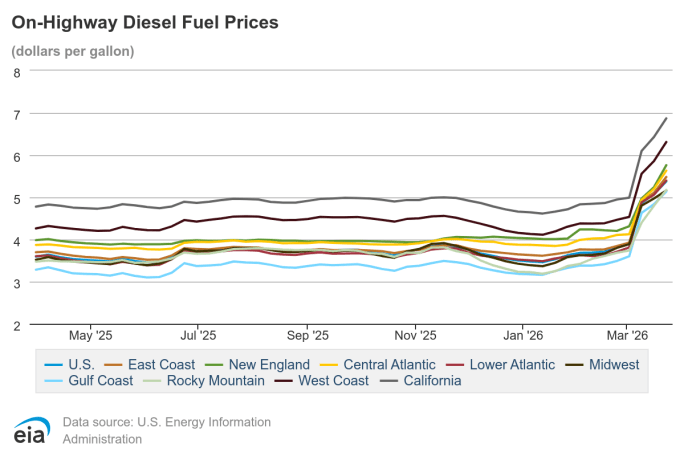
In the past month, the average price of diesel has shot up by nearly $1.57, up from $3.809 as reported on February 23.
Source:
Energy Information Administration
As Reuters reports, the war has caused one of the biggest disruptions to energy supplies in history.
Not only has Iran essentially closed the key Strait of Hormuz shipping route, through which a great deal of the global crude oil supply flows, but also, attacks in the Middle East have damaged production infrastructure in several countries.
The BBC reported that the head of the International Energy warned the war could see the world facing its worst energy crisis in decades.
But Isn’t the U.S. Energy Independent?
Even though the U.S. produces plenty of oil, it’s not shielded from global price swings. Oil is priced on a worldwide market, so when something disrupts supply anywhere, it shows up in U.S. fuel costs.
On top of that, the type of oil produced keeps the U.S. from being self-sufficient.
We export light, sweet crude oil while importing the heavier grades that many U.S. refineries are configured to run. So even as a net exporter, the U.S. is still buying and selling oil at global prices, which keeps diesel and fuel costs tied to global developments.
More Fuel Smarts

Wex Adds Cardless Fuel Payments for Over-the-Road Customers
A new fuel card feature for Wex customers offers convenience and security.
Read More →
New California Law Could Shed Light on Electric Truck Prices
Why do battery-electric Class 8 trucks remain so expensive? A California bill signed by Gov. Gavin Newsom would give fleets and state agencies more visibility into what manufacturers charge.
Read More →
How Volvo Updated Its D13 for EPA 2027 [Watch]
Volvo’s updated D13 promises lower emissions without sacrificing performance or fuel economy. Take a closer look at what changed inside the engine in this HDT Spotlight video.
Read More →

Diesel Price Spike Shortens Payback for Natural Gas Trucks, Report Says
Energy Vision estimates fleets could recover the higher purchase price of an RNG-fueled Class 8 tractor in 1.3 to 2.8 years under current fuel-price scenarios.
Read More →
Calstart Becomes Catalyst Mobility, Reflecting Broader Focus
Calstart is now Catalyst Mobility, reflecting the nonprofit’s growing national role in clean transportation, including zero-emission trucks, infrastructure and incentive programs.
Read More →
Record Diesel Prices Squeeze Trucking Fleets
Average U.S. diesel prices have climbed to nearly $6 a gallon, surpassing the 2022 record as tight refinery capacity and Middle East disruptions keep fuel costs elevated.
Read More →
Sponsored•September 9, 2026
How Fuel Delivery Shapes Engine Performance
Fuel delivery depends on more than what happens at the injector. For fleet, maintenance and technical professionals, looking at the full path from pump to injector can provide useful context for understanding engine performance.
Read More →
East Coast Port Launches $45M Electric Truck Push
The Port Authority of New York and New Jersey announced millions in incentives for zero-emission drayage trucks, yard tractors, and new charging hubs near the port.
Read More →
Detroit Opens Orders for EPA 2027 Engines
Detroit isn’t starting from scratch to meet EPA 2027 diesel emissions standards. Its Gen 6 DD13 and DD15 engines keep much of today’s platform while updating the fuel and aftertreatment systems.
Read More →
Zero-Emission Truck Corridor Planned for West Coast
California, Oregon, Washington, British Columbia and Baja California are coordinating plans for truck charging and hydrogen fueling from Canada to Mexico.
Read More →