





ATA’s Spear Warns Fuel Prices, Trade Policy, and Global Conflict Could Stall Trucking Recovery
From Diesel Prices to Cyberattacks: How the Iran War Is Affecting Trucking
The impact of the Iran conflict extends beyond fuel costs, bringing more fraud and cybersecurity risks to the trucking industry.
March 20, 2026
Higher diesel prices will drive some trucking companies out of the market. Any increase in carrier attrition increases the opportunity for fraud. Fraudulent motor carriers and identity takeover are extremely likely to rise.
Credit:
HDT Graphic
5 min to read
- The Iran conflict is impacting the trucking industry through increased diesel fuel costs.
- There is a rise in fraud incidents affecting the trucking sector due to the ongoing war.
- Cybersecurity risks have intensified for trucking companies as a result of the conflict.
*Summarized by AI
In the opening days of March, diesel prices rose 80 cents per gallon in a single week, a shock the industry has not seen since Russia invaded Ukraine in 2022.
This is one of the most obvious impacts the trucking industry is feeling from the current military operations in Iran. When fuel prices rise, margins shrink, leading to tightened capacity — an environment ripe for fraud.
When conflict with a geopolitical adversary heats up, so too does the cyber threat to U.S. critical infrastructure. That’s the environment trucking is operating in right now.
With the Strait of Hormuz closing, roughly 20% of the world’s oil supply has effectively been cut off. Brent crude oil prices, seen as an indicator of global oil performance, have been hovering around $100 per barrel, up by about 50% from a month earlier and from a year ago, according to a March 20 Fortune report.
Rising Oil and Diesel Prices
Diesel prices tend to swing more aggressively than crude oil prices. They jumped by double-digit percentages in less than two weeks. Energy Department numbers as of March 16 show the national average at 66 cents higher than a year ago.
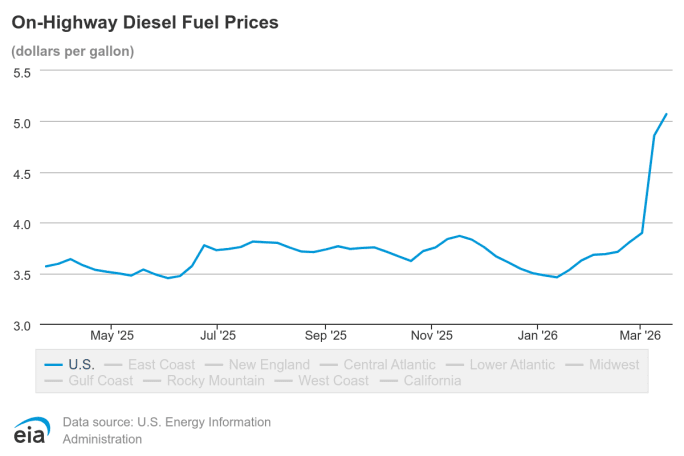
A $1-per-gallon increase in fuel can represent an estimated $40 billion in additional costs across the industry.
Credit:
U.S. Energy Information Administration
As we all know, fuel expenses make up a significant portion of the total cost per mile to operate a fleet, surpassed only by labor costs. And fuel surcharge rates tend to lag actual fuel prices by up to two weeks, with some locked in by contract rates.
This means motor carriers are left to absorb the increases at the pump. This pressure can prove too much for many small carriers and owner-operators. To put it in perspective, a $1-per-gallon increase in fuel can represent an estimated $40 billion in additional costs across the industry.
This is not good news for our industry, which has already been facing an extended recessionary cycle. This new strain on the industry is likely to stifle any recovery that has been starting.
Where Does Cybersecurity Come In?
So why is a cybersecurity guy talking about rising fuel costs and capacity pressures?
When margins collapse, some carriers exit the market, and capacity tightens rapidly. Some spot rates will rise due to demand, but often not enough for many smaller trucking operations.
Any increase in carrier attrition increases the opportunity for fraud. Fraudulent motor carriers and identity takeover are extremely likely to rise, given historical trends.
Reported cargo theft losses already had reached more than $725 million prior to this new fuel price shock. These numbers are expected to increase over the year, accelerated by a contracting capacity across the carrier base.
Theft by deception far outpaces straight cargo theft across the industry, driven by double-brokering, FMCSA account hijacking, fake carriers, stolen identities, and shipment redirection.
These schemes rely heavily on technology, and these risks are heightened when cybersecurity controls are weak.
Tight capacity will directly correlate with a spike in carrier fraud, as bad actors take advantage of market pressures to exploit the urgency shippers and brokers will feel.
Strengthening Your Fraud Defenses
What can you do to prepare for this increase in fraud?
Start by strengthening your cybersecurity stance to protect your own motor carrier number and company identity.
One option for resources to help is the recently released NMFTA Cybersecurity Cargo Crime Reduction Framework, which gives carriers a structured, actionable approach to reducing exposure across the cargo crime attack chain. Another is NMFTA’s newly published Freight Fraud Prevention Hub, which serves as a repository of freight fraud and cargo crime reduction resources.
Strengthening technical cybersecurity controls is essential, but operational security must be tightened as well:
- Strengthen vetting processes for carriers and partners
- Verify MC numbers and operating authority more rigorously
- Treat any request to reroute shipments with extreme caution
- Make sure load visibility tools are working and act quickly on any exceptions.
The Shadow War Threat
A war in the Middle East may not seem like a direct threat to the U.S. transportation sector, but it poses an elevated threat from the shadow war in the cybersecurity arena.
Iran has a documented history of targeting critical infrastructure, including transportation and logistics. U.S. agencies such as the Cybersecurity and Infrastructure Security Agency (CISA) and the National Security Agency (NSA) have specifically warned about threats to these sectors.
Groups like CyberAv3ngers — linked to Iran’s Islamic Revolutionary Guard Corps — targeted programmable logic controllers (PLCs) across water, energy, and transportation as recently as 2024. Their tools are still in circulation.
More than 60 hacktivist groups have mobilized in support of Iran, alongside pro-Russian groups such as Killnet.
The transportation sector is squarely in the crosshairs of these groups. Port systems, logistics platforms, and navigation systems have all been called out as targets.
Assume that your company is being actively targeted by cyber threat actors affiliated with, or sympathetic to, Iran — regardless of their size or seeming distance from the conflict zone.
Iranian state-backed hacking groups, including APT34, APT35, MuddyWater, and Handala, have historically been opportunistic, targeting “low-hanging fruit” operations with poor cybersecurity controls.
Now is not the time to be an easy target.
Don’t Be the Easy Target
Now is the time for every company in the supply chain to tighten its defenses:
- Review internet-facing systems for vulnerabilities
- Enable multi-factor authentication (MFA) across all accounts
- Patch known security flaws (including those in the CISA Known Exploited Vulnerabilities catalog)
- Update incident response and business continuity plans.
The Iran war is not a distant geopolitical event. It is already being felt at the fuel island. It will be seen on the load board. Don’t let it infiltrate your network as well.
Our industry is facing several pressures at once: Rising fuel prices, shrinking capacity seeding the ground for fraud, and a heightened cyber threat level. It is important not to treat these as three separate problems.
Carriers and logistics providers need a unified response: stronger operations, better vetting, and tighter cybersecurity.
The goal? Keep the wheels turning and the freight moving through arguably one of the most compressed operating environments the industry has faced in years.
Subscribe to Our Newsletter
More Fleet Management

Why Private Fleets Are Taking More Freight
Private fleets are putting their own trucks on demanding customers and high-cost lanes as companies seek greater control over service, costs, and capacity.
Read More →
Sponsored•September 16, 2026
Color Match Smarter: Tools That Restore & Perform
For fleet managers and collision repair professionals keeping heavy-duty trucks on the road, getting the color right the first time isn't just about appearance — it's about efficiency, turnaround time, and bottom-line results. Discover how today's digital color tools are transforming the repair process from guesswork to precision.
Read More →
FMCSA Pauses Biennial-Update Enforcement Amid Motus Transition
Carriers whose updates were due on or after June 1 have more time, while FMCSA works to stabilize its new registration system and warns of phishing sites impersonating its new carrier registration system, Motus.
Read More →


Sponsored•September 14, 2026
2026 Blueprint for Countering Smarter Supply Chain Theft
Cargo theft is no longer just the cost of doing business. It's a multi-billion-dollar criminal enterprise exploiting vulnerabilities across your fleet, drivers, and supply chain.
Read More →
Sponsored•September 1, 2026
How Telematics Improves Visibility, Control, and Performance in Refrigerated Fleets
Explore how telematics help refrigerated fleets improve visibility, uptime, efficiency, compliance, and cargo protection across connected cold chain operations.
Read More →
What the U.S.-Canada Trade War Means for Trucking
Escalating U.S.-Canada tariffs could disrupt cross-border freight, reduce truck volumes, raise costs, and create new uncertainty for carriers on both sides of the border.
Read More →
What Are Trucking’s Top Concerns for 2026?
The American Transportation Research Institute wants to know what's worrying trucking fleet managers, drivers, and other stakeholders in its annual Industry Issues survey.
Read More →
American Trucking Associations Looks for a New Leader
ATA President and CEO Chris Spear abruptly left his job at the association on August 21, at a pivotal time for the trucking industry.
Read More →
Public Wi-Fi Cybersecurity Risks: How Truck Drivers and Fleets Can Protect Their Data
Public Wi-Fi can expose truck drivers and fleets to credential theft, malware, and other cyber threats. Here’s how to reduce the risk on the road.
Read More →
For Nicky Cupp, Fleet Innovation Starts With Frustration
HDT Truck Fleet Innovator Nicky Cupp turns everyday pain points at Fraley & Schilling into opportunities for better technology and smarter processes.
Read More →