




ATA’s Spear Warns Fuel Prices, Trade Policy, and Global Conflict Could Stall Trucking Recovery
Speaking at the TMC Annual Meeting in Nashville, ATA President Chris Spear said trucking faces mounting pressure from rising fuel prices, geopolitical instability, and uncertainty around trade policy.

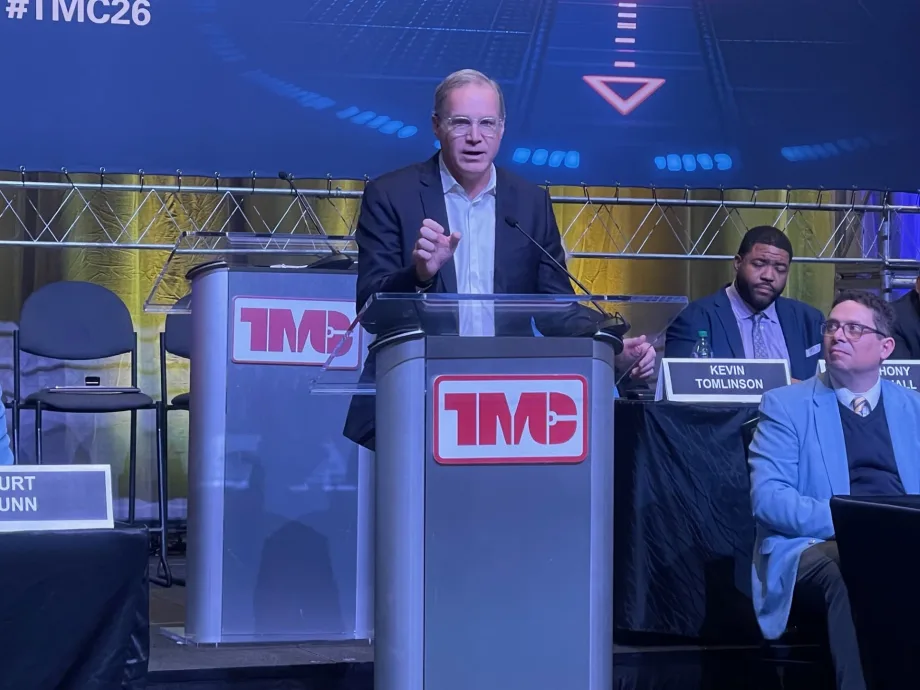
ATA President Chris Spear said that the North American trucking industry is facing extraordinarily challenging times now.
Jack Roberts
The trucking industry is still waiting for the long-anticipated freight rebound after several difficult years.
But new global and policy pressures could delay that recovery. That's what American Trucking Associations President Chris Spear told attendees at the Technology & Maintenance Council Annual Meeting in Nashville on March 16.
Spear said fleets across the supply chain remain eager for signs of stronger freight demand after what he described as a three- to four-year freight recession that followed the COVID-19 pandemic.
“It has been an extraordinarily challenging period,” Spear said. “The entire supply chain is looking for that window of opportunity where our industry starts to pick up.”
The prolonged downturn has put pressure on trucking companies and the broader logistics ecosystem, he said. That makes the work of organizations like TMC even more important.
Spear praised the council’s role in developing maintenance standards and technical guidance that fleets can rely on during uncertain times.
“The focus that we have right now really leans on you to give us that aspiration and guidance,” he told the audience of fleet maintenance professionals and suppliers. “Those are the steps forward that we need to be taking as an industry to get back into that rhythm.”
Regulatory Pressure Eases on Electrification
One major issue that dominated industry discussions a year ago -- electric truck mandates -- has shifted significantly, Spear said.
At the 2025 TMC meeting, fleets and suppliers were grappling with aggressive electrification policies, particularly California regulations requiring a rapid transition to zero-emission trucks.
According to Spear, the policy environment has changed dramatically over the past year with the arrival of a new administration and congressional majorities more sympathetic to trucking’s concerns about timing and feasibility.
“I’m not trying to squelch technology,” he said. “Electrification has wonderful attributes to our industry in a whole host of venues.”
However, he argued that the transition needs to start in sectors where electric vehicles make operational sense and where infrastructure can support them.
Spear pointed to applications such as garbage trucks, school buses, and port operations. These are vehicles with predictable routes and access to centralized charging. Those trucks, Spear argued, are examples where electrification could be implemented more quickly.
“You can build it out, have the infrastructure, have the power,” he said. “Rather than throwing everybody in trucking under the same umbrella.”
He said the shift away from sweeping mandates has allowed ATA to refocus on other pressing issues affecting fleets.
Fuel Prices Surge Amid Middle East Conflict
Among the most immediate concerns for trucking is the rapid increase in fuel prices tied to geopolitical tensions resulting from the war with Iran and associated disruptions in the Middle East.
Spear said a recent U.S. military operation involving Iran has already pushed diesel prices sharply higher and created uncertainty about future energy costs.
Fuel and labor remain trucking’s two largest expenses, he said, and sudden changes in diesel prices can quickly affect fleet profitability.
“We’ve seen fuel jump to $4.83 a gallon in just the last two weeks,” Spear said.
He added that crude oil prices for benchmarks such as West Texas Intermediate and Brent have surged past $100 per barrel, with no clear indication of when they might stabilize.
“There is probably no end in sight until there’s some indication that we’re going to start to back down,” he said.
Even modest fluctuations in diesel prices can have a large impact on trucking operations, Spear noted. But increases approaching a dollar per gallon within weeks create even more pressure for carriers already dealing with weak freight volumes.
Diesel Exhaust Fluid Supply a Potential Risk
Beyond diesel prices themselves, Spear warned fleets to watch another potential supply chain risk: diesel exhaust fluid.
About 45% of global DEF production comes from the Middle East, particularly countries such as Qatar, he said. Any disruption in that supply could have significant consequences for fleets that rely on the emissions-control additive to keep modern diesel engines operating.
“When you’ve got that much of the product coming out of the exact same place, when we’re in conflict the availability of DEF is a game changer for our industry,” Spear said.
Unlike fuel, which can generally be sourced globally even at higher prices, a shortage of DEF could directly limit vehicle operation because trucks equipped with selective catalytic reduction systems cannot run without it.
“We can always pay more for fuel -- we’ll have it,” Spear said. “But DEF is another factor we have to be paying attention to.”
Geopolitics Adds to Economic Uncertainty
The emerging energy concerns come at a difficult moment for the trucking industry.
Spear said many carriers had hoped that 2026 would bring stronger economic growth and freight demand, particularly heading into a highly competitive midterm election year.
Instead, new geopolitical tensions have created additional uncertainty.
“I personally was kind of hoping that 2026 was going to be an uptick year,” Spear said. “With this latest conflict, I’m not seeing that. This is the direct opposite.”
While expressing confidence in the U.S. military, he said the trucking industry hopes the conflict will be resolved quickly so economic conditions can stabilize.
USMCA Review Critical for Trucking
Trade policy is another major issue facing the industry this year, as the United States-Mexico-Canada Agreement undergoes its scheduled review.
The process began March 16 and will continue through July, Spear said.
He emphasized that the review is not meant to renegotiate the entire trade pact but rather to assess how the agreement is functioning.
“This is a review, not a renegotiation,” Spear said.
The stakes are significant for trucking. Cross-border trade with Mexico alone accounted for about 7.5 million truck crossings last year, with trucks handling roughly 85% of road freight moving between the two countries.
“This is no small matter,” Spear said.
ATA supports extending the agreement for another 16 years, he said, which would give businesses the certainty needed to invest in supply chains, equipment, and cross-border infrastructure.
Political Dynamics Affect Trade Talks
Spear said political relationships among North American leaders could play an important role in determining the outcome of the United States–Mexico–Canada Agreement (USMCA) review.
He recently traveled to Mexico City to meet with government officials, including members of the Mexican Senate and the country’s secretary of the economy.
Spear praised Mexico’s president for maintaining close communication with the White House on issues such as border security, drug trafficking, and immigration enforcement.
Those efforts, he suggested, could help smooth negotiations around trade.
By contrast, tensions between U.S. and Canadian leadership could complicate discussions about the agreement’s future.
“Those relationships matter when it comes to getting a 16-year extension done,” he said.
Tariffs and Manufacturing Decisions Loom
In addition to the USMCA review, trucking suppliers are watching potential tariff changes that could affect manufacturing locations and equipment costs.
Spear said the administration may pursue tariffs under trade statutes such as Section 232 or Section 301, measures that are harder to reverse once implemented.
That could influence decisions about where trucks, trailers, and components are manufactured -- whether in the United States, Mexico, or elsewhere in North America.
Some original equipment manufacturers already compliant with USMCA rules are beginning to reconsider their production strategies, Spear said.
“These decisions affect not just final trucks and trailers but all the parts and pieces that go into them,” he said.
Industry Input Critical for ATA Advocacy
With so many policy and economic issues evolving rapidly, Spear urged fleets and suppliers to remain engaged with ATA and industry groups such as TMC.
The association relies on feedback from members to understand how policy decisions in Washington affect day-to-day trucking operations.
“I can’t navigate this blindly,” he said. “My team and I need your counsel and advice.”
By working together, Spear said, the industry can replicate successes such as recent efforts to roll back California emissions regulations and ensure policymakers understand trucking’s operational realities.
“If we do that right,” he said, “I’m confident we can make things better for this industry.”
More Fleet Management

Nominations Open for HDT Emerging Leaders
Heavy Duty Trucking is looking for accomplished trucking fleet professionals under 40 who are making an impact and helping lead the industry forward.
Read More →
Why Private Fleets Are Taking More Freight
Private fleets are putting their own trucks on demanding customers and high-cost lanes as companies seek greater control over service, costs, and capacity.
Read More →
Color Match Smarter: Tools That Restore & Perform
For fleet managers and collision repair professionals keeping heavy-duty trucks on the road, getting the color right the first time isn't just about appearance — it's about efficiency, turnaround time, and bottom-line results. Discover how today's digital color tools are transforming the repair process from guesswork to precision.
Read More →


FMCSA Pauses Biennial-Update Enforcement Amid Motus Transition
Carriers whose updates were due on or after June 1 have more time, while FMCSA works to stabilize its new registration system and warns of phishing sites impersonating its new carrier registration system, Motus.
Read More →
2026 Blueprint for Countering Smarter Supply Chain Theft
Cargo theft is no longer just the cost of doing business. It's a multi-billion-dollar criminal enterprise exploiting vulnerabilities across your fleet, drivers, and supply chain.
Read More →
How Telematics Improves Visibility, Control, and Performance in Refrigerated Fleets
Explore how telematics help refrigerated fleets improve visibility, uptime, efficiency, compliance, and cargo protection across connected cold chain operations.
Read More →
What the U.S.-Canada Trade War Means for Trucking
Escalating U.S.-Canada tariffs could disrupt cross-border freight, reduce truck volumes, raise costs, and create new uncertainty for carriers on both sides of the border.
Read More →
What Are Trucking’s Top Concerns for 2026?
The American Transportation Research Institute wants to know what's worrying trucking fleet managers, drivers, and other stakeholders in its annual Industry Issues survey.
Read More →
American Trucking Associations Looks for a New Leader
ATA President and CEO Chris Spear abruptly left his job at the association on August 21, at a pivotal time for the trucking industry.
Read More →
Public Wi-Fi Cybersecurity Risks: How Truck Drivers and Fleets Can Protect Their Data
Public Wi-Fi can expose truck drivers and fleets to credential theft, malware, and other cyber threats. Here’s how to reduce the risk on the road.
Read More →