




How Mack & Kriete Helped Put Wisconsin’s First Class 8 BEV Refuse Trucks into Action
When the City of Madison rolled out Wisconsin’s first Class 8 battery-electric refuse trucks, it was the culmination of planning and teamwork between city leaders, Mack Trucks, and Kriete Truck Centers. What did it take to put the two Mack LR Electric refuse trucks on the road?

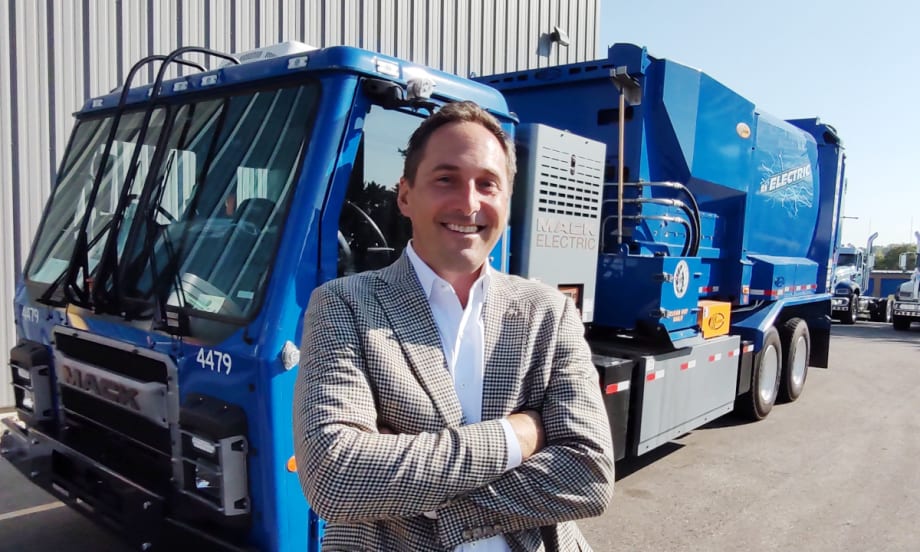
David Kriete, president and CEO of Kriete Truck Centers, shares what the Madison, Wisconsin, location had to do to prepare for electric trucks.
Photo: Wayne Parham
The City of Madison, working with Mack Trucks and Kriete Truck Centers, is the first to deploy fully electric Class 8 refuse trucks in the state of Wisconsin. The trucks started hitting the streets in mid-July, but more recently, Mack and Kriete officially handed them off to the city.
“We are excited that the City of Madison chose Mack to fulfill its refuse collection needs while also helping them move the needle toward their sustainability goals,” said Jonathan Randall, president of Mack Trucks North America.
Madison, which has the largest municipal battery-electric vehicle fleet in the state, is charging ahead toward achieving the goals of its Climate Forward Agenda. Already, the city fleet boasts more than 100 fully electric vehicles, including 62 electric buses that enter service this month, and 150 hybrids.
“Electrifying heavy-duty vehicles is on the forefront of zero-emissions technology," said Madison Mayor Satya Rhodes-Conway.
"Madison will help demonstrate the performance of these new electric garbage trucks in real-world conditions and help quantify the long-term savings associated with eliminating fossil fuel costs and reducing maintenance expenses."
Madison’s Mack LR Electric refuse trucks differ a little. One is equipped with a Leach rear loader and the other with a Labrie automated side loader (ASL). Both will be serviced at the Kriete Truck Center’s Madison location, which had to prepare in advance and become certified to handle Mack battery-electric vehicles.
The Road to Class 8 Electrification in Madison
Kriete Truck Centers began working about two years in advance, knowing that the City of Madison would eventually be running collection routes with the battery-electric Mack refuse trucks.
“We had talked to the city, and we knew this was coming, so we jumped on it,” said David Kriete, president and CEO of Kriete Truck Centers, which now has 10 sales and service locations.
Technicians at the Madison dealership had to be trained, and Kriete had to create dedicated EV service bays, and parts. service, and sales teams had to be certified, and charging stations were needed.
The addition of the charging stations also meant working on getting the needed utility infrastructure upgrade, which is now a 480 3-phase service. Although the city will typically charge the trucks at one of its facilities, Kriete still needed charging capabilities for when they come in for service.
Once the infrastructure upgrade order was placed, it only took about six months to complete and install chargers. Kriete Truck Centers is now going through similar processes to electrify four of its other locations around the state.
“Our biggest lesson was realizing which markets do we want to invest in now, knowing that the first electric opportunity may not be 12, 18, 24, months down the road,” the Kriete president said.
More Details on Madison's Mack LR Electric Refuse Trucks
The Mack LR Electric is powered by four NMC (nickel manganese cobalt oxide) lithium-ion batteries, charged through a 150 kW, SAE J1772-compliant charging system. That battery configuration powers the vehicle and all onboard accessories through 12V, 24V, and 600V circuits.
The trucks also benefit from a two-stage regenerative braking system that recaptures energy from the hundreds of stops they make each day. Considering the weight increases as the trucks load refuse, the regenerative braking also generates more power back into the system as the weight increases.
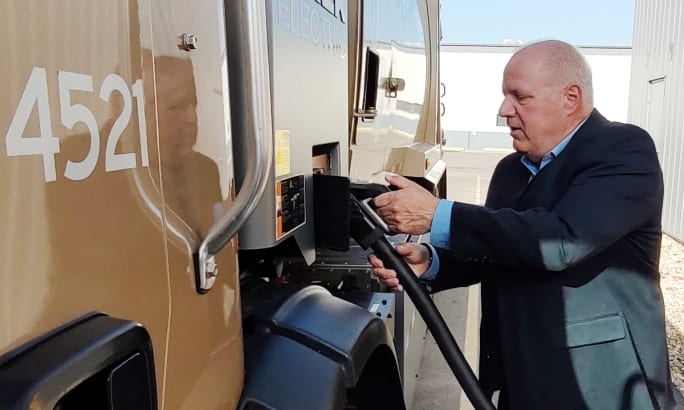
Adam Gaines, general manager of the Kriete location in Madison, demonstrates charging.
Photo: Wayne Parham
Mack’s Role in Electrification in Wisconsin
George Fotopoulos, vice president of E-mobility at Mack Trucks, was on hand at the official handing over of the trucks from Kriete and Mack to the city. He explained how battery-electric refuse trucks are more efficient, safer, quieter, and have lower emissions than their diesel-powered counterparts.
“The future of transportation and waste is actually here today, with these two vehicles behind us,” Fotopoulos added. “The introduction of these electric vehicles is not just about replacing old trucks with new trucks. It's embarking on a new era of waste management.”
He also shared that the first Mack MD Electric, a medium-duty truck available in a Class 6 or Class 7 configuration, delivered by Mack Trucks was in Wisconsin. And, it was retailed by Kriete Truck Centers. In August, Mack Trucks and Kriete handed over a Mack MD Electric to ABC Supply Co. in Beloit, Wisconsin
“We will continue to launch more electric truck models to make more efficient trucks, but also to transition our fleet to a fully zero-emission truck fleet,” Fotopoulos said.
Making Battery-Electric Truck Service Easy
The City of Madison’s Mack LR Electric models are covered under the Mack Ultra Service Maintenance Agreement, which provides Mack LR Electric customers with an uptime package tailored specifically for the technical needs of battery-electric vehicles.
The Mack Ultra Service Maintenance Agreement includes:
Scheduled maintenance
Preventive maintenance
Towing and repair
Battery monitoring service
Mack’s connected uptime services in one package that can be included with monthly truck payments
Mack’s Integrated Telematics Help Maximize Uptime
Mack’s integrated telematics solution, Mack GuardDog Connect, supports the LR Electric and its batteries. Mack said it helps customers achieve peak operating conditions and maximize uptime by monitoring battery health and performance and checking for fault codes and defects reported by the battery and electric components of the energy storage system.
More Fuel Smarts

How Volvo Updated Its D13 for EPA 2027 [Watch]
Volvo’s updated D13 promises lower emissions without sacrificing performance or fuel economy. Take a closer look at what changed inside the engine in this HDT Spotlight video.
Read More →
Diesel Price Spike Shortens Payback for Natural Gas Trucks, Report Says
Energy Vision estimates fleets could recover the higher purchase price of an RNG-fueled Class 8 tractor in 1.3 to 2.8 years under current fuel-price scenarios.
Read More →
Calstart Becomes Catalyst Mobility, Reflecting Broader Focus
Calstart is now Catalyst Mobility, reflecting the nonprofit’s growing national role in clean transportation, including zero-emission trucks, infrastructure and incentive programs.
Read More →

Record Diesel Prices Squeeze Trucking Fleets
Average U.S. diesel prices have climbed to nearly $6 a gallon, surpassing the 2022 record as tight refinery capacity and Middle East disruptions keep fuel costs elevated.
Read More →
How Fuel Delivery Shapes Engine Performance
Fuel delivery depends on more than what happens at the injector. For fleet, maintenance and technical professionals, looking at the full path from pump to injector can provide useful context for understanding engine performance.
Read More →
East Coast Port Launches $45M Electric Truck Push
The Port Authority of New York and New Jersey announced millions in incentives for zero-emission drayage trucks, yard tractors, and new charging hubs near the port.
Read More →
California Bill Could Shed Light on Electric Truck Prices
Why do battery-electric Class 8 trucks remain so expensive? A California bill headed to Gov. Gavin Newsom would give fleets and state agencies more visibility into what manufacturers charge.
Read More →
Detroit Opens Orders for EPA 2027 Engines
Detroit isn’t starting from scratch to meet EPA 2027 diesel emissions standards. Its Gen 6 DD13 and DD15 engines keep much of today’s platform while updating the fuel and aftertreatment systems.
Read More →
Zero-Emission Truck Corridor Planned for West Coast
California, Oregon, Washington, British Columbia and Baja California are coordinating plans for truck charging and hydrogen fueling from Canada to Mexico.
Read More →
A Closer Look at Kenworth’s Electric T880E Vocational Truck [Video]
Learn more about Kenworth's T880E battery-electric vocational truck at the Paccar Technical Center, including its range, applications, upfitting considerations, and PTO options, in this HDT Spotlight video.
Read More →