From Truck APUs to Intelligent Engines: NACFE Updates Idle Reduction Report
Idle reduction for heavy-duty trucks has come a long way. An updated playbook from the North American Council for Freight Efficiency explains what technologies deliver results today — and what’s coming next.
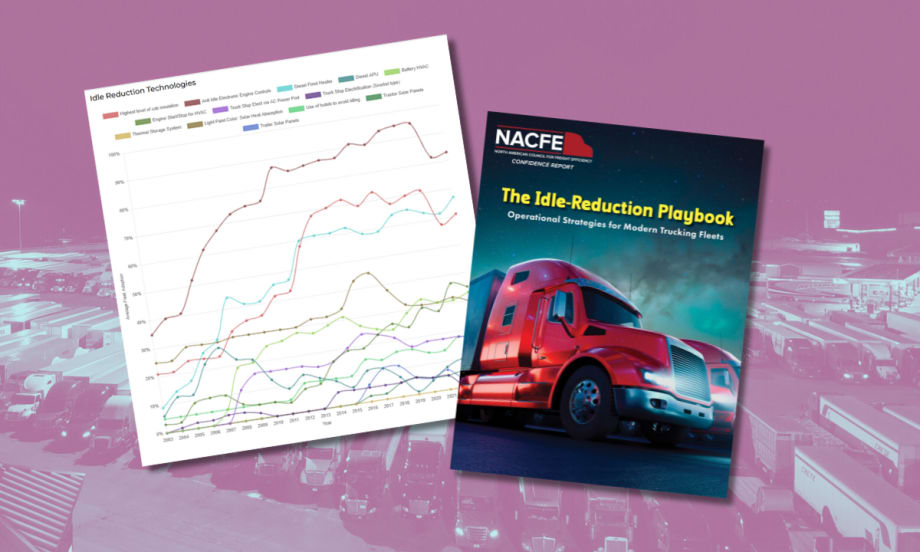
A new report delves into the state of idle reduction technologies for heavy duty trucking fleets.
Credit: HDT/NACFE/Iowa 80
5 min to read
Truckers have been looking for ways to reduce heavy-duty truck idling, with its wasted fuel and engine wear and tear, since the 1940s. Idle-reduction technology has advanced from engine block heaters and fuel-fired bunk heaters to sophisticated intelligent engine management systems. What's right for your fleet today?
To help trucking fleets determine the best current idle-reduction technologies and strategies, the North American Council for Freight Efficiency released a new report on idle reduction.
Why is Idle Reduction Important for Trucking Fleets?
Fuel represents a significant portion of a fleet’s operating expenses, and some of that fuel is consumed when the truck is not moving.
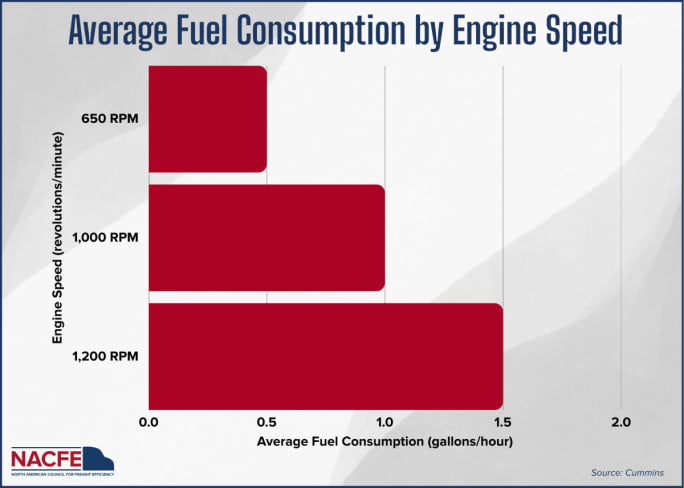
A typical Class 8 truck idles approximately six to eight hours per day on average at around 0.8 gallons of diesel per hour. That results in 1,000 to 1,800 gallons of diesel burned at idle annually per vehicle, depending on climate, duty cycle, and usage patterns.
Ad Loading...
For fleet operators, the challenge lies in finding practical ways to reduce idle time without compromising driver comfort, safety, or operational efficiency.
One of the biggest reasons for trucking fleets to reduce idle time is cuting fuel consumption, both for money savings and emissions reduction.
Credit: NACFE
This report looks at the reasons trucks idle and provides insight into a variety of idle-reduction technologies, including:
The report goes into depth on how each technology works and explains what its benefits are, cost and ROI considerations, as well as any challenges associated with deploying the technology.
“Fleets should take a holistic approach to deploying idle reduction strategies. The most effective programs usually combine operational policies, driver engagement, and technology,” says Dean Bushey, NACFE’s director of programs and lead author of the report.
Ad Loading...
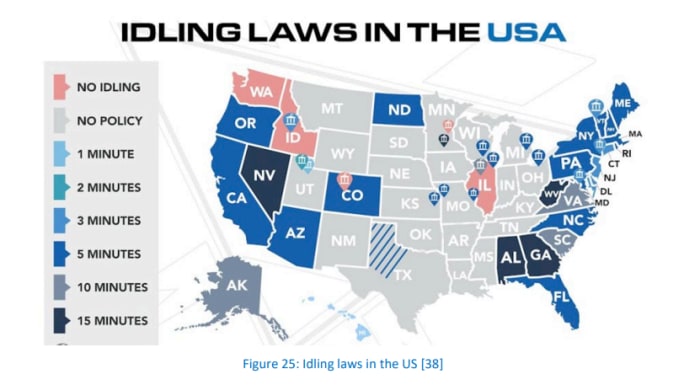
Mandates that set limits on truck idling also drive adoption of idle-reduction technologies among trucking fleets.
Credit: NACFE
What Are Best Practices for Trucking Fleets to Manage Idle Time?
NACFE shares best practices and recommendations for managing idle time.
Baseline best practices include:
Establishing an idle-reduction policy,
Using engine parameters aggressively,
Training and incentivizing drivers,
Providing alternatives for driver comfort during downtime, and
Monitoring and reporting idle percentages.
Advanced best practices include:
Investing in appropriate idle-reduction equipment,
Monitoring idle-reduction efforts and adjusting as needed.
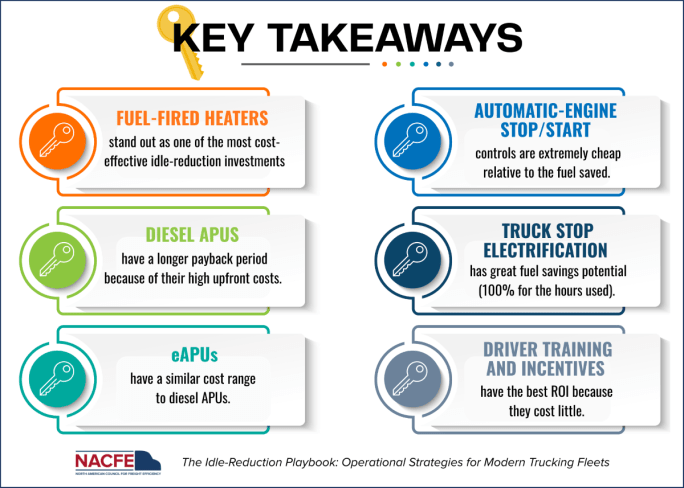
The report offers the following conclusions:
There is a wide array of solutions. Use a combination that addresses heating, cooling, and power needs.
Economic paybacks are generally favorable, especially as fuel prices rise and carbon-related costs — such as emissions surcharges, low-emission zone fees, or regulatory penalties — become more common.
Driver comfort and training are pivotal. Get buy-in from drivers.
Continued innovation will make idle reduction even easier and more effective in the near future, likely tied to the broader electrification trend.
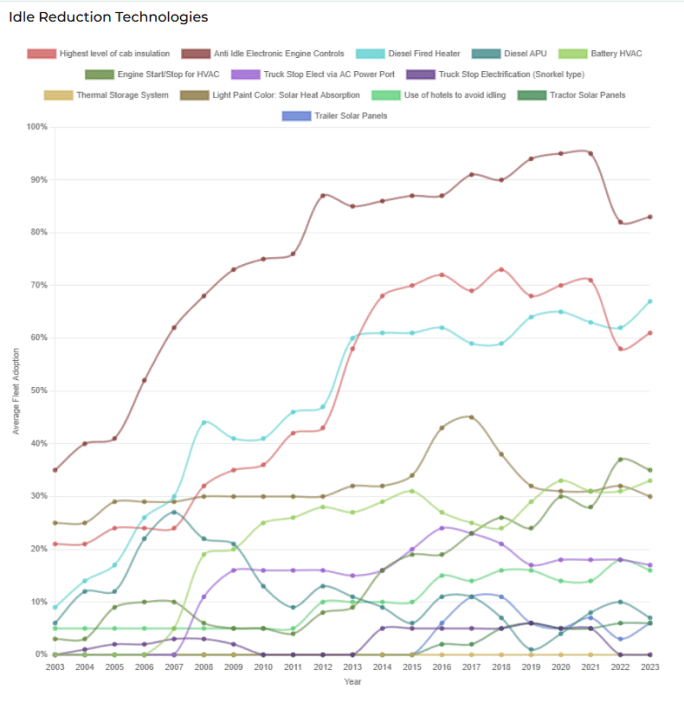
This graph shows the adoption curves for various idle-reduction technologies used by fleets participating in NACFE’s Fleet Fuel Study.The reduction in recent years is likely explained by the fact that there are more daycab fleets in the study with a lower focus on idle reduction technologies.
Credit: NACFE
Smart Engines, Less Truck Idling
Electronic engine controls remain the most commonly used idle reduction strategy, although the percentage of fleets using them dropped from a 2021 high of 95% to 83% in 2023.
Ad Loading...
“Modern intelligent engine management systems represent a paradigm shift in idle reduction,” says NACFE in its report. These include innovative shutdown systems, predictive idle shutdown systems, contextualized idle management, and adaptive power management systems.
Smart Shutdown / Auto-Start-Stop: These systems shut the engine off when cooling, batteries, and cab comfort are within set limits, then restart it only when needed. They use onboard sensors and software to maintain conditions without continuous idling and are often part of broader OEM energy-management systems.
Predictive Idle Shutdown: Predictive systems use telematics and analytics to anticipate when a truck is likely to sit unused, then shut the engine down before unnecessary idling occurs. The engine restarts only when power, heating, cooling, or charging is required.
Neutral Idle: Neutral idle automatically shifts the transmission to neutral when the truck stops, reducing engine load while stationary. This lowers fuel use and emissions by letting the engine power only essential accessories—without shutting it off.
Contextual Idle Management: These systems combine telematics and situational data—such as location, PTO status, weather, and operating conditions—to decide whether the engine should run, shut down, or switch to an alternative power source like an eAPU.
Adaptive Power Management: Adaptive power systems manage batteries, alternator output, hotel loads, and eAPUs as a single energy system. They optimize when to charge, store, or draw power, minimizing engine runtime while maintaining driver comfort and electrical reliability.
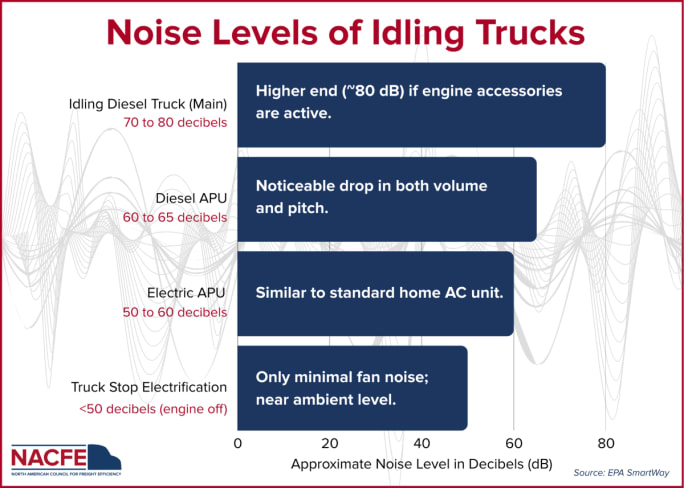
Reducing or eliminating idling can significantly lower noise levels in and around trucks, enhancing driver comfort and minimizing noise pollution in nearby communities.
Credit: NACFE
How Other Idle Reduction Technologies Stack Up
The use of diesel-fired heaters in fleets tracked by NACFE hit a high in 2023 of 67%, becoming the second most common idle reduction technology, followed by the highest level of cab insulation at 61%.
The other strategies in the report are all used by fewer than 50% of fleets.
Engine stop/start, battery HVAC, and painting trucks a light color are all around one-third of fleets, ranging from 30 to 35%.
Shore power and hotels come in at 16-17%.
Diesel APUs and solar panels were used by fewer than 10%. Diesel APUS are down from a high of 27% in 2007, unsurprisingly, as electric battery-powered APUs have become more reliable and more popular over that time period.
Ad Loading...
In evaluating idle reduction options, trucking fleets often consider bundling technologies to maximize benefits.
Credit: NACFE
New Idle-Reduction Technologies Gaining Ground
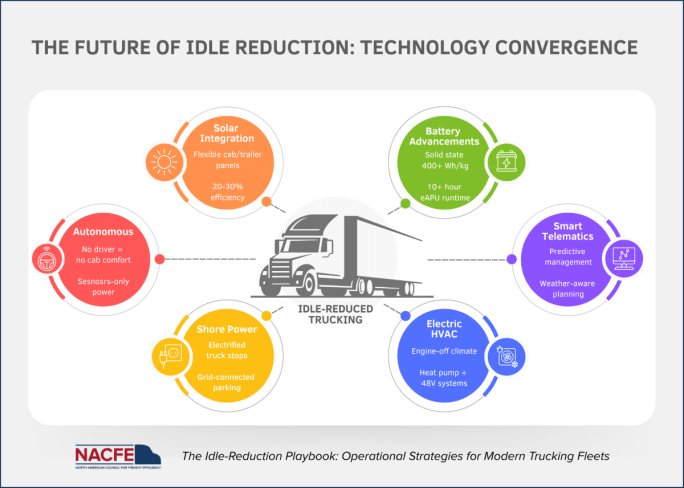
NACFE identified up-and-coming technologies that will further improve idle reduction for trucking fleets.
Improved lithium-ion battery packs, which have higher energy densities, faster recharging times, and lower weights than earlier technologies, have enabled nearly silent “parked HVAC” electric solutions that can operate for extended periods.
Several companies have developed solar panels designed for the tops of truck cabs and trailers. These solar panels charge onboard batteries throughout the day, helping to power HVAC systems, refrigeration units, and other devices without running the engine.
Fleet telematics have evolved into comprehensive Internet of Things (IoT) ecosystems, integrating GPS trackers, engine control unit interfaces, fuel flow meters, and cabin temperature and occupancy sensors that all connect to cloud analytics platforms.
This real-time connectivity identifies idle events, automatically dispatches geo-fenced shutdown prompts to drivers, and alerts fleet managers. It also correlates idling with routes, schedules, and driver behavior through integrated ELD and maintenance systems.
Ad Loading...
Early adopters using these IoT-driven insights report 10% to 15% reductions in idle time, according to NACFE.
The landscape of idle reduction for heavy-duty trucks is likely to evolve further, according to NACFE, driven by technological advancements and regulation changes.
Credit: NACFE
What’s Next for Idle Reduction in Heavy Duty Trucks?
Looking ahead to the next five to 10 years, the landscape of idle reduction is likely to evolve further, driven by technological advancements and regulation changes.
Here are some potential innovations and trends in the coming decade, according to NACFE:
Volvo’s updated D13 promises lower emissions without sacrificing performance or fuel economy. Take a closer look at what changed inside the engine in this HDT Spotlight video.
Energy Vision estimates fleets could recover the higher purchase price of an RNG-fueled Class 8 tractor in 1.3 to 2.8 years under current fuel-price scenarios.
Calstart is now Catalyst Mobility, reflecting the nonprofit’s growing national role in clean transportation, including zero-emission trucks, infrastructure and incentive programs.
Average U.S. diesel prices have climbed to nearly $6 a gallon, surpassing the 2022 record as tight refinery capacity and Middle East disruptions keep fuel costs elevated.
Fuel delivery depends on more than what happens at the injector. For fleet, maintenance and technical professionals, looking at the full path from pump to injector can provide useful context for understanding engine performance.
The Port Authority of New York and New Jersey announced millions in incentives for zero-emission drayage trucks, yard tractors, and new charging hubs near the port.
Why do battery-electric Class 8 trucks remain so expensive? A California bill headed to Gov. Gavin Newsom would give fleets and state agencies more visibility into what manufacturers charge.
Detroit isn’t starting from scratch to meet EPA 2027 diesel emissions standards. Its Gen 6 DD13 and DD15 engines keep much of today’s platform while updating the fuel and aftertreatment systems.
California, Oregon, Washington, British Columbia and Baja California are coordinating plans for truck charging and hydrogen fueling from Canada to Mexico.
Learn more about Kenworth's T880E battery-electric vocational truck at the Paccar Technical Center, including its range, applications, upfitting considerations, and PTO options, in this HDT Spotlight video.