





More on Diesel Emissions Rules: Justice Department Pulls Back on Criminal Prosecution of Diesel Emissions Deletes
California: Clean Truck Check Rules Still in Force for Out-of-State Trucks, Despite EPA Disapproval
The Environmental Protection Agency said California can’t enforce its Heavy-Duty Inspection and Maintenance Regulation, known as Clean Truck Check, on vehicles registered outside the state. But California said it will keep enforcing the rule.
January 29, 2026
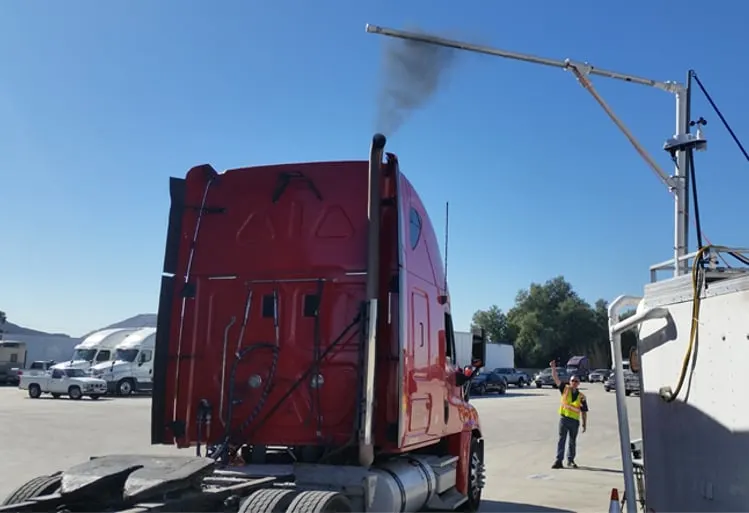
Part of California's enforcement of its Clean Truck Check regulations involves smoke opacity checks.
Credit: CARB
3 min to read
The Environmental Protection Agency said California can’t enforce its Heavy-Duty Inspection and Maintenance Regulation, known as Clean Truck Check, on vehicles registered outside the state. But California said it will keep enforcing the rule.
The state implemented the rule as part of its efforts to meet air quality standards by ensuring heavy-duty vehicle emissions control systems operate properly throughout the life of the vehicle and necessary repairs are made in a timely manner. Clean Truck Check requires reporting, payment of annual compliance fees, and vehicle emissions testing.
In a news release, EPA said that California’s attempt to establish the program in its State Implementation Plan for heavy-duty vehicles that pass through California, regardless of where the vehicle was registered, may be in conflict with the U.S. Constitution’s Commerce Clause.
However, according to published reports, the California Air Resources Board said it will continue to apply the program to all trucks, including those registered out of state.
Why Did EPA Deny California’s Smoke Check?
EPA determined that California failed to provide necessary assurances, as required by Section 110 of the Clean Air Act, that implementing the Regulation would be consistent with the U.S. Constitution’s Commerce Clause, which prevents states from interfering with interstate and international trade.
The agency said it has approved the regulation only as it applies to in-state-registered vehicles.
The Safe Bet: Continue to Follow Clean Truck Check Rule
“This announcement is a whole lot of bluster about bean counting,” said CARB spokesperson Lindsay Buckley in a statement widely reported by the media.
“EPA has no authority over this program, and we will continue to enforce the law to ensure that all trucks coming into and operating in California abide by the same rules — even if EPA doesn’t want to give us credit.”
As Politico explained, in practice, the rule remains in effect for out-of-state trucks, according to CARB spokesperson Buckley.
“EPA’s disapproval means that the air quality improvements stemming from those inspections will not count toward the list of emissions reductions efforts California has employed to clean up its air under the Clean Air Act, which could require CARB to take additional emissions reduction steps.”
California’s Reason for Smoke Checks on Trucks
CARB submitted the Heavy-Duty Inspection and Maintenance Regulation to EPA as a revision to the California SIP in December 2022.
According to CARB, heavy-duty vehicles are responsible for 52% of the on-road NOx emissions and 54% of on-road PM2.5 emissions. And out-of-state or out-of-country heavy-duty vehicles make up about half of the total number of heavy-duty vehicles travelling in the state and approximately 30% of heavy-duty vehicle NOX emissions.
The regulation applies to all non-gasoline combustion vehicles above 14,000 gross vehicle weight rating (GVWR) that operate in California. There is a limited five-day pass-through exception permitting program available once a year.
Clean Truck Check requires owners of heavy-duty vehicles operating in California to:
Report owner and vehicle information to CARB.
Demonstrate that their vehicle emissions control systems are properly functioning through vehicle compliance tests completed by CARB-approved testers.
Periodically submit vehicle compliance test results to CARB. Vehicles equipped with on-board diagnostic systems can be tested using OBD data, while older non-OBD vehicles are subject to smoke opacity and visual inspections.
Vehicle owners are also required to have a valid HD I/M compliance certificate with the vehicle while operating in California, which they must present to a CARB inspector and/or California Highway Patrol officer upon request.
More Fuel Smarts

How Volvo Updated Its D13 for EPA 2027 [Watch]
Volvo’s updated D13 promises lower emissions without sacrificing performance or fuel economy. Take a closer look at what changed inside the engine in this HDT Spotlight video.
Read More →
Diesel Price Spike Shortens Payback for Natural Gas Trucks, Report Says
Energy Vision estimates fleets could recover the higher purchase price of an RNG-fueled Class 8 tractor in 1.3 to 2.8 years under current fuel-price scenarios.
Read More →
Calstart Becomes Catalyst Mobility, Reflecting Broader Focus
Calstart is now Catalyst Mobility, reflecting the nonprofit’s growing national role in clean transportation, including zero-emission trucks, infrastructure and incentive programs.
Read More →

Record Diesel Prices Squeeze Trucking Fleets
Average U.S. diesel prices have climbed to nearly $6 a gallon, surpassing the 2022 record as tight refinery capacity and Middle East disruptions keep fuel costs elevated.
Read More →
Sponsored•September 9, 2026
How Fuel Delivery Shapes Engine Performance
Fuel delivery depends on more than what happens at the injector. For fleet, maintenance and technical professionals, looking at the full path from pump to injector can provide useful context for understanding engine performance.
Read More →
East Coast Port Launches $45M Electric Truck Push
The Port Authority of New York and New Jersey announced millions in incentives for zero-emission drayage trucks, yard tractors, and new charging hubs near the port.
Read More →
California Bill Could Shed Light on Electric Truck Prices
Why do battery-electric Class 8 trucks remain so expensive? A California bill headed to Gov. Gavin Newsom would give fleets and state agencies more visibility into what manufacturers charge.
Read More →
Detroit Opens Orders for EPA 2027 Engines
Detroit isn’t starting from scratch to meet EPA 2027 diesel emissions standards. Its Gen 6 DD13 and DD15 engines keep much of today’s platform while updating the fuel and aftertreatment systems.
Read More →
Zero-Emission Truck Corridor Planned for West Coast
California, Oregon, Washington, British Columbia and Baja California are coordinating plans for truck charging and hydrogen fueling from Canada to Mexico.
Read More →
A Closer Look at Kenworth’s Electric T880E Vocational Truck [Video]
Learn more about Kenworth's T880E battery-electric vocational truck at the Paccar Technical Center, including its range, applications, upfitting considerations, and PTO options, in this HDT Spotlight video.
Read More →