





Read More: Are Your Brakes Ready for CVSA's Brake Safety Week? [Video]
CARB Unveils ‘Smog Check’ for Trucks at LA Enforcement Event
CARB's Heavy Duty Inspection and Maintenance program begins in 2023 and is expected to deliver $75 billion in health benefits.
August 30, 2022
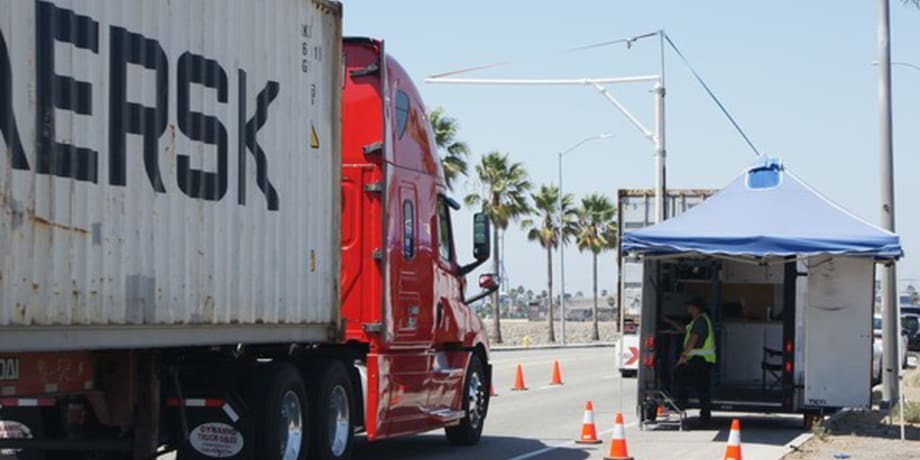
Unveiled at the enforcement event at the Port of Los Angeles, the first phase of the program, begins in January 2023.
Photo: California Air Resources Board
3 min to read
The California Air Resources Board (CARB) recently previewed the Heavy-Duty Inspection and Maintenance Program (HD I/M), due to begin phasing in on Jan. 1, 2023, at an enforcement truck event held at the Port of Los Angeles. According to a statement, CARB used the event, where about 1,200 trucks were screened, to help make owners and operators aware of the new ‘smog check’ requirements for heavy-duty vehicles and the phase-in timeline. The program is the first in the nation of its kind and will ensure that emissions control systems on heavy-duty vehicles operate effectively for the life of the vehicle, improving air quality and protecting public health.
The HD I/M program will apply to all heavy-duty trucks, buses, agricultural equipment and personal motorhomes with a gross vehicle weight rating (GVWR) of more than 14,000 pounds travelling in the state regardless of whether they are registered in California.
“The Heavy-Duty Inspection and Maintenance Program will ensure that the emissions control equipment in heavy-duty trucks does its job capturing and removing harmful emissions for the life of the vehicle," said CARB chair Liane Randolph in the statemnt. "And, if we discover it’s not working properly, it will be repaired quickly. This will save owners and operators in fuel costs and deliver significant improvements in air quality and public health especially in communities adjacent to highways, ports and warehouses that suffer from persistent air pollution as a result of heavy traffic.”
While the heavy-duty vehicles under this program comprise only 3% of all vehicles on California roads, they are responsible for more than half of all harmful smog-causing pollution and fine particulate matter from mobile sources in the state.
By ensuring that trucks continue to run clean for the life of the vehicle, the new program is expected to deliver $75 billion in health benefits, prevent 7,500 air-quality related deaths and 6,000 hospitalizations and emergency room visits from 2023 to 2050. These benefits are 18 times the estimated cost of the program at $4 billion.
In the first phase of the program, beginning in January 2023, the Portable Emissions Acquisition System (PEAQS) — a roadside monitoring system that measures truck emissions — will be deployed in various areas to screen for potential high-emitting vehicles operating on California roads. The detection/monitoring system was unveiled at the enforcement event at the Port of Los Angeles.
Vehicles flagged by the monitoring devices will be required to undergo an additional emissions test to verify their emissions-control equipment is functioning properly and repair any malfunctioning emission control equipment, if necessary.
In mid-2023, phase two of the HD I/M program requires all heavy-duty trucks to register with CARB and obtain a certificate of compliance to operate in the state.
In 2024, in the last phase of the program, heavy-duty truck registration in California will require proof of emissions compliance with the HD I/M Program. Emissions inspections will need to be performed twice a year for vehicles with onboard diagnostic (OBD) systems, increasing to four times per year testing in 2027.
Emissions inspections are designed to minimize downtime and the inconvenience to owners/operators. Unlike passenger car smog checks, heavy-duty vehicle owners will be able to complete the required test and deliver emissions systems inspection information remotely without having to travel to designated testing locations. The test can be conducted anywhere using the truck’s OBD system or stand-alone scan tool provided it’s performed by a CARB-credentialed tester using a CARB-certified readout device. It is projected that 75-80% of all heavy-duty trucks will have OBD equipment that can utilize telematics technology — that is, sending the data automatically — when the program begins.
Older heavy-duty vehicles without an OBD system will continue the current opacity testing requirements with an added visual testing component, twice each year.
More Safety & Compliance

FMCSA Pauses Biennial-Update Enforcement Amid Motus Transition
Carriers whose updates were due on or after June 1 have more time, while FMCSA works to stabilize its new registration system and warns of phishing sites impersonating its new carrier registration system, Motus.
Read More →
ZF Expands Commercial Vehicle Push in North America
ZF is expanding its North American commercial-vehicle presence with new transmission applications, electrification, trailer technology and autonomous-driving systems.
Read More →
Truck Drivers Need More Than Another Alert
Fleets have more visibility into truck health, safety events, and driver activity than ever. The next challenge is turning all that information into useful guidance for the person who has to decide what to do next.
Read More →
Tesla Wants a Self-Driving Semi. Are Cameras Enough?
Could Tesla’s camera-only autonomous driving technology work on an 80,000-pound Semi? In this commentary, HDT's Deborah Lockridge takes a look at Tesla, Cybercab, and how autonomous trucks see the road.
Read More →
What DOT’s Automated Vehicle Strategy Means for Trucking
The U.S. Department of Transportation issued a new automated-vehicle strategy that outlines plans for driverless-truck regulations, cross-state freight corridors, and federal safety standards.
Read More →
NYC Expands Speed, Pedestrian Safety Tech Across Fleet
New York City is expanding intelligent speed assistance and pedestrian-alert systems across its municipal fleet, moving the technologies from pilot programs into vehicle procurement and retrofit requirements.
Read More →
FMCSA Removes 110 Truck Driver Training Schools from Certified ELDT List
Federal regulators also are targeting more than 160 additional training providers and launching a nationwide audit of third-party CDL skills testers as part of a broader crackdown on trucking fraud.
Read More →
Beyond DOT Compliance: What Makes a Trucking Fleet Truly Safe?
A trucking fleet can follow every rule and still make unsafe decisions. The real test comes when safety conflicts with freight, productivity, or cost.
Read More →
Hours of Service Pilot Programs: FMCSA Readies for 2027 Rollout
Two pilot programs could eventually reshape hours-of-service rules, giving truck drivers options to pause their 14-hour clock or use longer split sleeper rest periods.
Read More →
New Guide Offers Pet Safety Tips for Truck Drivers
Hundreds of thousands of pets travel in truck cabs. A new safety guide from Volvo Trucks and the Center for Pet Safety offers practical advice for truck drivers who bring dogs and cats along for the ride.
Read More →