





Fleet Margins Fall as Trucking Costs Set New Records in ATRI’s 2025 Report
The Freight Recession Isn’t Over: Why Trucking’s Recovery Remains Elusive
When is trucking going to get out of the "sluggish morass" when it comes to freight and rates? The analysts at FTR shared their projections on economic and freight indicators and forecasts.
July 10, 2025

FTR’s latest analysis paints a mixed picture for trucking: less tariff uncertainty ahead, but weak freight volumes and overcapacity persist.
Image: HDT Graphic
9 min to read
Continuing uncertainty surrounding economic issues such as tariffs and continuing overcapacity in the trucking market are conspiring to keep freight rates down.
When it comes to trucking, “the last few years had just been sort of stuck in this sluggish morass,” said Jonathan Starks, FTR CEO, in the freight intelligence firm’s July 10 webinar.
“There was certainly some hope and some indications, as we were going through the end of 2024, that things could pick up and show a little bit brighter result for some of the trucking metrics and some of the operational results for the fleets themselves.”
However, FTR analysts expressed some cautious optimism that the level of uncertainty regarding tariffs and the business environment is dropping.
Tariffs: Riding the Roller Coaster
While there are other factors affecting the economy and freight demand, the situation with tariffs and international trade is front and center.
Joseph Towers, FTR’s senior analyst, rail, pointed to an FTR graph showing an overall average it has calculated for the global tariffs. It clearly shows how changes and pauses in U.S. tariffs on imports have led to large and rapid ups and downs in the U.S. tariff rate.
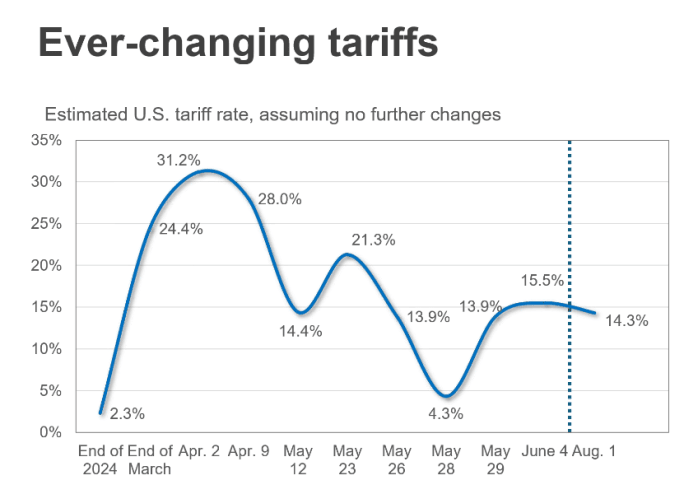
FTR's look at the roller coaster of tariffs, based on Census Bureau data.
Source: FTR
“When we started off the year, you saw that was really big swings, from 2% at the end of 2024 when we were in a very much a free trade environment, and then it shot up to 31%. That was with the reciprocal tariffs, that was with 145% on China, that was with kind of everything in the kitchen sink.”
Since then, he said, while there have still been ups and downs, the swings have been more modest, ranging from 13% to 15%. Right now, FTR is estimating overall tariff rates will come out at an average of 14.3%.
However, recent developments could change that.
“Just this week, we've had threats of tariffs and retaliatory tariffs between the U.S. and Brazil,” Towers said. “There's still a lot of outstanding items on pharmaceuticals, and there is still a lot of trade deal activity, and lack of trade deal activity, that's been occurring that could push this number up or down.”
Shifting Import Flows
Towers pointed out an interesting fact looking at the change in containerized ocean imports in April and May compared to a year earlier.
Unsurprisingly, there was a huge drop in the volume of containers coming from China. However, increases in container volumes coming from other southeast Asian countries, such as Vietnam, nearly offset the decrease from China.
“One of the things that makes that very significant is that these different countries utilize ports, they utilize different areas of the United States differently,” he explained.
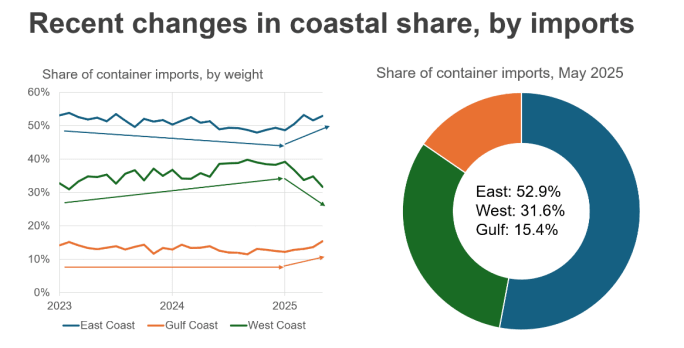
FTR's analysis of Census Bureau data shows shifts in where import containers are coming in to the U.S.
Source: FTR
For a number of years, the intermodal container import industry had seen a trend of companies moving more container imports to East Coast and Gulf Coast ports, away from West Coast ports. In 2023 and 2024, that trend reversed. But this year, we’re back to East Coast ports seeing a bigger share of container imports.
The share of containerized imports that’s coming into the East Coast, almost 53% in May, is the highest it’s been since the summer of 2023, Towers said.
The West Coast share of containerized imports, on the other hand, were the lowest since February 2023.
Gulf Coast imports are now the highest they've ever been, at least back to 2013.
“And the implication for surface transportation is that there's a big shift between demand for rail and for trucking, based off of the length of haul for containers coming into the United States,” Towers said.
“So if it's a very long straight length of haul thing, LA to Chicago, there's a lot more reason for that box to move by rail. If you're talking about 100- to 500-mile length of haul, let's say, from the Port of Savannah to Atlanta, Georgia, that's going to be much more likely to move by truck.”
What's Happening With The Economy?
After a strong first quarter, FTR said a manufacturing recession appears likely. While FTR’s pre-tariff forecast was projecting growth for a change, its latest forecast calls for big cuts in output. However, the apparent cooling of the trade war could mean better near-term results.
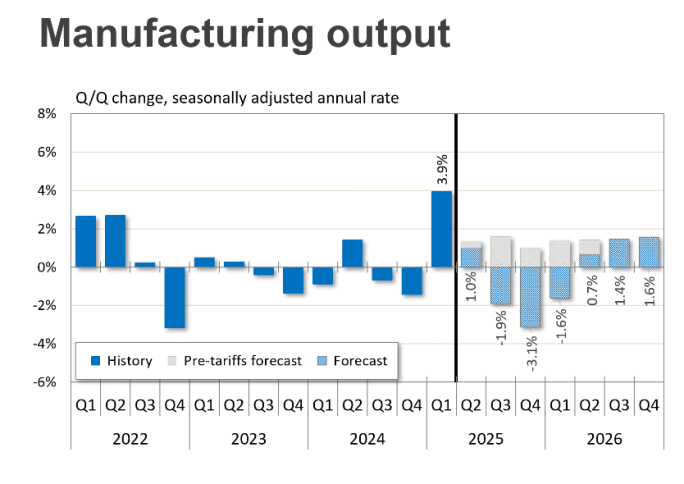
FTR and Witte Econometrics project weakness in manufacturing based on Federal Reserve data.
Source: FTR
Consumer spending, Vise said, is still likely to grow, but very slowly. And the outlook is worse for the goods that lead to truck freight, with more of that growth expected to happen in services, especially as healthcare continues to grow.
FTR expects growth in the Gross Domestic product to be volatile, likely into 2026, with swings in imports and inventory caused by tariffs distort the numbers. For the year as a whole, FTR expects 1.8% growth in the GDP. Vise called that “relatively solid growth, down from the past two years, but nothing to sneeze at.”
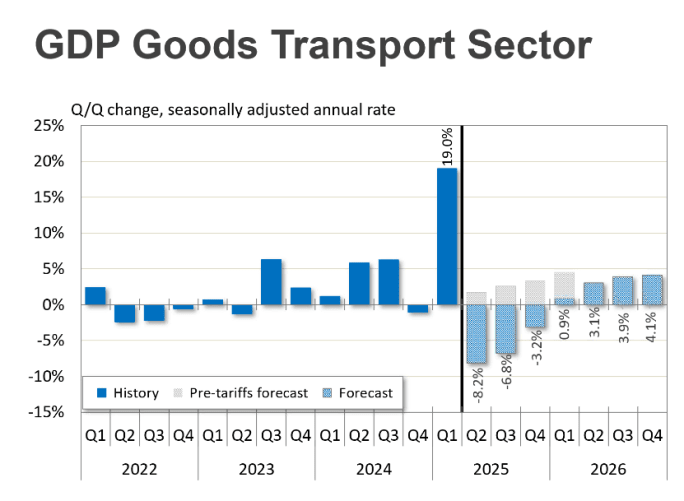
FTR and Witte Econometrics project a tougher freight market after a first-quarter import surge, based on Bureau of Economic Analysis data.
Source: FTR
Looking at FTR’s GDP Goods Transport Sector, which takes out the services that don’t lead to freight and adds in imports that do (regular GDP counts imports as negative), you can see the effect the pre-tariff import surge pushed the first quarter number up 19% from the previous quarter.
“We do expect payback,” Vise said.
Based on second-quarter numbers so far, FTR expects a considerably weaker outcome in its goods transport numbers for this quarter, with weakness continuing in the third and fourth quarters.
Because of the extraordinary strength in the first quarter, however, FTR projects the full-year growth in it goods transport to average out to a 2.5% gain.
Vise cautioned that this is based on dollar values, and although they are adjusted for inflation, they don’t necessarily directly correlate to freight.
For instance, pharmaceuticals and gold have high dollar values but low freight impact, and growth in computers includes downloadable software that generates no freight at all.
And, he said inflation and financing costs are still headwinds for growth in consumption.
Trucking Freight and Rates
FTR’s total truck loadings outlook, which includes contract freight as well as spot freight, saw improved volumes in the first quarter. But FTR is forecasting weaker volumes until 2026. The freight forecast is close to flat in 2025 and 2026, with tank and flatbed forecasts showing growth.
Key to freight rates, of course, is supply and demand, and trucking is still suffering from overcapacity.
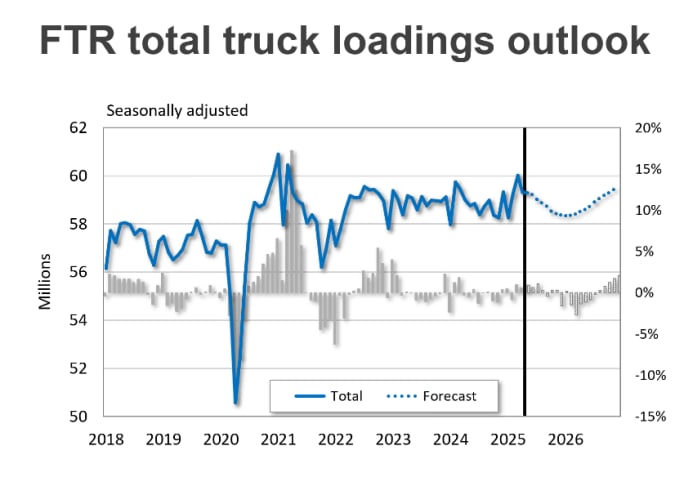
Based on FMCSA L&I data, FTR's total truck loadings outlook shows a flat freight forecast in 2025 and 2026.
Source: FTR
Looking at payroll numbers, the larger carriers with payroll employment have more or less brought their capacity back into line with the market, Vise said.
Truckload payroll employment came up during the strength of the post pandemic period, he said, and came right back down and has recently been pretty much in line with pre pandemic levels.
“But we still have this large overhang of mostly owner-operators,” he said, so overall capacity is still too high.
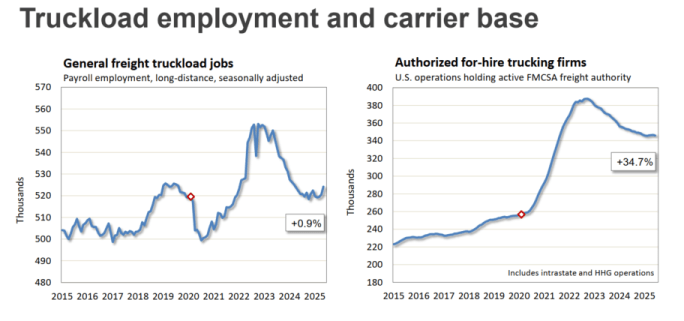
Data from the Bureau of Labor Statistics and the Federal Motor Carrier Safety Administration indicates the number of small motor carriers is still higher than pre-pandemic levels.
Source: FTR
He’s referring to changes in the for-hire carrier population. When spot rates spiked in 2020, a lot of truck drivers and leased owner-operators decided to start their own businesses to take advantage of the surge.
That number of authorized trucking firms, taking into account both new registrations and revocations, has more or less flattened out at close to 35% higher than we were before the pandemic.
After weak active truck utilization in 2022 and 2023, it started to recover last year, Vise said. “But it really kind of stalled out, and is still running at a level that is not very much higher than the historical average.
“Because of the freight weakness, we expect a little bit of softness for the next few months before we begin to recover.”
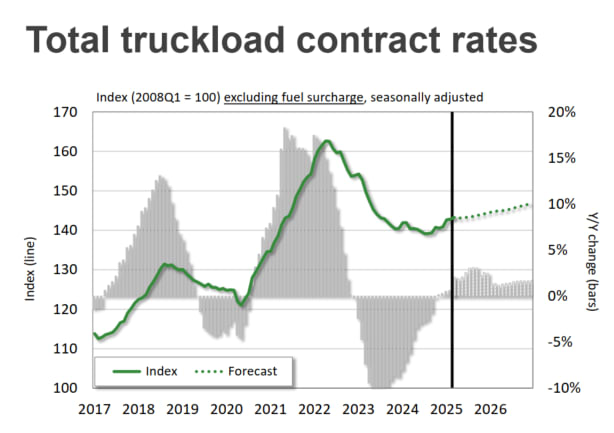
Contract rates are finally expected to rise, but likely not enough to offset inflation, based on FTR's Freight-cast and Trucking Update Service
Source: FTR
Some good news/bad news when it comes to contract rates.
“The contract rate environment is improving in our estimation, but from the carrier perspective, it is not growing robustly. Our forecast for 2025 and 2026 is for contract rates for all major equipment types to grow 2%.”
The problem? That’s not enough to offset inflation.
“We probably will lose a lot of carriers.”
Class 8 Truck Orders
The capacity situation doesn’t look much better when it comes to Class 8 truck orders, which have been very weak recently. Class 8 orders net of cancellations dropped in April to the lowest level since early 2010, except for during the 2020 lockdowns.
Some factors behind that include the tariff uncertainty, the lack of rebound in the freight market, and the fact that it looks like we may not have the EPA 2027 emissions rules to drive a pre-buy.
There is still an oversupply of trucks that have already been built, Vise said.
“In fact, we're at a record level of Class 8 inventories. That means that if there is a need for trucks, at least for a while, those trucks will be available.”
At the same time, it could set the stage for tighter capacity when we hit the next upturn.
“But you know, those inventories can quickly get drained,” Vise said.
What Could Help Bring Trucking Capacity Into Balance?
There has been speculation that stricter enforcement of federal requirements regarding driver English language proficiency, which went into effect last month, might mean fewer truck drivers and a corresponding drop in capacity.
Vis, said while it’s definitely a possibility, “We’re skeptical based on enforcement alone if that will be a game changer.”
More likely to make a difference, he said, are recent sharp increases in insurance premiums. But that likely won’t show up in the number of carriers until the second half of the year or into 2026 as carriers face their policy renewals.
“Frankly, none of that’s going to matter unless we have more freight,” Vise said. “That’s the bottom line, we must have more freight.”
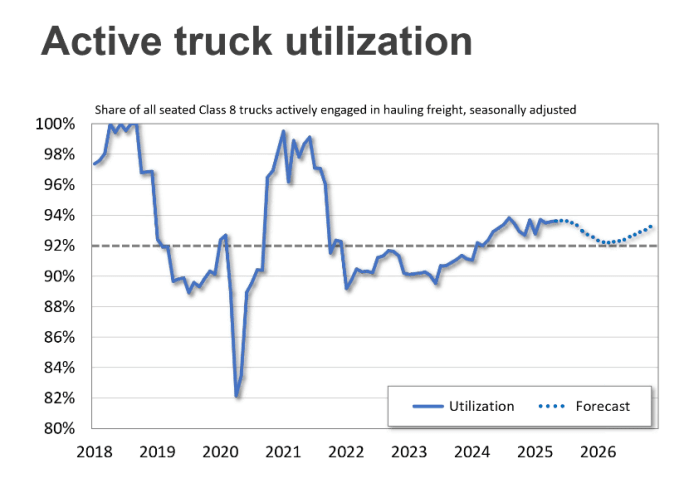
FTR's Freight-cast and its Trucking Update Service offer insights into truck utilization, but FTR said there is a lot of uncertainty, as utilization depends on both volume and capacity as well as productivity.
Source: FTR
Cautious Optimism
Asked how they felt about the chances for things to be better or worse than the FTR projections, both Towers and Vise expressed cautious optimism that things could swing somewhat to the upside.
Towers referred to the tariff rollercoaster we’ve been on since the end of 2024.
“As we get into a question of, are tariffs going to be 15% or 16%, that's a lot different conversation of are they going to be 4% or are they going to be 50%,” Towers said. “That decrease in uncertainty makes me a little bit more optimistic about 2026 and 2027.”
Vise agreed, saying, “we’re getting to a point where the range of variability is much more narrow.”
While you can make a case that we haven’t yet seen the full impact of tariffs, he said, those tariffs look like they’re going to be under 20%; we were looking at a 42% rate at one point if the Chinese tariffs stayed at 145% and all the liberation day tariffs snapped back.”
He also said the investment community has forced some discipline on some of the wildest swings. When the White House in April said it was imposing tariffs totaling 145% on China, and China retaliated with 125% tariffs on U.S. imports, there were huge losses on Wall Street and in global markets.
“145% was unacceptable long term,” Vise said.
In addition to the hopefully better news on tariffs, Vise said, the recent passage of the budget reconciliation law known as the One Big Beautiful Bill Act could play a role.
“I don't see necessarily a lot of upside from it, but the fact that there is certainty to it, and that businesses and consumers know that those tax breaks are not going to go away, that's not nothing,” he said.
“So I've become more optimistic that our current forecast might be a little too far on the downside, not by much, but I think maybe a little.”
More Fleet Management

Sponsored•September 16, 2026
Color Match Smarter: Tools That Restore & Perform
For fleet managers and collision repair professionals keeping heavy-duty trucks on the road, getting the color right the first time isn't just about appearance — it's about efficiency, turnaround time, and bottom-line results. Discover how today's digital color tools are transforming the repair process from guesswork to precision.
Read More →
FMCSA Pauses Biennial-Update Enforcement Amid Motus Transition
Carriers whose updates were due on or after June 1 have more time, while FMCSA works to stabilize its new registration system and warns of phishing sites impersonating its new carrier registration system, Motus.
Read More →
Sponsored•September 14, 2026
2026 Blueprint for Countering Smarter Supply Chain Theft
Cargo theft is no longer just the cost of doing business. It's a multi-billion-dollar criminal enterprise exploiting vulnerabilities across your fleet, drivers, and supply chain.
Read More →


Sponsored•September 1, 2026
How Telematics Improves Visibility, Control, and Performance in Refrigerated Fleets
Explore how telematics help refrigerated fleets improve visibility, uptime, efficiency, compliance, and cargo protection across connected cold chain operations.
Read More →
What the U.S.-Canada Trade War Means for Trucking
Escalating U.S.-Canada tariffs could disrupt cross-border freight, reduce truck volumes, raise costs, and create new uncertainty for carriers on both sides of the border.
Read More →
What Are Trucking’s Top Concerns for 2026?
The American Transportation Research Institute wants to know what's worrying trucking fleet managers, drivers, and other stakeholders in its annual Industry Issues survey.
Read More →
American Trucking Associations Looks for a New Leader
ATA President and CEO Chris Spear abruptly left his job at the association on August 21, at a pivotal time for the trucking industry.
Read More →
Public Wi-Fi Cybersecurity Risks: How Truck Drivers and Fleets Can Protect Their Data
Public Wi-Fi can expose truck drivers and fleets to credential theft, malware, and other cyber threats. Here’s how to reduce the risk on the road.
Read More →
For Nicky Cupp, Fleet Innovation Starts With Frustration
HDT Truck Fleet Innovator Nicky Cupp turns everyday pain points at Fraley & Schilling into opportunities for better technology and smarter processes.
Read More →
Adam Buttgenbach’s Approach to Electric Trucks: Start With Where They Fit
HDT Truck Fleet Innovator Adam Buttgenbach helped PepsiCo build one of North America’s largest EV fleets by focusing on where electric trucks make operational sense.
Read More →