





From the HDT Archives (2023): What’s Going on with Trucking Jobs Numbers?
Private Fleets Continue to Outpace Trucking in Driver Employment
In the employment of heavy truck drivers — those operating Class 7-8 vehicles — private fleets historically have trailed for-hire operations by a wide margin. But that’s changing. FTR's Avery Vise digs into the numbers.
May 1, 2025

Image: HDT Graphic
3 min to read
Private fleets have long dominated the employment of light-duty truck drivers, although the revolution in home delivery has cut private fleets’ share of those drivers from about two-thirds traditionally to barely more than half today, assuming we consider parcel and local delivery businesses to be “for-hire.”
In the employment of heavy truck drivers — those operating Class 7-8 vehicles — private fleets historically have trailed for-hire operations by a wide margin. But that’s changing.
Private fleets began to close the gap in the latter part of the last decade. In recent years, they have employed more heavy truck drivers than for-hire trucking companies have (at least as they are defined by the federal government.)
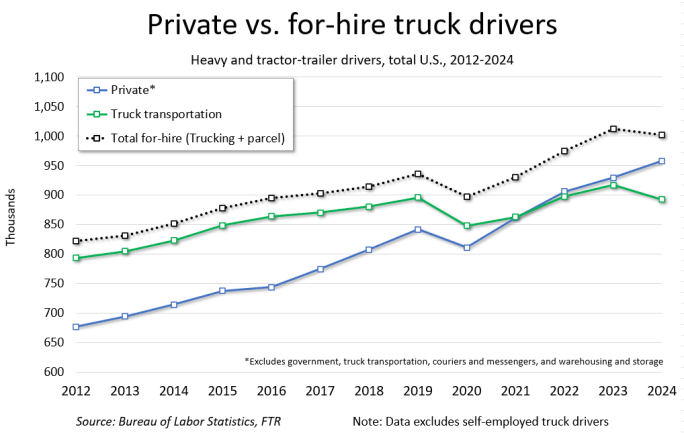
These BLS statistics don't include self-employee drivers, so in reality, for-hire trucking still has more heavy truck drivers than private fleets do. But that doesn't negate the trend of more private fleet drivers.
Source: FTR
How the Government Defines Trucking Employment
The Bureau of Labor Statistics each year publishes the findings of its Occupational Employment and Wages Statistics (OEWS) data collection, estimating employment levels by both occupation and industry across the U.S. economy. In early April, BLS released data for its 2024 survey, which was conducted in May of last year.
The OEWS data is the definitive source for these detailed estimates, although it has some significant limitations.
For trucking, the biggest limitation is that the OEWS figures do not include self-employed workers, which means they don’t count leased owner-operators or very small trucking firms unless they are organized in a way that their drivers are payroll employees.
Still, the OEWS data offers great insights into employment trends if you understand what it represents.
To interpret the data, we also need to define what we mean by “private” and “for-hire.”
The BLS term for what we consider for-hire trucking is “truck transportation,” so you could argue that everything except truck transportation and government is “private.” That definition would show a very strong trajectory, putting private fleet employment of heavy truck drivers ahead of for-hire as early as 2018 and more than 250,000 drivers ahead of for-hire today.
FTR's Take on the Definition of Private Fleet in BLS Data
FTR’s definition of a private fleet is narrower, however.
We consider a private fleet to be one that moves its own product and is not in the transportation business. Therefore, we exclude parcel and local delivery — what the federal government calls “couriers and messengers” — as well as warehousing and storage as a business.
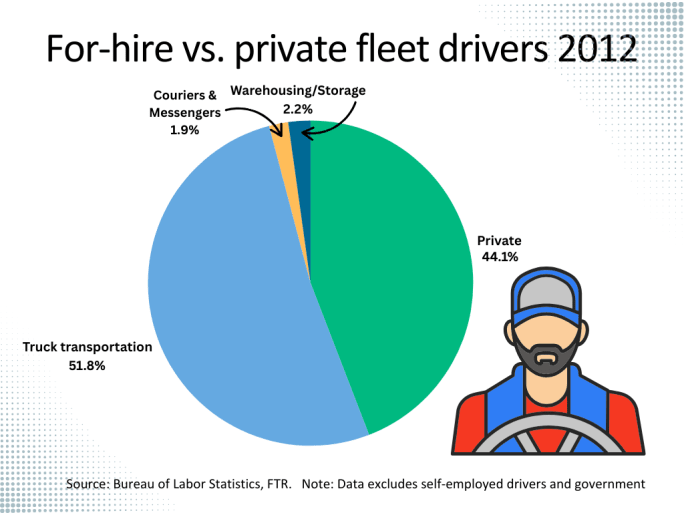
In 2012, the "truck transportation" category of the BLS numbers, largely the for-hire sector, made up about half of truck driver employment (not counting self-employed drivers).
Image: HDT Graphic
We recognize the fuzziness of this definition, depending on how BLS might categorize businesses. It might mean, for example, that we are treating Amazon as being in the transportation business rather than as a company delivering its own product. However, treating couriers and messengers as private would mean counting UPS and Federal Express as private fleets, which clearly would be even more misleading.
Even by our tighter accounting, private fleet employment of heavy truck drivers caught up with truck transportation in 2021. By 2024, our analysis shows, private fleet drivers exceeded for-hire by more than 65,000.
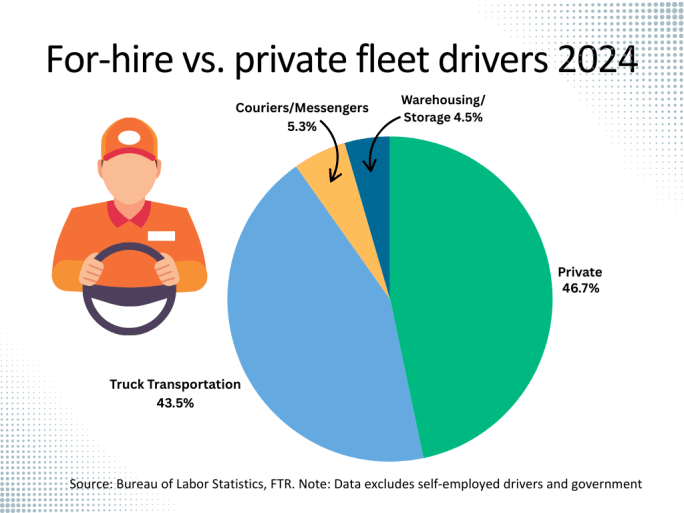
By 2024, the share of for-hire vs. private truck driver employment was nearly reversed.
Image: HDT Graphic
Of course, the truck freight market has far more than 65,000 self-employed heavy truck drivers, so in reality, for-hire trucking has more heavy truck drivers than private fleets do. But it is still an interesting phenomenon that illustrates a trend.
Over the past decade, all major private fleet categories have outpaced “for-hire” truck transportation except for mining, which has seen a big drop in its heavy truck driving force.
The wild ups and downs in the freight market in 2017-2018 and 2020-2021 likely fueled corporate desires to exert more control over their distribution and other trucking-related activity.
Although not at all surprising given the e-commerce revolution, even more impressive is the growth in heavy truck employment for warehousing and storage and, especially, couriers and messengers — the latter seeing job levels surge from under 30,000 in 2014 to nearly 110,000 in 2024.
Subscribe to Our Newsletter
More Drivers

EEOC Sues Texas Trucking Company Over Driver Age Limits
The agency says Trancasa USA rejected applicants over 65 and applied tougher driving-record standards to those over 60.
Read More →
Nussbaum, Roehl Announce Second Driver Pay Increase This Year
This year has seen a swath of major truck driver pay increases as freight capacity has tightened.
Read More →
From One Generation to the Next: How Mentorship Builds Safer Truck Drivers
After three decades in trucking, Harold Perry shares what he's learned about driver safety, mentorship, and helping the next generation build confidence behind the wheel.
Read More →
Truck Drivers Need More Than Another Alert
Fleets have more visibility into truck health, safety events, and driver activity than ever. The next challenge is turning all that information into useful guidance for the person who has to decide what to do next.
Read More →
FMCSA Removes 110 Truck Driver Training Schools from Certified ELDT List
Federal regulators also are targeting more than 160 additional training providers and launching a nationwide audit of third-party CDL skills testers as part of a broader crackdown on trucking fraud.
Read More →
Hours of Service Pilot Programs: FMCSA Readies for 2027 Rollout
Two pilot programs could eventually reshape hours-of-service rules, giving truck drivers options to pause their 14-hour clock or use longer split sleeper rest periods.
Read More →
Medical Cards, English Proficiency Reshape Roadcheck Violations
Medical-card violations jumped to the top of the driver out-of-service list during CVSA’s 2026 International Roadcheck, while English-language proficiency violations appeared among the leading violations for the first time.
Read More →
Driver Trust Can Make or Break the Success of Fleet Safety Technology
New Teletrac Navman research suggests that onboarding, transparency about driver data, and positive feedback can play a significant role in how commercial drivers respond to safety and coaching technology.
Read More →
EEOC Sues KLLM Over Alleged Sex Discrimination in Driver Training
KLLM is facing a federal sex-discrimination lawsuit over policies the EEOC alleges put female truck driver trainees at a disadvantage.
Read More →
FMCSA Moves to Codify English Language Requirements for Commercial Drivers
By changing regulations on English-language proficiency requirements for commercial drivers, rather than relying on a guidance memo, the FMCSA said future administrations won't be able to walk back the Trump administration's stricter enforcement with just a memo.
Read More →