





“Truck and trailer payment costs have undergone a sea change since the pandemic, increasing by 52.3% since 2019 and by 8.3% between 2023 and 2024 alone."
Fleet Margins Fall as Trucking Costs Set New Records in ATRI’s 2025 Report
The trucking industry last year experienced the highest non-fuel operating costs ever recorded by the American Transportation Research Institute, which combined with the ongoing freight recession to drive down fleet profitability.
July 1, 2025

The good news in ATRI's 2025 trucking operational costs report is that only three line-items outpaced inflation (which was 2.9%).
Image: HDT Graphic
5 min to read
The trucking industry last year experienced the highest non-fuel operating costs recorded by the American Transportation Research Institute, which combined with the ongoing freight recession to drive down operating margins.
According to ATRI’s Analysis of the Operational Costs of Trucking report, which it has been doing since 2008, the industry's average cost of operating a truck in 2024 was $2.26 per mile. That’s a 0.4% decline compared with the previous year.
However, when lower fuel costs are excluded, marginal costs rose 3.6% to $1.779 per mile.
Which Trucking Operational Costs Were Up? Which Were Down?
The 7-cent drop in fuel costs in 2024 was the largest year-over-year change in the survey. Repair and maintenance expenses also fell from 2023 to 2024.
And driver wages, the primary contributor to cost increases in the three years following the COVID-19 pandemic, rose by just 2.4%, half a percentage point less than inflation.
However, several line-items set new record highs in 2024: truck and trailer payments, insurance premiums, tires, tolls, driver pay, and driver benefits. Only three line-items outpaced inflation (which was 2.9%): truck and trailer payments, tolls, and driver benefits.
Only driver benefits costs, at $0.197 per mile, increased by a larger percentage in 2024 (4.8%) than they did in 2023 (2.7%). The percentage of respondents offering benefits increased, partly explaining the higher rate of increase.
Truck and trailer payments rose by 8.3% to a record-high $0.39 per mile.
“Truck and trailer payment costs have undergone a sea change since the pandemic, increasing by 52.3% since 2019 and by 8.3% between 2023 and 2024 alone,” said ATRI in its report.
“No other line item has been subject to such a radical cost upheaval. Even driver wages, with the second-highest percentage increase during the same period, rose at the comparatively milder rate of 44% during the same 5-year period.”
After a 12.5% spike in truck insurance premiums in 2023, insurance rose an additional 3.0% in 2024 to $0.102 per mile, a new record high. However, this rate of increase was below the annual average for the commercial auto segment as a whole, ATRI pointed out.
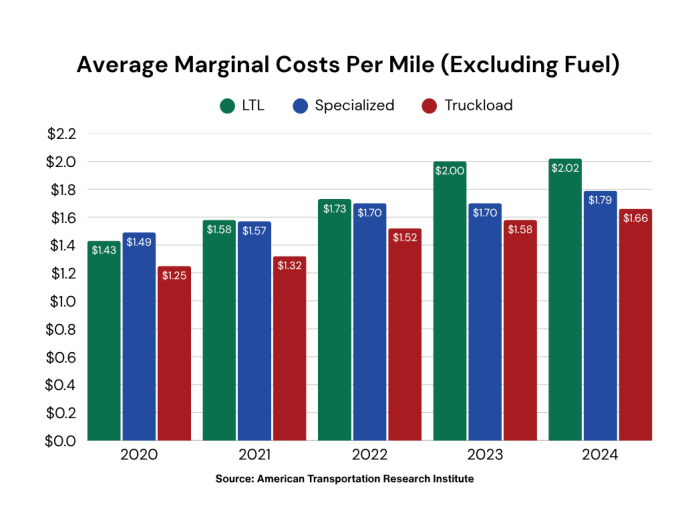
When lower fuel costs are excluded, marginal costs rose 3.6% to $1.779 per mile.
Image: HDT Graphic
The Impact of the Freight Recession
Carrier profitability suffered across all industry sectors under the pressures of these higher costs and the continuing freight recession, according to ATRI.
Average operating margins were less than 2% in every sector aside from less-than-truckload. The truckload sector had an average operating margin of -2.3%. Trucking firm bankruptcies mounted in 2024.
While parts of the U.S. economy grew, in trucking and specifically in the dry van, flatbed, and refrigerated sectors, nationwide contract and spot freight rates continued to slide over the year.
Motor carriers sold trucks.
Empty miles rose to an average of 16.7%.
The number of drivers per truck fell to 0.93 as carriers parked trucks.
Truck capacity dropped 2.2%.
Another cost-management strategy was reducing non-driver staff by 6.8%.
At the same time, average truck age, average dwell time per stop, and mileage between breakdowns improved.
Newer Trucks, Older Dry Vans, More Miles
Average truck age fell again in 2024, to 3.4 years from 3.8 years in 2023. ATRI said this low average reflects continued 2024 deliveries of aggressive 2023 truck purchases, following truck shortages and delays during the COVID-19 pandemic.
There was no overall trend in trailer age, but the average age of 53-foot trailers, the most common trailer type by far, rose by one year to 7.4 years old.
Average annual truck mileage increased for a second year in a row, from 80,159 in 2023 to 82,677 in 2024, after a multi-year period of decline.
Trucks operated an average of 268 days per year, a substantial increase from 243 days of operation in 2023. ATRI said this trend may result from fleets reducing their capacity.

Average annual truck mileage increased for a second year in a row, from 80,159 in 2023 to 82,677 in 2024, after a multi-year period of decline.
Source: ATRI
Looking Ahead
“Economic conditions in the trucking industry continue to appear uncertain at best for the foreseeable future,” ATRI said in its report.
GDP slipped 0.2% in Q1 2025, due primarily to the large volume of imports ahead of expected tariffs, and it is forecast to be counterbalanced by a disproportionately high Q2 GDP.
“The pertinent disappointment for trucking, however, is that the swell of Q1 import freight did not buoy freight rates; aside from slight improvements in the flatbed sector, rates continued to stagnate in the first quarter of 2025," ATRI said.
“The full impact of tariffs and trade agreements, along with geopolitical disruptions in Europe and the Middle East, cast uncertainty not only over freight volumes and rates but over industry costs and profitability."
The Overcapacity Question
Many freight experts remain concerned that excess capacity (too many trucking companies and too many trucks for the current level of demand) is preventing a recovery in freight rates.
"It is safe to conclude that capacity left the freight market in meaningful volumes during 2024 and will likely continue to do so in 2025," ATRI said.
Will that help improve freight rates?
While the number of monthly operating authority revocations has eclipsed the number of newly authorized motor carriers since Q4 2022, ATRI said, this data is skewed towards owner-operators and very small fleets.
Last year’s Ops Costs report showed that most of the industry, outside of owner-operators and very small fleets, were still adding capacity (at a rate of 4.1%) in 2023.
In 2024, however, returning Ops Costs participants decreased fleet sizes by an average of 2.2%. In addition, an increased proportion of the remaining trucks were unseated.
The Importance of Benchmarking
“The trucking industry is facing the most challenging freight market in years, with loads down and costs increasing,” said Groendyke Transport President and CEO Greg Hodgen, in a news release.
“ATRI’s Operational Costs data and the customized benchmarking report that compares us to similar fleets are more critical than ever as we navigate rising costs and decreasing margins in this adverse environment.”
(Carriers that participate in providing data for the report receive a customized report directly comparing their operations to an anonymized peer group of the same sector and size.)
The full report is available on ATRI’s website.
More Fleet Management

Geotab Links Fleet Card to Vehicle Data
The new card combines fuel discounts with telematics-based purchase controls. Geotab’s analysis also points to potential savings from choosing lower-priced fuel stops.
Read More →
How MFA Helps Protect Trucking Fleets
Multi-factor authentication adds protection when passwords are stolen. Here’s how it works and where fleets should start.
Read More →
How Better Freight Data Helps Trucking Teams Get Ahead of Disruption
Trucking and logistics teams have plenty of data. The problem is getting the right information in front of the right people soon enough to act. Better-connected data can help teams spot trouble earlier and make smarter decisions before small problems become big ones.
Read More →

Trimble: Taking Artificial Intelligence in Trucking Beyond Faster Tasks
At Insight 2026, Trimble executives argued that fleets may need to redesign workflows to get more from AI as it introduced new products and enhancements. AI’s value will depend on how fleets combine automation with their people's knowledge.
Read More →
Sponsored•September 28, 2026
Build a bulletproof fleet: Uniting ELDs and dash cams for total compliance
An ELD can prove compliance, but it cannot always prove what happened on the road. Discover how uniting accurate ELD data with AI-powered dash cam video can help your fleet strengthen compliance, defend against liability, protect drivers and reduce operational costs.
Read More →
Nominations Open for HDT Emerging Leaders
Heavy Duty Trucking is looking for accomplished trucking fleet professionals under 40 who are making an impact and helping lead the industry forward.
Read More →
Why Private Fleets Are Taking More Freight
Private fleets are putting their own trucks on demanding customers and high-cost lanes as companies seek greater control over service, costs, and capacity.
Read More →
Sponsored•September 16, 2026
Color Match Smarter: Tools That Restore & Perform
For fleet managers and collision repair professionals keeping heavy-duty trucks on the road, getting the color right the first time isn't just about appearance — it's about efficiency, turnaround time, and bottom-line results. Discover how today's digital color tools are transforming the repair process from guesswork to precision.
Read More →
FMCSA Pauses Biennial-Update Enforcement Amid Motus Transition
Carriers whose updates were due on or after June 1 have more time, while FMCSA works to stabilize its new registration system and warns of phishing sites impersonating its new carrier registration system, Motus.
Read More →
Sponsored•September 14, 2026
2026 Blueprint for Countering Smarter Supply Chain Theft
Cargo theft is no longer just the cost of doing business. It's a multi-billion-dollar criminal enterprise exploiting vulnerabilities across your fleet, drivers, and supply chain.
Read More →