




Questar Predictive Fleet Health Platform Now Available Through Geotab Marketplace
Quester’s AI-driven maintenance insights aim to help fleets reduce unplanned downtime, improve repair planning, and better understand the true cost of maintenance decisions.

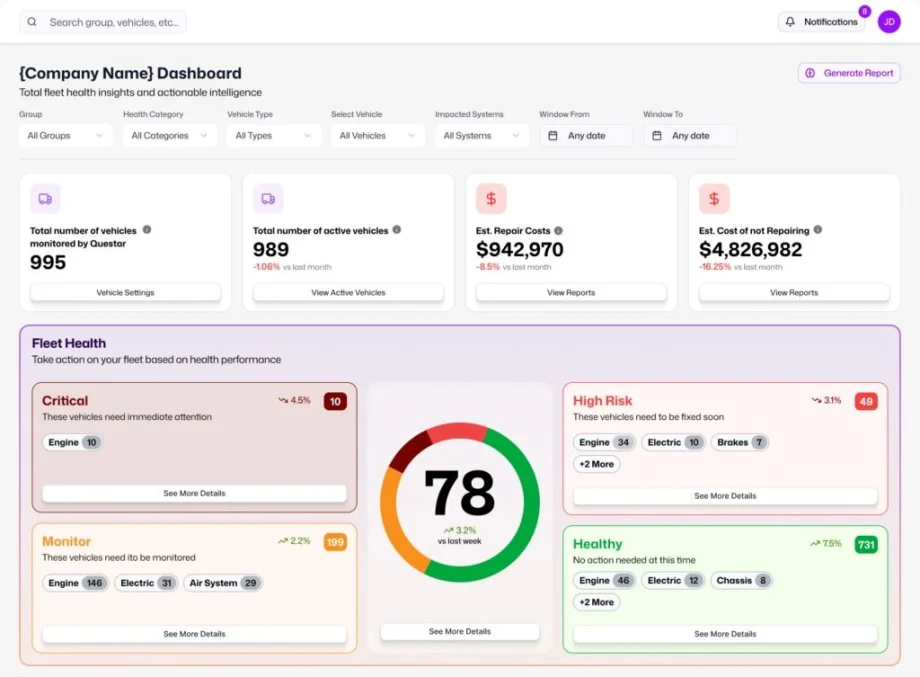
The Quester fleet health platform uses artificial intelligence to analyze vehicle telemetry, engine fault codes, maintenance history, and other operating conditions.
Quester
Questar Auto Technologies has made its predictive Total Fleet Health Management solution available through the Geotab Marketplace.
The two companies said this partnership gives fleets a new way to leverage vehicle data to anticipate failures, plan maintenance proactively, and keep trucks on the road longer.
The solution uses artificial intelligence to analyze vehicle telemetry, engine fault codes, maintenance history, and other operating conditions. Its goal is to identify emerging issues before they become costly breakdowns.
By integrating directly with Geotab through a cloud-to-cloud connection, Questar requires no additional hardware, allowing fleets to deploy the technology quickly using data they are already collecting.
Predictive Maintenance with an Economic Lens
What differentiates Questar’s platform, according to the company, is its focus on economics as well as diagnostics.
In addition to flagging potential problems, the system estimates both the cost of early intervention and the downstream cost of doing nothing, helping fleets prioritize repairs based on financial impact rather than alarms alone.
That approach is designed to support more confident maintenance decisions, especially in operations where shop capacity, parts availability, and uptime pressures require constant trade-offs.
Questar says fleets using its predictive health tools have been able to reduce unplanned downtime while optimizing maintenance spend by addressing problems earlier, when repairs are typically less expensive and less disruptive.
Early Warnings, Actionable Insights
Using Geotab’s vehicle data as a foundation, the Questar platform provides early-warning issue alerts. In some cases, these alerts are issued up to 30 days in advance of a breakdown. The platform also issues prescriptive repair recommendations tailored to each vehicle.
Additionally, the system factors in environmental context and historical performance to reduce false positives and focus attention on issues that are most likely to escalate.
By combining high-quality telematics data with Questar’s patented AI foundation models, fleets gain a more proactive approach to maintenance planning, the company says. The result is more predictable service intervals, fewer roadside events, and improved vehicle utilization.
Seamless Integration for Fleets
Because the integration is cloud-based, fleets can activate Questar’s solution through the Geotab Marketplace without installing additional sensors or devices. That ease of implementation is increasingly important as fleets look to expand their use of data analytics without adding complexity to the vehicle.
“Fleets are looking for solutions that fit naturally into their existing technology environments,” said Aaron Howell, vice president of sales for Questar North America. “Through the Geotab Marketplace, fleets across North America can now access Questar’s advanced features.”
For fleets already using Geotab, the addition of predictive fleet health insights offers another layer of visibility into vehicle condition — one aimed squarely at reducing downtime and improving the return on maintenance investments.
More Fleet Management

Geotab Links Fleet Card to Vehicle Data
The new card combines fuel discounts with telematics-based purchase controls. Geotab’s analysis also points to potential savings from choosing lower-priced fuel stops.
Read More →
How MFA Helps Protect Trucking Fleets
Multi-factor authentication adds protection when passwords are stolen. Here’s how it works and where fleets should start.
Read More →
How Better Freight Data Helps Trucking Teams Get Ahead of Disruption
Trucking and logistics teams have plenty of data. The problem is getting the right information in front of the right people soon enough to act. Better-connected data can help teams spot trouble earlier and make smarter decisions before small problems become big ones.
Read More →

Trimble: Taking Artificial Intelligence in Trucking Beyond Faster Tasks
At Insight 2026, Trimble executives argued that fleets may need to redesign workflows to get more from AI as it introduced new products and enhancements. AI’s value will depend on how fleets combine automation with their people's knowledge.
Read More →
Build a bulletproof fleet: Uniting ELDs and dash cams for total compliance
An ELD can prove compliance, but it cannot always prove what happened on the road. Discover how uniting accurate ELD data with AI-powered dash cam video can help your fleet strengthen compliance, defend against liability, protect drivers and reduce operational costs.
Read More →
Nominations Open for HDT Emerging Leaders
Heavy Duty Trucking is looking for accomplished trucking fleet professionals under 40 who are making an impact and helping lead the industry forward.
Read More →
Why Private Fleets Are Taking More Freight
Private fleets are putting their own trucks on demanding customers and high-cost lanes as companies seek greater control over service, costs, and capacity.
Read More →
Color Match Smarter: Tools That Restore & Perform
For fleet managers and collision repair professionals keeping heavy-duty trucks on the road, getting the color right the first time isn't just about appearance — it's about efficiency, turnaround time, and bottom-line results. Discover how today's digital color tools are transforming the repair process from guesswork to precision.
Read More →
FMCSA Pauses Biennial-Update Enforcement Amid Motus Transition
Carriers whose updates were due on or after June 1 have more time, while FMCSA works to stabilize its new registration system and warns of phishing sites impersonating its new carrier registration system, Motus.
Read More →
2026 Blueprint for Countering Smarter Supply Chain Theft
Cargo theft is no longer just the cost of doing business. It's a multi-billion-dollar criminal enterprise exploiting vulnerabilities across your fleet, drivers, and supply chain.
Read More →