




Fleet Advantage: Fleets Embrace Generative AI, but Data Problems Limit Operational Gains
New Fleet Advantage research shows generative AI adoption has exploded among private fleets. But poor data integration and weak ROI tracking are preventing fleets from unlocking AI’s full operational and financial value.

A new Fleet Advantage study has found that weak data infrastructure and limited measurement capabilities are keeping many organizations from realizing deeper operational benefits from generative AI technology.
Fleet Advantage
Generative artificial intelligence has rapidly become a mainstream tool among private fleets. But weak data infrastructure and limited measurement capabilities are keeping many organizations from realizing deeper operational benefits.
That assessment is according to a new Fleet Advantage survey released during the National Private Truck Council’s 2026 Annual Conference and Exhibition.
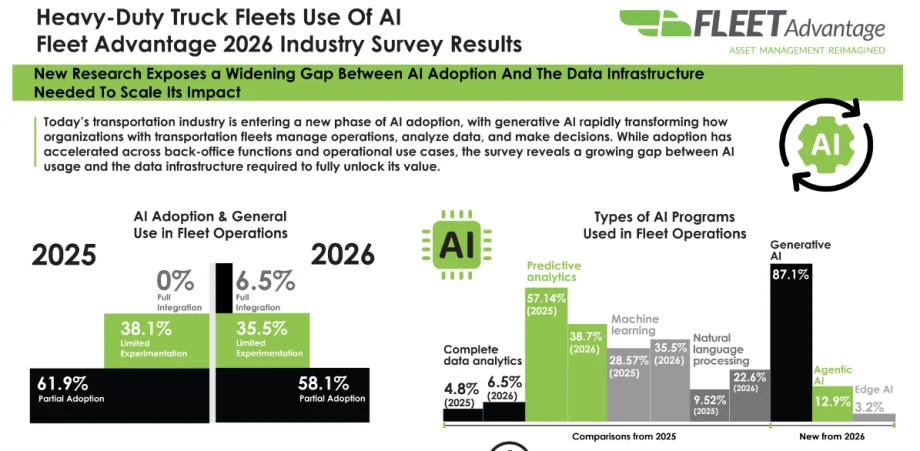
The survey, conducted in April among more than 2,500 transportation and private fleet executives, found that 87.1% of respondents are now using generative AI large language models. Applications include back-office tasks, driver feedback, and extracting information from fleet documents, including maintenance manuals, compliance guides, and standard operating procedures.
Fleet Advantage said the findings reveal both significant progress in AI adoption and growing concern over the quality of the data supporting those systems.
GenAI Adoption Surges Across Fleet Operations
Fleet Advantage said generative AI’s rapid rise represented one of the largest year-over-year shifts the company has recorded in its annual survey. The technology category did not appear in the company’s 2025 survey at all.
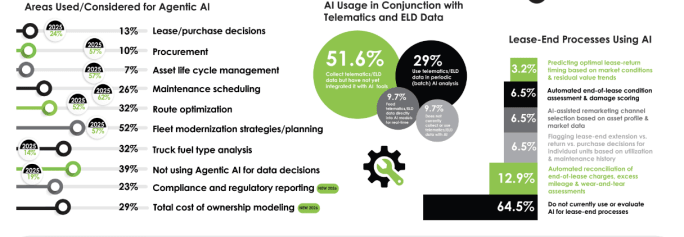
Meanwhile, fleets also reported sharp increases in operational AI use cases between 2025 and 2026, including:
- Route optimization growing from 42.9% to 71%
- Maintenance scheduling increasing from 33.3% to 64.5%
- Fuel type analysis rising from 0% to 61.3%
- Asset lifecycle management climbing from 9.5% to 38.7%
Predictive analytics and machine learning adoption also increased, though at lower rates than generative AI applications.
Fleet Advantage
The survey found that 61.3% of fleets now use AI-powered tools for driver monitoring, coaching, and safety management.
Still, Fleet Advantage noted that 6.5% of respondents reported having no formal driver safety monitoring program at all, highlighting what the company described as a concerning gap in baseline safety practices.
Data Integration Emerges as the Biggest Obstacle
While fleets are deploying AI more aggressively, the survey found that implementation challenges intensified significantly year over year.
Respondents citing data integration issues jumped from 38.1% in 2025 to 71% in 2026, while concerns about inaccurate data rose from 23.8% to 64.5%. Lack of AI expertise also increased from 19% to 45.2%.
Fleet Advantage said the results suggest many fleets are struggling to build the foundational data systems needed to scale AI initiatives effectively.
Fleets Pull Back on Agentic AI Expectations
The survey also found a decline in active use and enthusiasm surrounding agentic AI technologies.
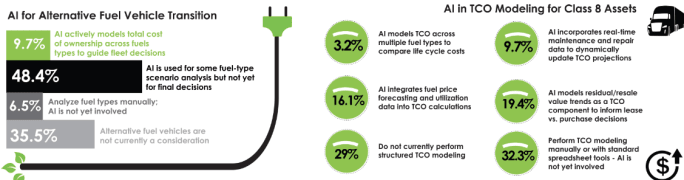
Respondents reporting no use of agentic AI nearly doubled year over year, increasing from 19% in 2025 to 38.7% in 2026. Interest in using agentic AI for procurement fell sharply from 57.1% to 9.7%, while interest in asset lifecycle management dropped from 57.1% to 6.5%.
Fleet Advantage
Fleet Advantage said the findings indicate that earlier survey responses may have reflected aspirational goals rather than actual deployment activity.
ROI Tracking and TCO Modeling Remain Weak Spots
Despite increasing investment in AI tools, few fleets appear to have formal systems for measuring returns.
Only 9.7% of respondents reported having a formal AI ROI tracking framework, while 51.6% said they track metrics informally and 19.4% rely on anecdotal assessments.
Fleet Advantage
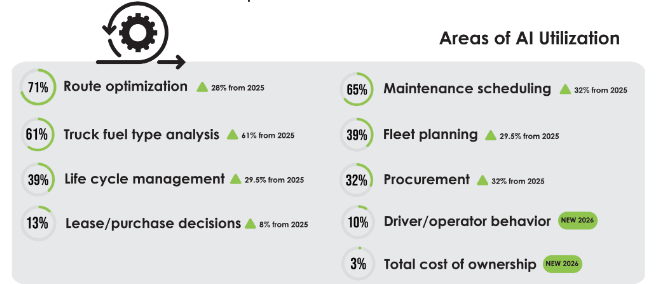
The survey also identified major gaps in total cost of ownership modeling for Class 8 equipment. About 32% of respondents said they still conduct TCO modeling manually, while 29% reported not performing TCO analysis at all. Adoption of AI-driven TCO modeling averaged just 12.1%.
Telematics and Lease-End AI Opportunities Remain Untapped
Fleet Advantage identified telematics integration and lease-end processes as two major areas where fleets have yet to fully apply AI technologies.
More than half of respondents said they collect telematics and ELD data but have not integrated it into AI systems. While only 9.7% are using those data streams for real-time AI insights. Additionally, 64.5% reported no use or evaluation of AI for lease-end processes such as damage scoring, remarketing, or excess mileage assessment.
“The data tells a story we see playing out across the industry every day,” Mac Hudson, senior off-lease manager at Fleet Advantage, said. “Private fleets are embracing AI faster than anyone anticipated, particularly GenAI, but enthusiasm alone does not create results.”
More Fleet Management

Nominations Open for HDT Emerging Leaders
Heavy Duty Trucking is looking for accomplished trucking fleet professionals under 40 who are making an impact and helping lead the industry forward.
Read More →
Why Private Fleets Are Taking More Freight
Private fleets are putting their own trucks on demanding customers and high-cost lanes as companies seek greater control over service, costs, and capacity.
Read More →
Color Match Smarter: Tools That Restore & Perform
For fleet managers and collision repair professionals keeping heavy-duty trucks on the road, getting the color right the first time isn't just about appearance — it's about efficiency, turnaround time, and bottom-line results. Discover how today's digital color tools are transforming the repair process from guesswork to precision.
Read More →


FMCSA Pauses Biennial-Update Enforcement Amid Motus Transition
Carriers whose updates were due on or after June 1 have more time, while FMCSA works to stabilize its new registration system and warns of phishing sites impersonating its new carrier registration system, Motus.
Read More →
2026 Blueprint for Countering Smarter Supply Chain Theft
Cargo theft is no longer just the cost of doing business. It's a multi-billion-dollar criminal enterprise exploiting vulnerabilities across your fleet, drivers, and supply chain.
Read More →
How Telematics Improves Visibility, Control, and Performance in Refrigerated Fleets
Explore how telematics help refrigerated fleets improve visibility, uptime, efficiency, compliance, and cargo protection across connected cold chain operations.
Read More →
What the U.S.-Canada Trade War Means for Trucking
Escalating U.S.-Canada tariffs could disrupt cross-border freight, reduce truck volumes, raise costs, and create new uncertainty for carriers on both sides of the border.
Read More →
What Are Trucking’s Top Concerns for 2026?
The American Transportation Research Institute wants to know what's worrying trucking fleet managers, drivers, and other stakeholders in its annual Industry Issues survey.
Read More →
American Trucking Associations Looks for a New Leader
ATA President and CEO Chris Spear abruptly left his job at the association on August 21, at a pivotal time for the trucking industry.
Read More →
Public Wi-Fi Cybersecurity Risks: How Truck Drivers and Fleets Can Protect Their Data
Public Wi-Fi can expose truck drivers and fleets to credential theft, malware, and other cyber threats. Here’s how to reduce the risk on the road.
Read More →