





5 Ways Fleets Can Compete for Truck Drivers in a Tough Labor Market
How Trucking Companies Can Use Artificial Intelligence to Connect With Drivers
Artificial intelligence can help trucking companies communicate better with drivers -- and if used correctly, actually improve the type of human connections that are vital to truck driver recruiting and retention.
January 15, 2025

Can AI in the cab help trucking companies communicate better with drivers?
Image: HDT Graphic
6 min to read
Artificial intelligence is popping up in all aspects of managing a trucking fleet, from predictive maintenance to load-planning. Tim Crawford, co-founder and CEO of Tenstreet, is excited about the potential for AI to transform how trucking companies interact with their drivers.
Crawford founded Tenstreet in 2006. It’s a software company that connects carriers and drivers across the lifecycle, from pre recruitment advertising through recruiting and onboarding, as well as safety management after they’re hired.
“So all the places where carriers and drivers come together, we try to build tools to make those interactions better,” Crawford explains.
And today, that involves creating ways to use artificial intelligence to do just that.
Tenstreet has been working on that, and last year added Pulse+, a new communication platform that uses generative AI to automate processes, freeing up recruiter time to build stronger connections while at the same time enabling instant after-hours and weekend replies to engage applicants.
We talked to Crawford about the new technology and how motor carriers can improve their engagement with their drivers.
Getting Ready for the Freight Cycle Upswing — and the Driver Shortage
As the freight and rate outlook appears to be improving, trucking fleets are looking more closely at how to improve their operations, make things run more smoothly and efficiently, and avoid being caught flat-footed when things really start picking up and the driver shortage gets ugly again.
With the rapid changes in technology available to motor carriers, especially with the growth of generative AI, there are opportunities to improve communications and relationships with a carrier’s drivers.
“What we’re seeing is people asking, whatcan we do with all the technology that's just ubiquitous today in the driver's pocket, in the cab?” Crawford says.
“One of the things we really are big believers in is this idea of interdependence, that if you can connect to islands of technology, you not only make connections that weren't possible before, but you make both sides of your connecting better than they would have been independently.”
For instance, he says, having a driver onboarding system that's deeply integrated with a recruiting experience makes for a better experience for drivers.
Or, if you can have a navigation experience that's deeply connected to both your retention and your safety program, you're going to end up with better outcomes on both sides.
And Tenstreet has been working on that.
“I really feel like we’re just starting to scratch the surface on it,” Crawford says.
How AI Can Help Make Connections With Drivers
When looking at how AI can help in driver recruiting, Crawford says, in its nearly 20 years of working with driver recruiting and retention, Tenstreet has learned that the issues drivers want to know about tend to fall into about six or seven categories.
“So we built some generative AI to give carriers the ability to respond to those standard questions,” such as pay rates, home time, pet policy, etc.
“If you think about the importance of human connection, a recruiter is not going to make a human connection with a driver around ‘Here's our standard pay package,’” Crawford says. “Allow the recruiter do the exploration about what's most important to that driver, as a human. That's where we think people are going to get the best outcomes.”
What about driver retention?
Crawford says geofencing technology and AI can help improve both shipper satisfaction and driver retention.
For instance, when a driver arrives at a terminal, a generative AI system could send the driver a welcome video and let them know things such as where the washer and dryer are, the code to the wi-fi, and a button to press if they need help with anything.
Geofencing can identify when drivers arrive at a shipper, resulting in reminders for drivers when they arrive about any instructions specific to that location.
And if the driver is stuck at that shipper or receiver for more than a certain amount of time, the system could automatically send the driver a message such as, “It looks like you’re detained. We’re really sorry. Here’s a gift card for dinner on us when you do finally get out of there. And if there’s anything else you need, tap here,” Crawford says.
“We think this intersection between different parts of the business, as well as between technology and humans, enables things that are really, really interesting.”
Does AI Get in the Way of Personal Communication?
The key to using artificial intelligence like this effectively is to keep in mind that it’s not supposed to replace human, personal communication, but to enhance it.
“What we see in terms of both recruiting outcomes and safety outcomes is, the more humans get involved, the better the outcomes are,” Crawford says.
“So what we're really focused on is, how do you build this technology in such a way that it furthers those human connections?”
The AI technology could be used to communicate the rote, routine data, freeing up time for more real human connections between people.
“So when humans have a conversation, it’s about making human connections, whether that connection is in recruiting context -- Why come drive for a given carrier? -- or a safety context -- tell me what's really going on here.”
The key is to let drivers know that this technology is being used, but if the AI can’t respond, or it’s too complex a situation for the AI, there’s a human conversation.
“Humans are always part of it, making that personal connection. But we think it's really important to get the most out of the tech in a way that is most impactful for both drivers and carriers.”
Trucking’s Complicated. AI Can Help.
“A metaphor we use is we want to be like an escalator. Because if you think about it, escalators never really break; they just turn into stairs,” Crawford says.
“Trucking is complicated. But it's not put-a-man-on-the-moon complicated. It's what I call death by a thousand cuts complicated. There's all these little things that can go wrong and do go wrong every day.
“And so the challenge from a technology perspective is, how do you build something so that when those exceptions come up, you're not on an elevator stuck between floors? You're on an escalator climbing the stairs.
“Whether that's inevitable delays or problems with a truck, or shipper challenges or scheduling challenges, or, ‘I couldn't get a parking spot and I'm running out of hours,’" he says, "Tenstreet is focused on how technology can help anticipate the range of those exceptions in a way that they can get managed gracefully."
What Steps Can Fleets Take in Adopting AI?
Asked what advice he would give carriers about adopting this kind of technology, Crawford says, “I think the important thing is to understand the evolution and don't bite off more than you can chew. It’s sort of crawl, walk, run.”
As the market improves, he says, motor carriers need to be asking themselves, “How do I position myself to succeed?”
“So start early, start gradually. And make sure that while you see the ultimate goal, you don't have to get there in one step. And you'll adopt it at the rate that makes sense for each organization. And really move in an iterative fashion.
“When we see clients sort of swinging for the fences, you're going to strike out a lot. And to continue the baseball analogy, just get on base and advance the runners. That's where you're going to get the biggest results.”
Subscribe to Our Newsletter
More Drivers

From One Generation to the Next: How Mentorship Builds Safer Truck Drivers
After three decades in trucking, Harold Perry shares what he's learned about driver safety, mentorship, and helping the next generation build confidence behind the wheel.
Read More →
Truck Drivers Need More Than Another Alert
Fleets have more visibility into truck health, safety events, and driver activity than ever. The next challenge is turning all that information into useful guidance for the person who has to decide what to do next.
Read More →
FMCSA Removes 110 Truck Driver Training Schools from Certified ELDT List
Federal regulators also are targeting more than 160 additional training providers and launching a nationwide audit of third-party CDL skills testers as part of a broader crackdown on trucking fraud.
Read More →
Hours of Service Pilot Programs: FMCSA Readies for 2027 Rollout
Two pilot programs could eventually reshape hours-of-service rules, giving truck drivers options to pause their 14-hour clock or use longer split sleeper rest periods.
Read More →
Medical Cards, English Proficiency Reshape Roadcheck Violations
Medical-card violations jumped to the top of the driver out-of-service list during CVSA’s 2026 International Roadcheck, while English-language proficiency violations appeared among the leading violations for the first time.
Read More →
Driver Trust Can Make or Break the Success of Fleet Safety Technology
New Teletrac Navman research suggests that onboarding, transparency about driver data, and positive feedback can play a significant role in how commercial drivers respond to safety and coaching technology.
Read More →
EEOC Sues KLLM Over Alleged Sex Discrimination in Driver Training
KLLM is facing a federal sex-discrimination lawsuit over policies the EEOC alleges put female truck driver trainees at a disadvantage.
Read More →
FMCSA Moves to Codify English Language Requirements for Commercial Drivers
By changing regulations on English-language proficiency requirements for commercial drivers, rather than relying on a guidance memo, the FMCSA said future administrations won't be able to walk back the Trump administration's stricter enforcement with just a memo.
Read More →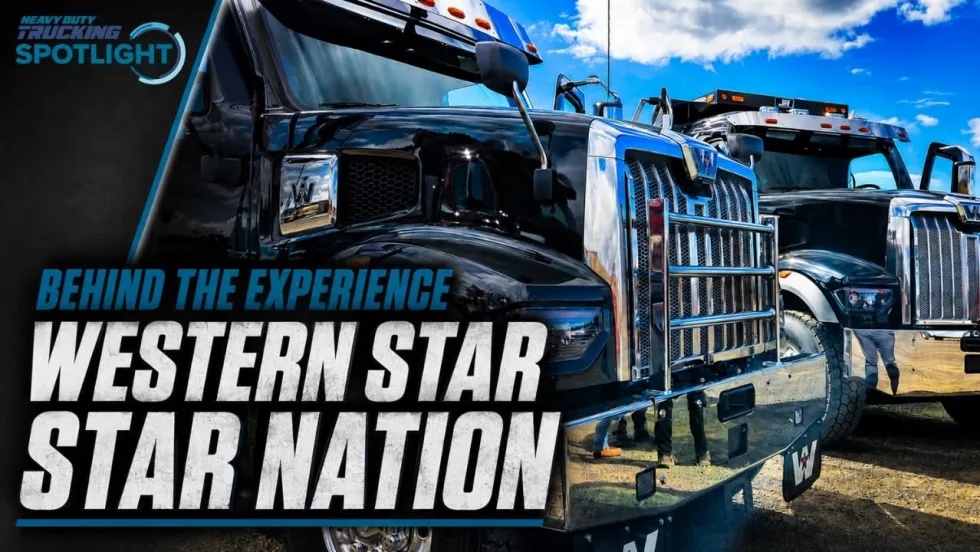
Drivers Put Western Star Trucks to the Test at Star Nation Experience
Watch to get an inside look at the Western Star trucks, technology, and community behind the Star Nation Experience 2026!
Read More →
Trump Administration Looks to Put More Veterans Behind the Wheel
The Freedom Haulers program pulls together existing and expanded programs at several federal agencies to recruit veterans to drive commercial heavy-duty trucks and cut the red tape for them to get a CDL, training, and employment.
Read More →