




Q&A: Lisa Kelly Explains Ice Road Trucking, Reality TV Editing, and Life as a Female Driver
Lisa Kelly talks to HDT about the return of the show Ice Road Truckers, what really happens on the ice roads, how reality TV shapes drivers’ stories, and the career she’s built beyond the show.

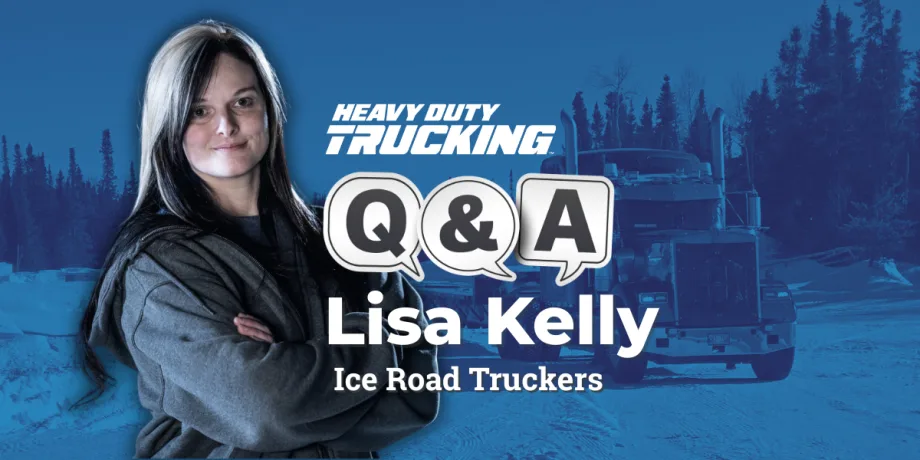
Lisa Kelly returned to "Ice Road Truckers" for a 12th season.
HDT Graphic
This fall, the TV show “Ice Road Truckers” returned to The History Channel for a 12th season, after an eight-year hiatus – and Lisa Kelly returned to the screen, as well.
The show, which debuted in 2007, was billed as a “documentary series examining the lucrative but highly dangerous job of driving trucks on Canada's notorious ice highway.” But it had a more reality-TV feel.
Kelly was the first woman truck driver featured on the show. She appeared in a majority of the seasons — including the spinoff "IRT: Deadliest Roads," where the drivers traded the ice roads for dangerous highways in the Himalayas and Andes mountains.
She was driving a truck for Carlile, the Alaska-based trucking company collaborating with the TV production company to film "Ice Road Truckers," when her boss suggested her for the show.
Since "Ice Road Truckers" went off the air in 2017, the now-44-year-old has been busy advancing her truck driving career. She's now a truck owner-operator and horse breeder. But she took a break to appear on the 12th season.
We talked to Kelly shortly after the new season began. Here are some highlights of that interview, edited for clarity and length. You can listen to or watch the full conversation on the HDT Talks Trucking podcast.
Lockridge:You've been doing the owner-operator thing. How's that been going?
Kelly: It's awesome. It's really nice that no one else can drive your truck. But the downfall is, if your truck breaks, you can't jump into another company truck. The money's good, but you have to budget, because you get lots more money, but you've got a lot more going out.
As long as you're careful with that, it pays really good.
As long as your truck doesn't break.
Q: Are you able to set aside money for potential repairs?
A: I did.... and then I bought a horse with it. So that was not my wisest decision. So I'm starting to build up again.
Photo: History Channel
Q: I'm sure you've done a zillion interviews. What is one question that everybody asks you that you think to yourself, 'No, not that one again'?
A: Back in the day, it was, “What happened to the puppy?” [that she rescued during the first season of “IRT: Deadliest Roads.” It's not that I didn't like answering it. It's that I heard it so much that I just started making up stupid answers — and that's my social experiment where no one actually really listens.
So they're like, “What happened to that puppy in India?” And I'm like, “I ate him.” and they’re like, “That's nice.” They just hear what they want to hear.
Another one is, “What's it like to be a woman in a man's industry?” That's kind of what I've always done, so it’s really hard for me to answer because it's my reality. I'm just doing the job. You know, my feet still reach the pedals.
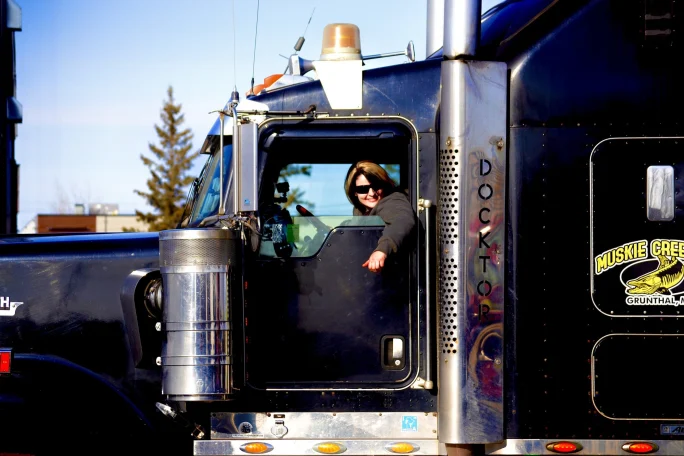
Kelly loved the classic Kenworth she got to drive on the show this season.
Photo: History Channel
Q: Did you feel like the show over-dramatizes things, or do you feel like it was a good representation of what it's like being on the ice roads?
A: It's a bit of a tricky question, because everyone's like, “It's all scripted, blah, blah, blah.” But if it's scripted, no one has ever told me what to say!
Yes, it can be dramatized. But trucking is really boring — until it's really exciting. If they did not edit it down to the most exciting parts, no one wants to see that.
And there's a lot of playing up worst-case scenarios. So yes, those things could happen. And yes, they do happen. But it's pretty minimal.
Q: Did anything happen that really was scary or dramatic?
A: The other countries [in “IRT: Deadliest Roads”] were really scary. I didn't know the trucks. I didn’t know the language. The roads were just falling apart out from underneath. So they were legit scary.
On ice roads, things have happened here and there, but that is what I do for a living.
I have slid my truck backwards off a hill.
When you burn out on a hill, you get stopped, and you get out and throw chains. Well, I threw one chain, and I went under the truck and trailer to throw the other side. Right when I got to the other side, because the tires were warm, they melted a layer of ice and that truck slid backwards.
The truck's steering must have been turned a little, because it came over and almost slammed me into the guardrail. I had to jump the guardrail and roll down the hill, then just stand there and watch the truck go all the way to the bottom, with chains hanging over the top of the tire.
Q: What is it like driving the ice roads? What are things that people might not understand?
A: I don't think people understand how cold it is. [In comments they say things like] “If she doesn't have heat in her truck, if the truck's running, the truck's creating heat.”
And I'm like, you don't understand how this works. If you don't have a blower motor to blow [the heat from the engine] into the cab, it's so cold that engine heat isn't going to be enough.
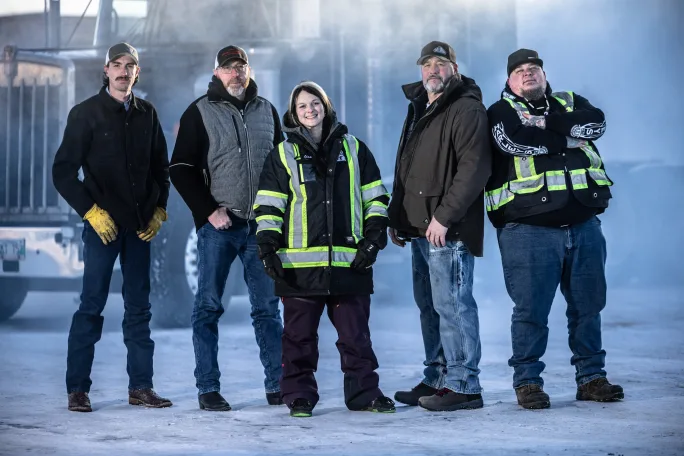
Lisa Kelly, center, with the rest of this season's Ice Road Truckers. From left, Riley Harris, Shaun Harris, Kelly, Todd Dewey, and Scott Yuil.
Photo: History Channel
Q: You've been a female face in an industry that is heavily male. Do you think that's had an impact on people watching about what women can do and be successful at in trucking?
A: Yeah, I think so. There's definitely more women in it now than there was back in the day, and it's cool that people say I've been an inspiration for them.
And I'm not just an advocate for women, but anybody, that you can do what you set your mind to if you want to do it bad enough. You just can't make excuses. You got to go do it.
Q: How have you managed to maintain boundaries between that public persona and your personal life?
A: Because I am me, I'm not playing a character, when there's criticism, it's more personal. But I also realized that TV is a two-dimensional way to portray a three-dimensional person.
If there are six characters on a show, it's 45 minutes long, and you split it evenly, then you've got what? Maybe 10 minutes an episode that's actually being portrayed? You could show anybody having 10 minutes of a bad day, 10 minutes of a good day, 10 minutes of being tired.
It's not that you're not being who you are. They're not twisting it, but they can kind of shape your character.
Which is good, because I feel like my character has been like, the sweet girl that's tough. But I have my bad days where I'm not so sweet all the time, and days where I'm not so tough and I just want to go lie down.
And there are a lot of people [criticizing] that have no idea what they're talking about. They weren't there, and hindsight's 20/20. I did the best I could with the information I had at the time. And I just have to trust that I did my absolute best.
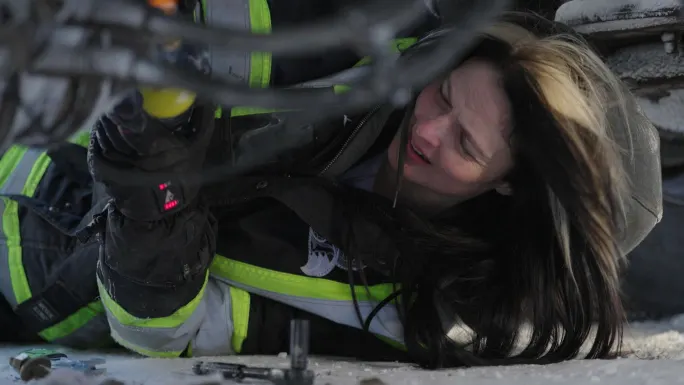
One thing most people don't understand, Kelly says, is just how cold it is, especially when you have to deal with sudden repairs.
Photo: History Channel
Q: What's something that you take with you on the road in the truck that might surprise people?
A: I don't think there's anything that's going to surprise anybody. It's like bathroom stuff, clothes, tools, food, phone. I'm kind of boring.
I do have a little pillow because I like to drive with it on my lower back. And this pillow has been all over the world with me in every truck that I've ever driven.
Q: Where do you want to go from here?
A: I hope they keep doing "Ice Road Truckers."
But I'm at the age now where I’m where I want to be in my career. I don't need more trucks. I don't need a fleet. I don't need employees.
I really like hooking to my tanker and going to Prudhoe and back to Fairbanks again. And I want to have this job till I don't work anymore.
And other than that, maybe get a piece of property that's a little bit bigger and breed some more horses.
Watch Deborah Lockridge's full conversation with Lisa Kelly on HDT Talks Trucking, including behind-the-scenes stories of filming the show, how she got into trucking, and more.
More Drivers

Truck Drivers Need More Than Another Alert
Fleets have more visibility into truck health, safety events, and driver activity than ever. The next challenge is turning all that information into useful guidance for the person who has to decide what to do next.
Read More →
FMCSA Removes 110 Truck Driver Training Schools from Certified ELDT List
Federal regulators also are targeting more than 160 additional training providers and launching a nationwide audit of third-party CDL skills testers as part of a broader crackdown on trucking fraud.
Read More →
Hours of Service Pilot Programs: FMCSA Readies for 2027 Rollout
Two pilot programs could eventually reshape hours-of-service rules, giving truck drivers options to pause their 14-hour clock or use longer split sleeper rest periods.
Read More →
Medical Cards, English Proficiency Reshape Roadcheck Violations
Medical-card violations jumped to the top of the driver out-of-service list during CVSA’s 2026 International Roadcheck, while English-language proficiency violations appeared among the leading violations for the first time.
Read More →
Driver Trust Can Make or Break the Success of Fleet Safety Technology
New Teletrac Navman research suggests that onboarding, transparency about driver data, and positive feedback can play a significant role in how commercial drivers respond to safety and coaching technology.
Read More →
EEOC Sues KLLM Over Alleged Sex Discrimination in Driver Training
KLLM is facing a federal sex-discrimination lawsuit over policies the EEOC alleges put female truck driver trainees at a disadvantage.
Read More →
FMCSA Moves to Codify English Language Requirements for Commercial Drivers
By changing regulations on English-language proficiency requirements for commercial drivers, rather than relying on a guidance memo, the FMCSA said future administrations won't be able to walk back the Trump administration's stricter enforcement with just a memo.
Read More →
Drivers Put Western Star Trucks to the Test at Star Nation Experience
Watch to get an inside look at the Western Star trucks, technology, and community behind the Star Nation Experience 2026!
Read More →
Trump Administration Looks to Put More Veterans Behind the Wheel
The Freedom Haulers program pulls together existing and expanded programs at several federal agencies to recruit veterans to drive commercial heavy-duty trucks and cut the red tape for them to get a CDL, training, and employment.
Read More →
Putting Mack’s Command Steer to the Test
A test drive of Mack’s Command Steer active steering system evaluates how it can make truck driving easier and less tiring.
Read More →