Women are making inroads into more areas of trucking, but there's more trucking companies can do.
Image: HDT Graphic
4 min to read
Attracting more women to trucking — and keeping them — has long been a goal, not just to help fill driver and technician shortages, but to bring in new perspectives and strengthen company culture.
Many trucking companies are finding that when they make things better for women, they make things better for everyone.
Ad Loading...
“Everything that you do that makes things better for women drivers makes things better for every driver,” says Mark Murrell, president of CarriersEdge and co-creator of the Best Fleets to Drive For program.
Safety and Security Benefits Everyone
Safety is often one of the first concerns raised by women drivers, but those concerns are hardly unique to women. Companies that have responded to those concerns find their changes appreciated across the board.
Murrell offers examples such as panic buttons on electronic logging devices, access to safe parking, and allowing pets in the cab.
“Anything that is going to improve security is a positive in that area,” Murrell says.
What might start as a solution to a specific issue raised by women drivers often turns out to be a welcome improvement for all drivers.
Ad Loading...
Updating Family Leave and Support
At Atlas World Group, efforts to better support women led to reassessing policies around parental leave.
Previously, women had to use regular sick leave time if they gave birth. Beyond that, they faced unpaid time off. Atlas now provides short-term disability for employees who give birth and offers parental leave time for all new parents, whether they’re welcoming a newborn or adopting a child.
The company also created a new space for nursing mothers — more private and comfortable than previous options.
These changes not only support women but also send a broader signal that employees are valued in every aspect of their lives, not just for the work they do on the clock.
Mentoring for Truck Drivers and beyond
After six years on the road as a truck driver and owner-operator, Tammie Dean decided to do something to help support women drivers at Lily Transportation, where she is the recruitment manager.
Ad Loading...
Dean started a program called Lily Ladies in 2019.
“I started it as a way to bring in more women to the company — and they love it,” she says.
“We want to be supportive to women and drivers and show them that trucking is just not a male-dominated field anymore, but there's a lot of women drivers out here in the industry as well.”
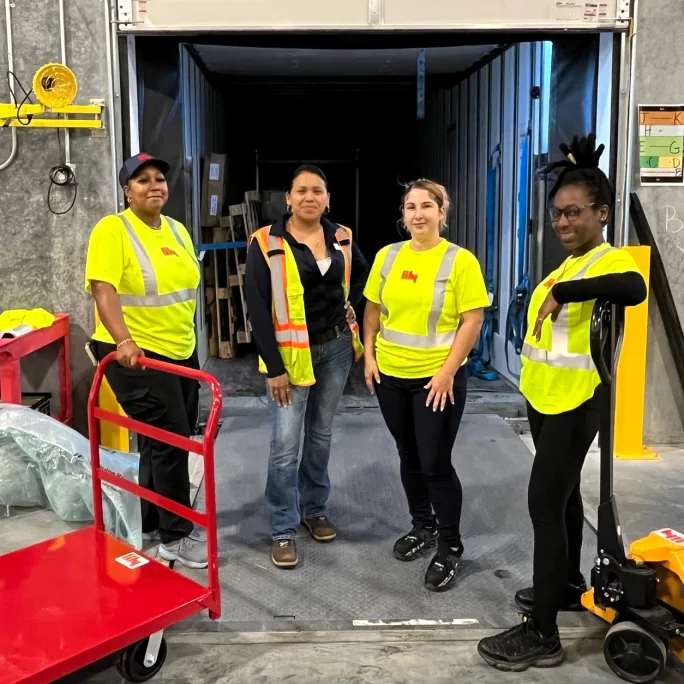
At Lily Transportation, women are found from the cab and the dock to the executive offices.
Photo: Lily Transportation
The Lily Ladies Committee organizes events, workshops, and networking opportunities for women drivers and other female employees. It provides a platform for sharing experiences, addressing challenges, and celebrating achievements, in person and on social media.
Plus there’s pink swag with the Lily Ladies logo, such as shirts and jackets.
The real purpose, Dean says, is to provide mentoring and support to women drivers, paying it forward for the mentoring she received from a female trainer and from the male friend who encouraged her to get her CDL.
Mentoring in general is big at Lily, she says.
Playing to Different Strengths
If there’s a part of trucking where there are probably the fewest women, it’s in the shop.
Kaitlynn Aikin, a 20-year-old diesel technician at Southeastern Freight Lines' Fort Worth service center, acknowledges that there are some things she’s unable to do as well with her slight frame as her larger male counterparts. But that doesn’t stop her.
“You might have to do things a little differently, but there’s a way for you to do everything that a man does in this job,” she says.
Ad Loading...
For instance, she might need someone to help when lifting heavy objects.
“But I've also found with other tasks, like when we do transmissions, some of the connectors are hard to get to, but I can fit up in there and lay on top of the transmission.”
Atlas’ Kelly Cruse, upon hearing that example, points out, “She brings something to the table, right?” says Cruse. “And that’s the thing. We’re looking at areas of the workforce that do tend to attract mostly men. She’s experiencing the workplace very different than everybody else. She's probably bringing new perspectives and she’s bringing different talents.”
In other words, it’s not about doing everything the same way — it’s about finding different ways to get the job done.
A Rising Tide Lifts All Workers
Many of the improvements that begin with addressing the needs of women turn out to be good ideas for everyone.
Ad Loading...
Whether it’s safer equipment, better facilities, more home time for drivers, more flexible policies for families, or finding new ways to do things, trucking companies are learning that having women as an integral part of the team helps them become more thoughtful employers overall — and more competitive in the long run.
When companies recognize and respond to what women need to succeed, the whole workforce — and the company — benefits.
How Female Trucking Leadership is Changing
Over the years, Mark Murrell says the Best Fleets to Drive For program has revealed an interesting evolution in female leadership at trucking companies.
“For a while, we were seeing cases where there were fleets that were women-owned or women-led that didn't have much diversity,” he says.
What was happening, he says, is these were often family businesses where a daughter took over from a parent and just kept running the company largely the same way their father and even grandfather had run it.
“And it really wasn't appealing to anybody but the traditional driver,” Murrell says.
“But in the past few years, that's changed, and we've seen some of the women-led companies really starting to have broader diversity programs across quite a wide range.”
The new card combines fuel discounts with telematics-based purchase controls. Geotab’s analysis also points to potential savings from choosing lower-priced fuel stops.
Trucking and logistics teams have plenty of data. The problem is getting the right information in front of the right people soon enough to act. Better-connected data can help teams spot trouble earlier and make smarter decisions before small problems become big ones.
At Insight 2026, Trimble executives argued that fleets may need to redesign workflows to get more from AI as it introduced new products and enhancements. AI’s value will depend on how fleets combine automation with their people's knowledge.
An ELD can prove compliance, but it cannot always prove what happened on the road. Discover how uniting accurate ELD data with AI-powered dash cam video can help your fleet strengthen compliance, defend against liability, protect drivers and reduce operational costs.
Private fleets are putting their own trucks on demanding customers and high-cost lanes as companies seek greater control over service, costs, and capacity.
For fleet managers and collision repair professionals keeping heavy-duty trucks on the road, getting the color right the first time isn't just about appearance — it's about efficiency, turnaround time, and bottom-line results. Discover how today's digital color tools are transforming the repair process from guesswork to precision.
Carriers whose updates were due on or after June 1 have more time, while FMCSA works to stabilize its new registration system and warns of phishing sites impersonating its new carrier registration system, Motus.
Cargo theft is no longer just the cost of doing business. It's a multi-billion-dollar criminal enterprise exploiting vulnerabilities across your fleet, drivers, and supply chain.