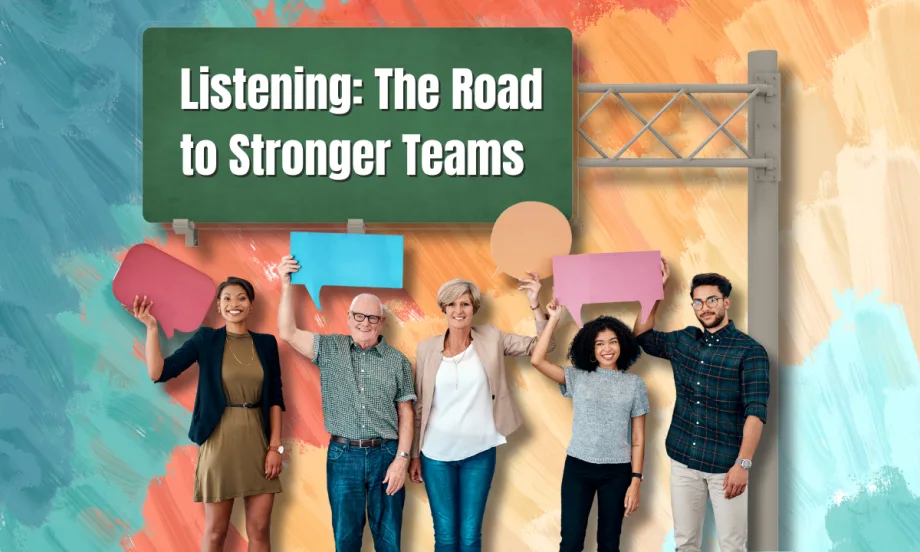
When a diverse group of employees have a voice and a seat at the table, trucking companies can benefit.
Image: HDT Graphic
4 min to read
“One of the biggest things that you can do to help people stick around, feel good, and contribute to the company positively is give them a voice,” says Mark Murrell, president of CarriersEdge and co-creator of the Best Fleets to Drive Forprogram. “And we are starting to see that in the Best Fleets now.”
Ad Loading...
That starts with listening to employees — and acting on what you hear.
This is the second in a five-part series exploring how trucking companies can boost performance, retention, and culture in today's more diverse workforce.
People are more likely to stay with companies where they feel heard and where their feedback leads to real change.
Ad Loading...
Murrell has long emphasized the importance of creating open lines of communication with truck drivers. But when managing a more diverse workforce, that kind of feedback loop becomes even more critical.
“One of the things that we have said for years and years to fleets is to ask drivers what they want. Ask drivers what they think about things,” Murrell says. “Don’t just sit back and wait for them to come to you.”
An open-door policy isn’t enough. Nor is relying solely on anonymous surveys. “It works way better to be proactive and go out there and ask,” he says.
And this advice holds true for non-driving employees, as well.
The importance of giving everyone a voice guided Atlas World Group after it rolled out companywide bias-awareness training developed in partnership with the University of Evansville — training that resulted in an American Trucking Associations Change Leadership Award in 2024.
Ad Loading...
Following the training, Atlas offered optional listening sessions where employees could share follow-up ideas and their own workplace experiences.
“I was very happy with people feeling comfortable enough to share their personal experience,” says Kelly Cruse, vice president of human resources and chief diversity officer at Atlas.
The sessions provided a forum for employees to express concerns, ask questions, and offer ideas.
Some of the most tangible results of those listening sessions came from employee suggestions.
“The African American History Museum is near our headquarters,” Cruse says, “so the company invited guest speakers from the museum and provided free museum tickets for employees.”
Ad Loading...
Who Gets Heard, Who Gets to Lead: Rethinking Trucking Culture
But listening alone isn’t enough. Companies also need to think about who gets a seat at the table.
Real change happens when the people helping steer the company also bring a variety of backgrounds and perspectives to the conversation.
“It’s not enough to hire a workforce that looks different,” says Murrell. “Companies should make sure there is representation on committees, career path options, support in the office, and that there’s a management team where different minorities and viewpoints are represented.”
He points out that while company demographics are changing in many day-to-day roles, upper leadership is often lagging.
“If you look at the top, it’s still a bunch of … old white men,” he says. “And that’s where there’s a real opportunity for improvement.”
Ad Loading...
Real change happens when the people helping steer the company also bring a variety of backgrounds and perspectives to the conversation.
Photo: Polaris Transportation
What Good Leadership Looks Like
That shift is already happening in some of the trucking industry’s most forward-looking companies.
According to Murrell, two of the three overall Best Fleets to Drive For winners this year were women-owned companies, and they pursue strategies that are good for both workforce representation and the business.
At Atlas World Group, having people in leadership who bring different experiences is already making an impact.
“We’re starting to see how, when we have strong leaders in our organization, that is broadening perspectives,” Cruse says.
Preparing the Next Generation of Trucking Leaders
One company putting strategy behind its commitment to balanced leadership is Polaris Transportation Group, a less-than-truckload and logistics company specializing in cross-border trucking between the U.S. and Canada.
Ad Loading...
In 2022, Polaris launched the Larry Cox Academy (LCA), a 15-month program to help team members gain broad knowledge and leadership skills by rotating through different parts of the company.
"The selected LCA candidate works in different departments within the company while completing online leadership courses.” explains Brenda Brajkovich, director of marketing at Polaris.
“They gain knowledge and learning in different areas, such as IT, planning, dispatch, and many other departments they may not have been exposed to.”
Brajkovich says the program is helping shape the future leadership pipeline at the company.
“It really sets the pace of who our next generation within Polaris are going to be leaders.”
Ad Loading...
Up Next: The Growing Role of Women in Trucking Roles
The new card combines fuel discounts with telematics-based purchase controls. Geotab’s analysis also points to potential savings from choosing lower-priced fuel stops.
Trucking and logistics teams have plenty of data. The problem is getting the right information in front of the right people soon enough to act. Better-connected data can help teams spot trouble earlier and make smarter decisions before small problems become big ones.
At Insight 2026, Trimble executives argued that fleets may need to redesign workflows to get more from AI as it introduced new products and enhancements. AI’s value will depend on how fleets combine automation with their people's knowledge.
An ELD can prove compliance, but it cannot always prove what happened on the road. Discover how uniting accurate ELD data with AI-powered dash cam video can help your fleet strengthen compliance, defend against liability, protect drivers and reduce operational costs.
Private fleets are putting their own trucks on demanding customers and high-cost lanes as companies seek greater control over service, costs, and capacity.
For fleet managers and collision repair professionals keeping heavy-duty trucks on the road, getting the color right the first time isn't just about appearance — it's about efficiency, turnaround time, and bottom-line results. Discover how today's digital color tools are transforming the repair process from guesswork to precision.
Carriers whose updates were due on or after June 1 have more time, while FMCSA works to stabilize its new registration system and warns of phishing sites impersonating its new carrier registration system, Motus.
Cargo theft is no longer just the cost of doing business. It's a multi-billion-dollar criminal enterprise exploiting vulnerabilities across your fleet, drivers, and supply chain.