




Augment Launches Freight-Native Knowledge Hub to Preserve Operational Know-How
Knowledge Hub is designed to turn scattered tribal knowledge into execution-ready intelligence and help logistics teams make faster, more consistent decisions.

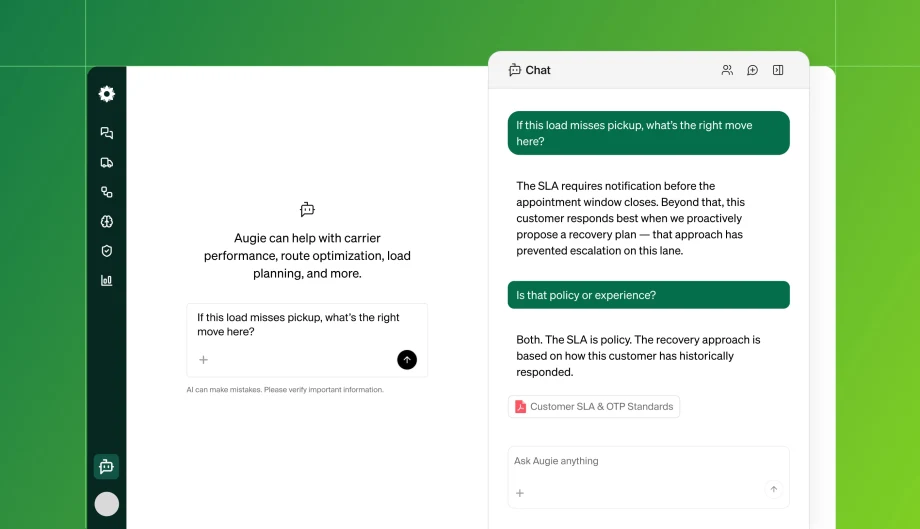
Knowledge Hug preserves and provides critical operational know-how for fleets that lives in emails, spreadsheets, disconnected systems -- or in the heads of a handful of experienced operators.
Augment
- When experienced people leave a company, their experience is lost. Knowledge Hub seeks to help fleets change that.
*Summarized by AI
Augment, an AI productivity platform focused on logistics operations, has rolled out Knowledge Hub. The new platform is designed to capture and operationalize the institutional knowledge that keeps freight moving day to day.
Knowledge Hug is aimed at a familiar pain point for fleets: brokers, and 3PLs. The system aids fleets by providing critical operational know-how that lives in emails, spreadsheets, disconnected systems -- or in the heads of a handful of experienced operators.
When those people are unavailable or leave the organization, that knowledge often goes with them.
Knowledge Hub is designed to make that experience durable and usable at scale by turning operational context into a governed, freight-specific knowledge layer that delivers answers directly inside the tools logistics teams already use.
Turning Experience into Infrastructure
According to Augment, freight operations rely heavily on experience-driven decisions. Examples include which carriers perform best on specific routes, how certain customers expect exceptions to be handled, or what actually worked the last time a load went sideways.
Knowledge Hub unifies that information across operational data, policies, past decisions, and workflows, then surfaces it at the moment decisions are made.
Rather than functioning as a traditional document repository or generic AI chatbot, Knowledge Hub is built to support execution, the company said.
The system provides context-aware answers within TMS workflows, customer and carrier portals, email, chat, and collaboration tools like Slack and Microsoft Teams.
For example, an operator can ask why a specific carrier was used on a prior Dallas–Chicago move and receive an answer grounded in past performance, customer requirements, and prior exceptions.
Carriers can quickly access facility-specific requirements for detention or check-ins, while customers can gain visibility into which shipments are at risk and what actions are underway.
Built Specifically for Freight
Augment says Knowledge Hub uses the same freight-native intelligence layer that powers its AI assistant, Augie. That system supports companies managing more than $50 billion in freight annually.
The difference is that Knowledge Hub makes that intelligence persistent across the organization rather than dependent on individual users, according to the company.
“We built Knowledge Hub to capture the know-how of a company’s strongest operators and make it instantly available to everyone in the business,” said Harish Abbott, co-founder and CEO of Augment. “Instead of losing critical context when people change roles or leave, that knowledge compounds over time—getting more valuable with every decision and every load.”
Key features include:
- A freight-native context built around loads, lanes, carriers, facilities, and service levels
- Consistent execution at scale: Carrier preferences, escalation patterns, and exception handling persist beyond individual employees.
- Faster ramp for operators: Years of operational knowledge available from day one.
- Reduced dependency on senior operators: Routine decisions no longer bottleneck around a few experienced team members.
- Fully secure with governed access by default: Role-aware permissions built in from the start. Built with strict data boundaries, so every customer’s insights remain private, secure, and accessible only within their organization.
- Continuous learning: Improves over time based on real questions, decisions, and outcomes.
- Available Anywhere: Slack, Teams, Emails, TMS or any web portal.
Improving Consistency and Productivity
For large operations, the ability to standardize decision-making without slowing execution is a major benefit. Knowledge Hub is designed to preserve carrier preferences, escalation paths, and exception-handling rules even as teams grow or change.
“Before Knowledge Hub, too many operational questions depended on knowing who to ask,” said Jim Hanselmann, vice president of TM innovation at NFI. “Now our teams can get clear, consistent answers to SOP and policy questions instantly—without interrupting senior operators.”
Augment positions the platform as a way to reduce operational friction, improve consistency across teams, and lower the overall cost to serve by ensuring decisions are informed by past experience and not guesswork.
Knowledge Hub is available now to Augment customers, with controls that allow organizations to determine which data sources are connected, who has access, and where insights appear across daily workflows.
More Fleet Management

How MFA Helps Protect Trucking Fleets
Multi-factor authentication adds protection when passwords are stolen. Here’s how it works and where fleets should start.
Read More →
How Better Freight Data Helps Trucking Teams Get Ahead of Disruption
Trucking and logistics teams have plenty of data. The problem is getting the right information in front of the right people soon enough to act. Better-connected data can help teams spot trouble earlier and make smarter decisions before small problems become big ones.
Read More →
Trimble: Taking Artificial Intelligence in Trucking Beyond Faster Tasks
At Insight 2026, Trimble executives argued that fleets may need to redesign workflows to get more from AI as it introduced new products and enhancements. AI’s value will depend on how fleets combine automation with their people's knowledge.
Read More →


Nominations Open for HDT Emerging Leaders
Heavy Duty Trucking is looking for accomplished trucking fleet professionals under 40 who are making an impact and helping lead the industry forward.
Read More →
Why Private Fleets Are Taking More Freight
Private fleets are putting their own trucks on demanding customers and high-cost lanes as companies seek greater control over service, costs, and capacity.
Read More →
Color Match Smarter: Tools That Restore & Perform
For fleet managers and collision repair professionals keeping heavy-duty trucks on the road, getting the color right the first time isn't just about appearance — it's about efficiency, turnaround time, and bottom-line results. Discover how today's digital color tools are transforming the repair process from guesswork to precision.
Read More →
FMCSA Pauses Biennial-Update Enforcement Amid Motus Transition
Carriers whose updates were due on or after June 1 have more time, while FMCSA works to stabilize its new registration system and warns of phishing sites impersonating its new carrier registration system, Motus.
Read More →
2026 Blueprint for Countering Smarter Supply Chain Theft
Cargo theft is no longer just the cost of doing business. It's a multi-billion-dollar criminal enterprise exploiting vulnerabilities across your fleet, drivers, and supply chain.
Read More →
How Telematics Improves Visibility, Control, and Performance in Refrigerated Fleets
Explore how telematics help refrigerated fleets improve visibility, uptime, efficiency, compliance, and cargo protection across connected cold chain operations.
Read More →
What the U.S.-Canada Trade War Means for Trucking
Escalating U.S.-Canada tariffs could disrupt cross-border freight, reduce truck volumes, raise costs, and create new uncertainty for carriers on both sides of the border.
Read More →