





McKinsey at CES: 2026 Begins with More Economic Pain Up Front
After Three Years of Pressure, Motor Carriers and Brokers See Early Signs of a Turn
Survey data show carriers and brokers expect improving demand in 2026, even as rates lag and capital investment remains on hold.
February 12, 2026

There's some optimism about 2026 among motor carriers and brokers, but still a lot of uncertainty.
Credit:
HDT Graphic
3 min to read
- Motor carriers and brokers anticipate an improvement in freight demand this year.
- Current freight rates are still disappointing.
- Uncertainty means capital investments in the sector are presently on hold.
*Summarized by AI
After more than three years of depressed freight rates and uneven freight demand, motor carriers and brokers are beginning to see early signs of stabilization. However, most are still keeping their wallets closed, for now.
According to a late-2025 survey of more than 600 carriers and freight brokers conducted by Truckstop.com in partnership with Bloomberg Intelligence, the freight market remains under pressure, but optimism is rebounding from early signs of stabilization and improvement.
The survey participants overall reported year-over-year declines in rates, volumes, and revenues, but generally have a positive outlook for the first three to six months of 2026.
After a Prolonged Downturn, Freight Market Signals Begin to Shift
As HDT has previously reported, however, any rate recovery is likely to be driven more by capacity leaving the market than a surge in freight demand.
“Sentiment among small carriers appears to be turning more positive heading into 2026, even though challenges persist from tepid demand, inflationary pressures and slack capacity,” said Lee Klaskow, senior freight transportation and logistics analyst at Bloomberg Intelligence.
“Spot rates appear poised to move higher as the federal government's crackdown on noncompliant truck drivers, carriers and commercial driving schools pushes more capacity out of the market.”
Although not all analysts agree that the FMCSA’s enforcement push will drive significant capacity out of the market.
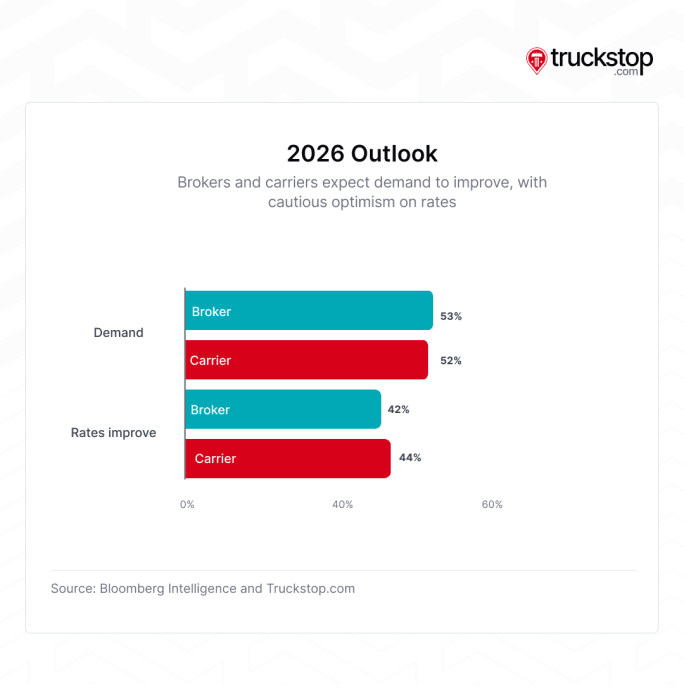
The freight market remains under pressure, but optimism is rebounding from early signs of stabilization and improvement.
Credit:
Truckstop.com
Spot Rates Struggle While Freight Volumes Show Mixed Signals
Motor carriers reported continued freight softness in the fourth quarter, with nearly half seeing lower volumes than a year earlier. Brokers reported a similarly split picture in the second half of 2025, underscoring how uneven the recovery remains across the market.
- 45% of carriers experienced lower volumes
- 18% of carriers saw increases in volume
- 38% of brokers reported lower volumes
- 35% of brokers saw higher volumes.
Rates proved more challenging, especially for carriers.
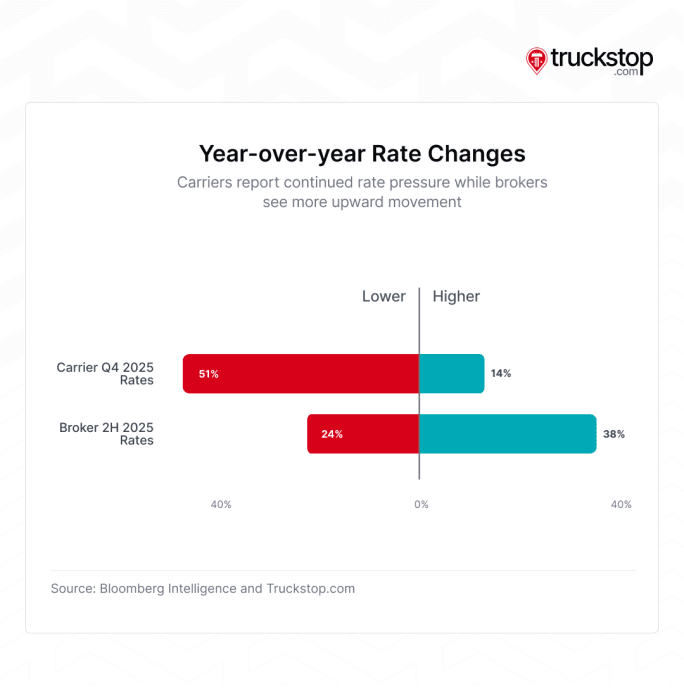
Brokers have fared better than motor carriers when it comes to year over year freight rates.
Credit:
Bloomberg Intelligence and Truckstop.com
In the fourth quarter of 2025, half of carriers (51%) reported lower rates than a year earlier. Only 14% reported year-over-year rate increases, and 41% experienced revenue declines.
Brokers were divided: 38% said rates were up, 24% said rates were down, and revenue results were mixed in the second half of 2025.
Peak season also fell short of expectations, with 42% of carriers and 39% of brokers reporting weaker holiday demand compared to the previous year.
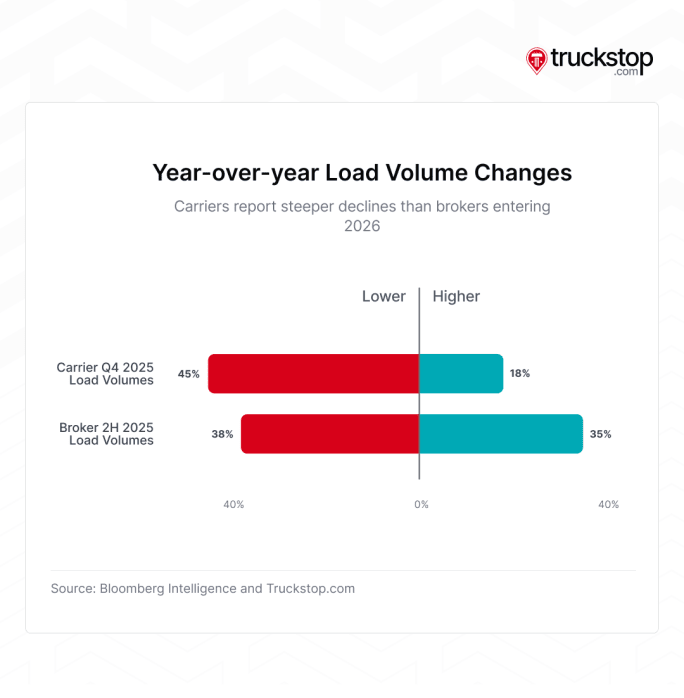
Brokers fared better than motor carriers in the latter part of 2026 on load volumes.
Credit:
Truckstop.com and Bloomberg Intelligence
Uncertainty Keeps Fleets from Committing Capital in Early 2026
“Unlike previous downcycles, which lasted 12 to 18 months, this trucking recession has now exceeded its third year,” said Todd Waldron, vice president of carrier experience at Truckstop.com.
That prolonged uncertainty is shaping how carriers and brokers approach hiring, equipment purchases, and risk.
“Transportation companies remain hesitant to allocate resources to a recovery until market signs clearly indicate one is happening,” Waldron said.
While nearly half of brokers say they are adding staff, carriers remain far more cautious. More than two-thirds say they do not plan to purchase additional equipment in the first half of 2026, reflecting continued uncertainty about when rates will meaningfully recover.
When asked when the market would reach its lowest point, the most common answer from both groups was “don’t know.”
More than one-third of motor carriers are uncertain about where they’ll be professionally in six months, and two-thirds of brokers expect more broker exits.
Freight Demand Expectations Rise Despite Ongoing Rate Pressure
“Yet, despite low volumes and rates in 2025, optimism remains for a turnaround in the first half of 2026,” Waldron said.
The data showed a bit more than half of both carriers and brokers expect demand to rise over the next three to six months. Forty-two percent of carriers and 44% of brokers expect spot rates to increase. Many others expect them to remain flat.
Profit outlooks for brokers are improving, along with their preparedness to prevent freight fraud. Fifty-three percent of brokers expect gross margins to grow in the first half (17% anticipate declines), and 83% believe they will be better able to combat fraud in 2026 than in previous cycles.
More Fleet Management

FMCSA Pauses Biennial-Update Enforcement Amid Motus Transition
Carriers whose updates were due on or after June 1 have more time, while FMCSA works to stabilize its new registration system and warns of phishing sites impersonating its new carrier registration system, Motus.
Read More →
Sponsored•September 14, 2026
2026 Blueprint for Countering Smarter Supply Chain Theft
Cargo theft is no longer just the cost of doing business. It's a multi-billion-dollar criminal enterprise exploiting vulnerabilities across your fleet, drivers, and supply chain.
Read More →
Sponsored•September 1, 2026
How Telematics Improves Visibility, Control, and Performance in Refrigerated Fleets
Explore how telematics help refrigerated fleets improve visibility, uptime, efficiency, compliance, and cargo protection across connected cold chain operations.
Read More →

What the U.S.-Canada Trade War Means for Trucking
Escalating U.S.-Canada tariffs could disrupt cross-border freight, reduce truck volumes, raise costs, and create new uncertainty for carriers on both sides of the border.
Read More →
What Are Trucking’s Top Concerns for 2026?
The American Transportation Research Institute wants to know what's worrying trucking fleet managers, drivers, and other stakeholders in its annual Industry Issues survey.
Read More →
American Trucking Associations Looks for a New Leader
ATA President and CEO Chris Spear abruptly left his job at the association on August 21, at a pivotal time for the trucking industry.
Read More →
Public Wi-Fi Cybersecurity Risks: How Truck Drivers and Fleets Can Protect Their Data
Public Wi-Fi can expose truck drivers and fleets to credential theft, malware, and other cyber threats. Here’s how to reduce the risk on the road.
Read More →
For Nicky Cupp, Fleet Innovation Starts With Frustration
HDT Truck Fleet Innovator Nicky Cupp turns everyday pain points at Fraley & Schilling into opportunities for better technology and smarter processes.
Read More →
Adam Buttgenbach’s Approach to Electric Trucks: Start With Where They Fit
HDT Truck Fleet Innovator Adam Buttgenbach helped PepsiCo build one of North America’s largest EV fleets by focusing on where electric trucks make operational sense.
Read More →
Deen Albert: Let Automation Do the Math, People Make the Decisions
HDT Truck Fleet Innovator Deen Albert makes sure people are still at the heart of operations at Grand Island Express, even while adopting artificial intelligence tools. AI-assisted dispatch helped boost revenue 25% with the same number of trucks.
Read More →